Home » AI Visibility Strategy » AI Governance Best Practices: 15 Actions Every Business Should Take
- Christopher Littlestone
AI Governance Best Practices: 15 Actions Every Business Should Take
Most AI governance content explains why governance matters. This article skips that part.
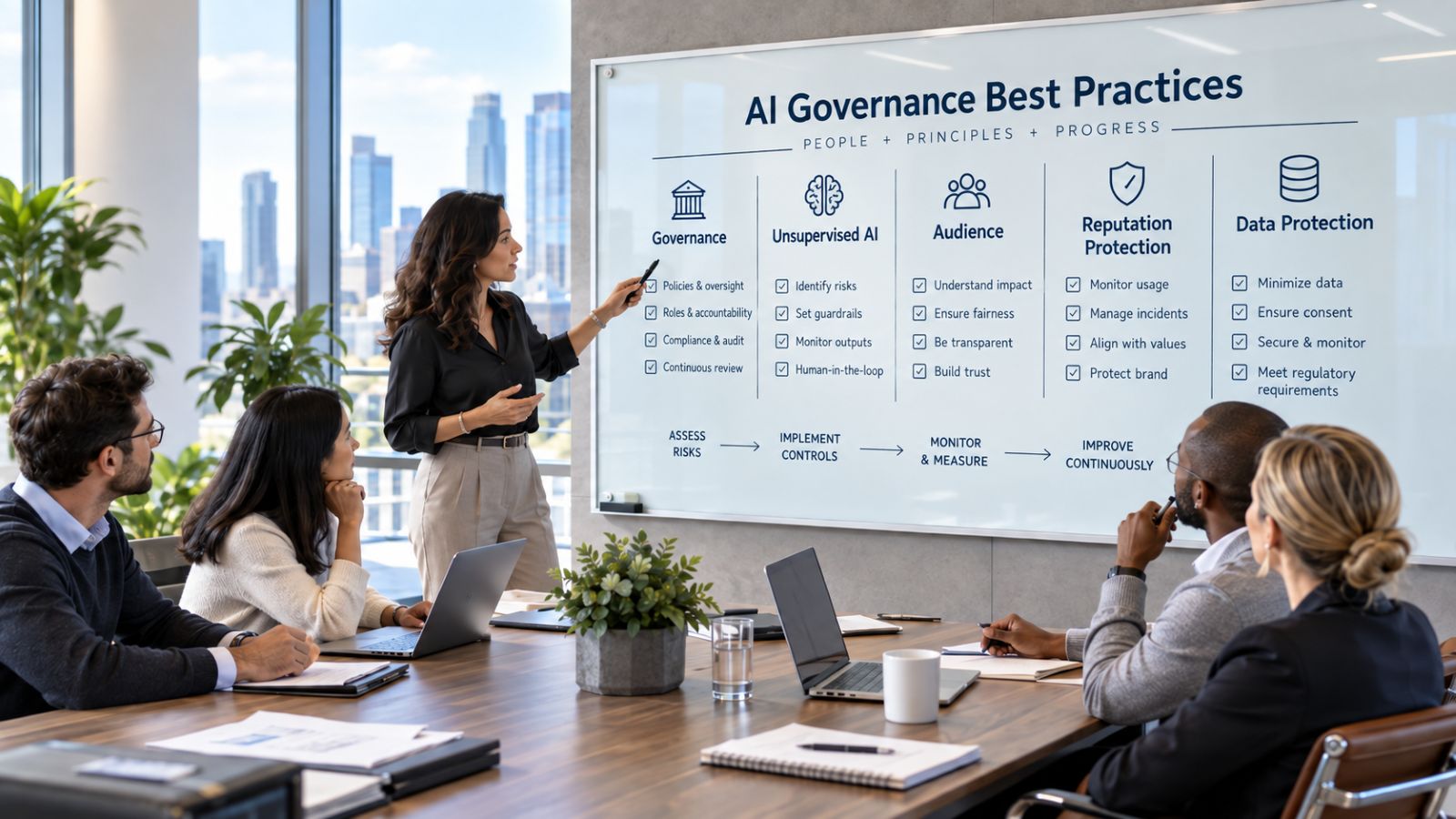
When we teach AI governance and safety, we use the GUARD Framework.
In this article, you get 15 actions, organized under the five GUARD categories, ready to execute this week.
Featured Definition
AI governance best practices are the specific, executable actions a business takes to establish ownership, oversight, and accountability over how it uses AI. They cover who approves AI output, who reviews it, what data AI systems can touch, and what happens when AI is wrong.
TL;DR
- This checklist covers 15 actions across Governance, Unsupervised AI, Audience, Reputation Protection, and Data Protection: the five categories of the GUARD Framework.
- Each action can start this week. None require a governance department or an outside consultant.
- This checklist is built directly from the GUARD Framework, developed by Christopher Littlestone, a retired U.S. Army Special Forces officer (Green Beret, Lieutenant Colonel) and founder of Special Operations University, where he has taught cybersecurity and small business security to more than 4,000 students with a 4.9 Trustpilot rating.
- If you want the doctrine behind these actions, read our article, Principles of AI Security. This article is the execution list; that one is the reasoning behind it.
Table of Contents
- Featured Definition
- Snippet Definition
- What Is the GUARD Framework?
- G – Governance: Actions 1-3
- U – Unsupervised AI: Actions 4-6
- A – Audience: Actions 7-9
- R – Reputation Protection: Actions 10-12
- D – Data Protection: Actions 13-15
- Summary Table
- Bad Example vs. Good Example
- FAQs
- Key Takeaways
- About the Author
- Final Thoughts
Snippet Definition
AI governance best practices are the concrete steps a business takes to control how AI is used: naming an owner, requiring human review, training employees on AI limitations, protecting data, and correcting AI errors quickly. They turn AI governance from a policy statement into daily operating practice.
What Is the GUARD Framework?
GUARD is the AI Visibility Professional framework for AI governance and safety. It is a business protection framework, not an ethics framework and not a cybersecurity framework. Five categories, five letters, each one covering a different way AI can expose a business and a different set of actions that close the gap.
- G – Governance: rules, ownership, and accountability for how AI gets used.
- U – Unsupervised AI: trust, but verify. What isn’t reviewed eventually creates risk.
- A – Audience: influence precisely, exclude aggressively.
- R – Reputation Protection: brand trust matters more than traffic.
- D – Data Protection: secure the information that powers the business.
The 15 actions below map three to each category, in order: Governance, then Unsupervised AI, then Audience, then Reputation Protection, then Data Protection.
G – Governance: Actions 1-3
For more on why governance failures happen, read our article, Principles of AI Security. These three actions are what to do about it this week.
1. Name a single AI governance owner. Assign one person, not a committee. Committees diffuse accountability; a single owner makes decisions and answers for them.
2. Publish a written AI usage policy. One page is enough to start. State which tools employees can use, what data those tools can touch, and who approves exceptions.
3. Require approval before AI output reaches a customer. No AI-generated email, ad, or webpage ships without a human sign-off step. Build the step into the workflow, not into someone’s memory.
U – Unsupervised AI: Actions 4-6
Trust, but verify. For the security principles behind this category, read our article, Principles of AI Security. These three actions put them into practice.
4. Mandate human review before anything ships. Automation without oversight compounds risk instead of reducing it. Set a rule: nothing AI-generated goes live without a human reading it first.
5. Build an escalation path for AI errors. Define who gets notified, how fast, and what happens next when an AI output is wrong. A path that exists only in theory fails the first time it is needed.
6. Train employees on where AI fails. Operating a tool and trusting it correctly are different skills. Teach employees the specific situations that need extra scrutiny: numbers, legal language, medical claims, anything customer-facing.
A – Audience: Actions 7-9
Influence precisely. Exclude aggressively. For the security logic behind this, read our article, Principles of AI Security. These three actions apply it to targeting.
7. Define the ideal customer profile before any AI-targeted campaign. AI targeting amplifies whatever audience definition you feed it. A vague ICP produces a vague, wasteful campaign at scale.
8. Exclude aggressively with negative audience lists. Precision comes from what you cut as much as what you include. Build exclusion lists before launch, not after the budget report.
9. Review lead quality against sales feedback, not click volume. Clicks measure attention. Sales feedback measures fit. Governance means checking the number that actually matters.
R – Reputation Protection: Actions 10-12
Brand trust is more important than traffic. For the underlying security principle, read our article, Principles of AI Security. These three actions protect it.
10. Fact-check every AI-generated claim before publish. AI hallucinations are not rare edge cases. Treat every statistic, quote, and factual claim from an AI tool as unverified until a human checks it.
11. Set a written brand-voice guideline AI content must match. Voice drift happens quietly, one AI-generated post at a time. A short written standard gives reviewers something concrete to check against.
12. Build a rapid correction protocol for AI misinformation. Speed matters as much as accuracy once AI gets something wrong publicly. Know in advance who corrects it, where, and how fast.
D – Data Protection: Actions 13-15
Secure the information that powers your business. For the security foundation behind this, read our article, Principles of AI Security. These three actions protect the data layer.
13. Restrict what data can be entered into third-party AI tools. Employees paste whatever solves their immediate problem unless told otherwise. Set clear boundaries on customer data, financial data, and trade secrets.
14. Vet every AI vendor’s data handling terms before adoption. Read the terms before the team starts using the tool, not after an incident. Know where the data goes, how long it is retained, and who else can see it.
15. Encrypt and minimize data flowing into AI systems. Send AI tools only the data required for the task. Less data exposed means less data at risk.
Summary Table
| # | Action | GUARD Category |
|---|---|---|
| 1 | Name a single AI governance owner | Governance |
| 2 | Publish a written AI usage policy | Governance |
| 3 | Require approval before AI output reaches a customer | Governance |
| 4 | Mandate human review before anything ships | Unsupervised AI |
| 5 | Build an escalation path for AI errors | Unsupervised AI |
| 6 | Train employees on where AI fails | Unsupervised AI |
| 7 | Define the ideal customer profile before any AI-targeted campaign | Audience |
| 8 | Exclude aggressively with negative audience lists | Audience |
| 9 | Review lead quality against sales feedback, not click volume | Audience |
| 10 | Fact-check every AI-generated claim before publish | Reputation Protection |
| 11 | Set a written brand-voice guideline AI content must match | Reputation Protection |
| 12 | Build a rapid correction protocol for AI misinformation | Reputation Protection |
| 13 | Restrict what data can be entered into third-party AI tools | Data Protection |
| 14 | Vet every AI vendor’s data handling terms before adoption | Data Protection |
| 15 | Encrypt and minimize data flowing into AI systems | Data Protection |
Bad Example vs. Good Example
Bad Example
A mid-size firm lets every department adopt its own AI tools without a policy. Marketing pastes campaign data into a free AI writing tool with no data agreement. An AI-generated blog post publishes with a fabricated statistic that no one checked. When a customer flags it, no one owns the response, and it stays live for six days.
Good Example
A firm of the same size names an AI governance owner in week one. That owner publishes a one-page policy: approved tools only, no customer data outside vetted vendors, human review before publish. When a factual error slips through, the escalation path catches it within hours, and the correction goes up the same day.
FAQs
What is the difference between AI governance and AI ethics?
AI governance and AI ethics are related but distinct. Governance is the structure: ownership, approval workflows, and accountability. Ethics is the set of principles behind those decisions. A business can publish an ethics statement and still lack the governance workflow that makes it enforceable. Both matter; only governance shows up in daily operations.
What does responsible AI governance actually look like day to day?
Responsible AI governance looks like the 15 actions above in practice: a named owner, a written policy, human review before publish, and a correction protocol that activates fast. It is a workflow, not a mission statement.
What should an AI governance policy include?
An AI governance policy should name approved tools, define what data can and cannot be entered into them, set the approval workflow for AI-generated output, and assign a single accountable owner. Our articles, What Is AI Governance? The Complete Guide for Businesses and AI Governance Solutions: How to Build an AI Governance Program, cover how to build the full program behind the policy.
How does AI governance relate to AI compliance?
AI governance is the operational structure that makes compliance achievable. Compliance requirements change by industry and jurisdiction. Governance is the ownership and approval structure that lets a business meet whatever requirements apply without rebuilding its workflow every time a regulation changes.
Key Takeaways
- AI governance is 15 specific actions, not a philosophy.
- Each action maps to one of the five GUARD categories: Governance, Unsupervised AI, Audience, Reputation Protection, Data Protection.
- None of these actions require a governance department. They require a named owner and a written workflow.
- Read Principles of AI Security for why these actions matter. This article is the execution list.
About the Author
Christopher Littlestone is the creator of the AI Visibility Professional (AVP) category and developer of the FOUND, PAID, and GUARD frameworks. He is a retired U.S. Army Special Forces officer (Green Beret, Lieutenant Colonel) and founder of Special Operations University, where he has taught cybersecurity and small business security to more than 4,000 students with a 4.9 Trustpilot rating.
Final Thoughts
Governance that exists only on paper protects nothing.
The businesses that get exposed by AI in the next two years already have a policy document. What they lack is a workflow behind it.
Start with one action from this list this week. Then the next. The AI Governance Checklist turns this article into a working document your team can run against; the AI Governance Audit checks whether the workflow is actually holding.
Our Services
AVP provides assessments, education, and certification to help businesses achieve trusted organic and paid AI visibility.

Tools
Professional tools and audits that maximize AI visibility, attract qualified customers, and increase revenue.

Articles
Clear, standards-driven education explaining how organic and paid AI visibility works in real-world AI systems.

Courses
Explore our courses so you can learn on your own timeline, with new titles added every quarter.
Certification
Become a Certified "AI Visibility Professional" and earn the credential that proves your expertise in organic AI visibility, paid AI amplification, and AI governance.