Home » AI Governance & Safety » AI Governance Solutions: How to Build an AI Governance Program
- Christopher Littlestone

AI Governance Solutions: How to Build an AI Governance Program
Knowing that AI governance matters is not the same as having one.
Most businesses that recognize the risk still don’t have an actual program: no assigned owner, no written policy, no procedure for what happens when AI gets something wrong.
The gap between awareness and implementation is where most companies stay stuck, and it’s the gap this article is built to close.
An AI Governance Program is the documented set of policies, procedures, and ownership structures a business puts in place to control how artificial intelligence is adopted, monitored, and corrected across the organization. It moves AI governance from a concept the business agrees with to a system the business actually operates.
TL;DR Executive Summary
- Most businesses agree AI governance matters but have no actual program: no owner, no policy, no procedure.
- AI Governance Compliance and AI Governance Standards are where most of the confusion lives, and both can be addressed with a clear policy-versus-procedure distinction.
- Enterprise frameworks like NIST, ISO 42001, and Big Four consulting engagements solve real problems, but most are priced for organizations with compliance departments, not 10 to 200-person businesses.
- The GUARD Framework’s AI Governance Policy and AI Governance Solution products were built to deliver an implementation-ready program at a fraction of enterprise cost.
- Christopher Littlestone, founder of the AI Visibility Professional (AVP) certification and a retired U.S. Army Special Forces officer who has taught cybersecurity and small business security to more than 4,000 students with a 4.9 Trustpilot rating, designed both deliverables around the same principle he used to train security practitioners: a program only works if the people executing it can actually follow it.
- A written policy without a process behind it is a document. A process without a named owner is a hope. A real program requires both.
Table of Contents
- Why Most Businesses Lack an AI Governance Program
- AI Governance Compliance vs. AI Governance Standards
- AI Governance Policies vs. Procedures
- Why Enterprise AI Governance Frameworks Price Out Small Business
- Building Your AI Governance Program: Policy and Solution
- Who Should Hold AI Governance Roles
- Common Mistakes When Building an AI Governance Program
- Frequently Asked Questions (FAQs)
- Key Takeaways
Snippet Definitions
The following definitions are adapted from the AI Visibility Definition Library.
AI Governance Program — The documented set of policies, procedures, and ownership structures a business puts in place to control how artificial intelligence is adopted, monitored, and corrected across the organization.
AI Governance Compliance — The degree to which a business’s AI practices align with its own stated AI policy and with applicable external regulations, demonstrated through documentation, review processes, and consistent enforcement.
AI Governance Standards — The defined benchmarks an organization uses to determine what acceptable AI use looks like, covering data handling, human review, disclosure, and escalation.
GUARD Framework — An AI Governance and Safety framework built around five pillars: Governance, Unsupervised AI, Audience, Reputation Protection, and Data Protection. It helps organizations protect their reputation, data, and customers as they adopt artificial intelligence.
AI Visibility Professional (AVP) — A certified practitioner trained in organic AI visibility (FOUND), paid AI visibility (PAID), and AI governance and safety (GUARD), responsible for helping organizations operate responsibly and competitively in AI-driven search and discovery.
Summary Table: Building an AI Governance Program
| Risk | Business Consequence | Countermeasure |
|---|---|---|
| No written AI policy | Inconsistent employee use, no standard to enforce | Draft a documented AI Governance Policy |
| Policy exists but no procedure | Policy is ignored in practice, becomes a compliance prop | Build a corresponding AI Governance SOP |
| No assigned ownership | No one is accountable when something goes wrong | Assign a named AI Governance owner |
| No review or escalation path | AI errors go unnoticed until a customer or regulator finds them | Establish human review and escalation procedures |
| No measurement of compliance | Business can’t show progress or defend its practices | Conduct a recurring AI Governance Audit |
Why Most Businesses Lack an AI Governance Program
Most businesses lack an AI governance program for a simple reason: governance was never anyone’s job. AI tools got adopted department by department, often without a conversation at the leadership level, and by the time the risk became visible, there was no clean starting point to build from.
This is different from not caring about the problem. Most business owners and executives, when asked directly, agree that AI governance matters. The gap is not awareness. The gap is that awareness alone does not produce a policy, a procedure, or a named owner. A program requires documentation and follow-through, not just agreement.
If your business hasn’t assessed where it currently stands, the starting point is the AI Governance Checklist ($50) or the AI Governance Audit ($300). Both are built to identify the specific gaps before you invest in a full program. This article picks up from there: what an actual program looks like once you’re ready to build one.
AI Governance Compliance vs. AI Governance Standards
AI Governance Standards are the benchmarks that define what compliant practice actually looks like in the first place.
AI Governance Compliance is the act of aligning a business’s AI practices with its own stated policy and with applicable external regulation.
Standards come first. Compliance is what you measure against them.
This distinction matters because most businesses skip the standards step entirely. They reach for compliance language, often borrowed from a regulation they’re not even subject to, without first defining their own internal standard for acceptable AI use. The result is a policy that sounds compliant but has no internal benchmark behind it.
A workable standard answers concrete questions: What data can an employee put into an AI tool? What AI-generated content requires human review before publishing? What response time is required when an AI system produces an error? Once those standards exist, compliance becomes something the business can actually measure, rather than a word used to describe good intentions.
A standard you cannot measure against is not a standard. It is a slogan.
AI Governance Policies vs. Procedures
An AI Governance Policy defines what a business will and will not do with artificial intelligence. An AI Governance Procedure, often called a standard operating procedure (SOP), defines exactly how that policy gets carried out day to day. Confusing the two is one of the most common reasons governance programs fail before they start.
A policy might state that all AI-generated customer-facing content requires human review before publishing. That’s a rule. It says nothing about who reviews it, how long they have, what happens if they’re unavailable, or what the escalation path looks like if the reviewer flags a problem. That operational detail is the procedure, and without it, the policy is a sentence on a page that nobody actually follows.
This is the most common failure point in AI governance: a business writes a policy, feels like the job is done, and never builds the procedure that makes the policy real. Six months later, no one remembers the policy exists, because nothing in daily operations ever required them to follow it.
Why Enterprise AI Governance Frameworks Price Out Small Business
The major AI governance frameworks in use today were built primarily for large enterprises and government agencies, and the pricing reflects that audience directly.
| Framework | Small Business Cost | Mid-Size Business Cost | Enterprise Cost |
|---|---|---|---|
| NIST AI Risk Management Framework | $5,000–$25,000 | $25,000–$100,000+ | $100,000–$1,000,000+ |
| ISO 42001 Certification | $10,000–$50,000 | $50,000–$200,000 | $200,000–$1,000,000+ |
| EU AI Act Compliance | $5,000–$30,000 | $30,000–$250,000 | $250,000+ |
| Big Four Consulting Engagement | $25,000 (assessment) | $100,000 (program build) | $500,000–$5,000,000+ (transformation) |
A full AI governance audit under one of these frameworks typically evaluates the same categories GUARD addresses: governance and policy, unsupervised or “shadow” AI usage, reputation and public-facing risk, data protection, and vendor risk. The categories aren’t fundamentally different. What’s different is who the engagement was built to serve.
A 20-person company is not going to engage Deloitte for $50,000 to assess AI risk. That doesn’t make the risk smaller. It means the business has been priced out of the conversation entirely, which is exactly the gap the GUARD Framework exists to close: the same risk categories, structured and priced for a business that needs to act on a $1,000 or $3,000 budget rather than a six-figure one.
Building Your AI Governance Program: Policy and Solution
Once a business has assessed where it stands, typically through the AI Governance Checklist or Audit, the next step is building the actual program: a written policy and the procedures that make it operational.
AI Governance Policy ($1,000)
The AI Governance Policy is a customized policy and standard operating procedure built specifically for the client’s organization. It covers governance rules, oversight responsibilities, defined roles, and step-by-step procedures, delivered as an implementation-ready document rather than a generic template.
This is where the policy-versus-procedure distinction gets resolved directly. The deliverable doesn’t stop at stating what the business should do. It defines who does it, how often, and what happens when something goes wrong, because a policy without that operational layer is the most common reason governance programs fail to survive contact with daily business operations.
AI Governance Solution ($3,000)
The AI Governance Solution is the complete engagement for a business that wants the full program built and explained, not just delivered. It includes an executive AI visibility briefing, a full AI Governance Audit, a customized policy and SOP, implementation guidance, and direct consulting with Christopher Littlestone.
The Solution exists for businesses where leadership needs to understand the reasoning behind the program, not just receive the paperwork. That distinction matters in practice: a policy a business understands gets followed. A policy a business was simply handed often does not.
A governance program a business doesn’t understand is a governance program it won’t follow.
Who Should Hold AI Governance Roles
AI governance roles fail when they’re distributed too thin or assigned to no one in particular. The most functional structure assigns one person as the named owner of the AI governance program, supported by clear escalation paths rather than a committee structure that meets occasionally and owns nothing day to day.
In most small and mid-sized businesses, this owner is a COO, a marketing operations lead, or increasingly a trained AI Visibility Professional who already understands how the GUARD Framework fits alongside FOUND and PAID. The owner’s job is not to personally review every AI output. It is to ensure the policy exists, the procedure is being followed, and the escalation path actually gets used when something goes wrong.
Larger organizations sometimes add a secondary reviewer role, particularly for public-facing AI content, but the core principle stays the same regardless of company size: one name has to be attached to the outcome, or the program exists on paper only.
Common Mistakes When Building an AI Governance Program
Brief Context: A 40-person marketing agency decides to formalize its AI governance after a near-miss, where an AI-generated client report contained a factual error that almost went out under the agency’s name.
Bad Example
The agency writes a one-page AI policy stating that “all AI use must be reviewed,” circulates it once in a team meeting, and considers the matter closed. No one is assigned to actually perform the review. Three months later, the same type of error happens again, this time in front of a client, because the policy exists only as a document, not as a working procedure.
Good Example
The agency engages the AI Governance Policy, which produces both a written policy and the procedure behind it: a named reviewer for client-facing AI content, a 24-hour review window, and a defined escalation step if the reviewer is unavailable. The next near-miss gets caught before it reaches a client, because the procedure, not just the intention, was actually built.
The difference is not effort or awareness. Both businesses cared. Only one built a program that functions without someone having to remember it exists.
Frequently Asked Questions (FAQs)
What is an AI Governance Program?
An AI Governance Program is the documented set of policies, procedures, and ownership structures a business uses to control how it adopts, monitors, and corrects its use of artificial intelligence. It is the operational version of AI governance, not just the concept.
What is the difference between AI Governance Compliance and AI Governance Standards?
AI Governance Standards are the internal benchmarks that define what acceptable AI use looks like. AI Governance Compliance is the measurement of whether a business’s actual practices meet those standards. Standards have to exist before compliance can be measured against them.
What is the difference between an AI Governance Policy and an AI Governance SOP?
A policy defines what a business will and will not do with artificial intelligence. A standard operating procedure (SOP) defines exactly how that policy is carried out, including who is responsible, what the timeline is, and what the escalation path looks like.
How much does it cost to build an AI Governance Program?
Enterprise frameworks like NIST, ISO 42001, and Big Four consulting engagements typically range from $25,000 to over $1,000,000. A small or mid-sized business can build a complete, implementation-ready program through the AI Governance Policy ($1,000) or AI Governance Solution ($3,000) instead.
Who should be responsible for AI governance roles inside a company?
Responsibility should sit with one named owner, such as a COO, marketing operations lead, or trained AI Visibility Professional, supported by a clear escalation path rather than a shared or committee-based structure that no one is fully accountable for.
Does a small business really need a formal AI Governance Program?
Yes. The risks a formal program addresses, including data exposure, reputational damage, and unsupervised AI use, apply regardless of company size. What changes with company size is the scale of investment required, not whether the risk exists.
What happens if a business has an AI policy but no procedure?
The policy typically gets ignored in practice. Without a defined procedure, including who is responsible and what the timeline is, a policy has no mechanism that forces it to actually be followed day to day.
How is the GUARD Framework different from NIST or ISO 42001 for building a program?
NIST and ISO 42001 address similar risk categories but are scoped and priced for large enterprises and government agencies. The GUARD Framework addresses the same categories of risk through deliverables, like the AI Governance Policy and Solution, priced for small and mid-sized businesses to implement directly.
What is included in the AI Governance Solution?
The AI Governance Solution includes an executive AI visibility briefing, a complete AI Governance Audit, a customized AI Governance Policy and SOP, implementation guidance, and direct consulting with Christopher Littlestone.
How often should an AI Governance Program be reviewed?
An AI Governance Program should be reviewed whenever the business adopts a new AI tool or workflow, and at minimum on an annual basis, since both AI capabilities and the regulatory landscape continue to change.
Key Takeaways
- An AI Governance Program is the operational version of AI governance: documented policy, working procedure, and named ownership.
- Most businesses agree governance matters but have never built the actual program.
- AI Governance Standards must exist before AI Governance Compliance can be measured.
- A policy without a procedure behind it is rarely followed in practice.
- Enterprise frameworks like NIST and ISO 42001 address real risk but are priced for large organizations.
- The AI Governance Policy and AI Governance Solution were built to deliver the same outcome at a fraction of enterprise cost.
- AI governance roles need one named owner, not a shared or committee-based responsibility.
- A governance program a business doesn’t understand is a governance program it won’t follow.
About the Author
Christopher Littlestone is a retired U.S. Army Special Forces (Green Beret) Lieutenant Colonel, entrepreneur, author, and AI Visibility Strategist. He founded Special Operations University, where his cybersecurity and small business security courses have enrolled more than 4,000 students with an overall 4.9 Trustpilot rating. He is the creator of the FOUND, PAID, and GUARD Frameworks and the founder of the AI Visibility Professional (AVP) certification standard, which formalizes competent practice in AI visibility and AI governance for businesses.
A Note on Long-Term Ownership
Building an AI Governance Program is not a one-time project. Policies need review, procedures need updating, and someone inside the business needs to stay current as AI tools and AI-specific regulation continue to evolve. For this reason, we recommend that every business identify one person, internal or contracted, to serve as a trained AI Visibility Professional (AVP). A Certified AVP is equipped to manage AI governance alongside the rest of a business’s AI visibility needs, rather than treating governance as a separate, disconnected function.
Final Thoughts
A governance program is not a document.
It is the combination of a written policy, a working procedure, and a person whose job it is to make sure both are actually followed.
Most businesses have at most one of those three pieces, which is functionally the same as having none.
The businesses that close this gap early will not need to learn its importance through an incident. They will simply have already done the work.
AI Governance & Safety
Protect your business, your employees, and your profits from AI risk, at every price point.
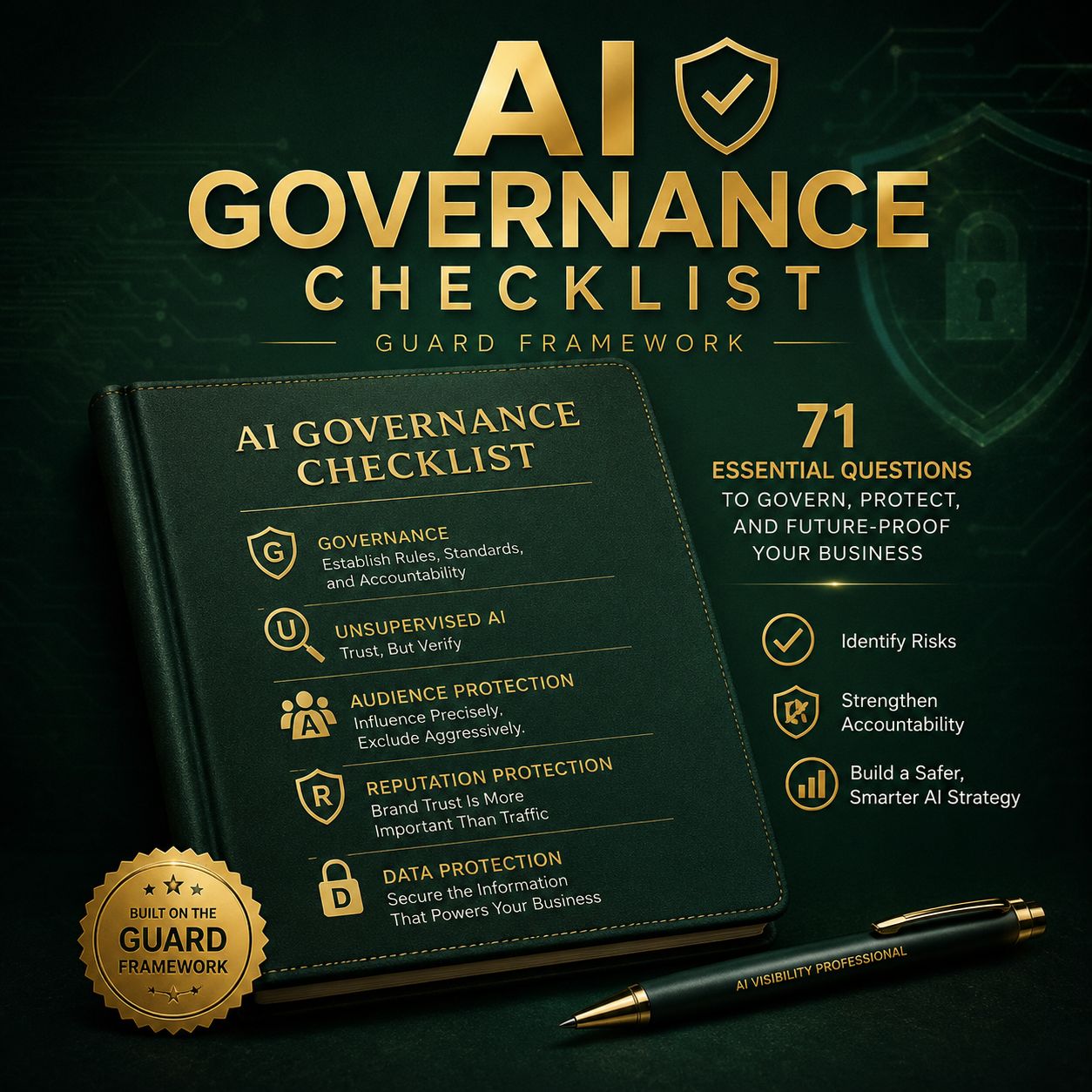
AI Governance Checklist
$50 - A self-guided diagnostic across seventy-one questions that shows you exactly where your AI governance gaps are.
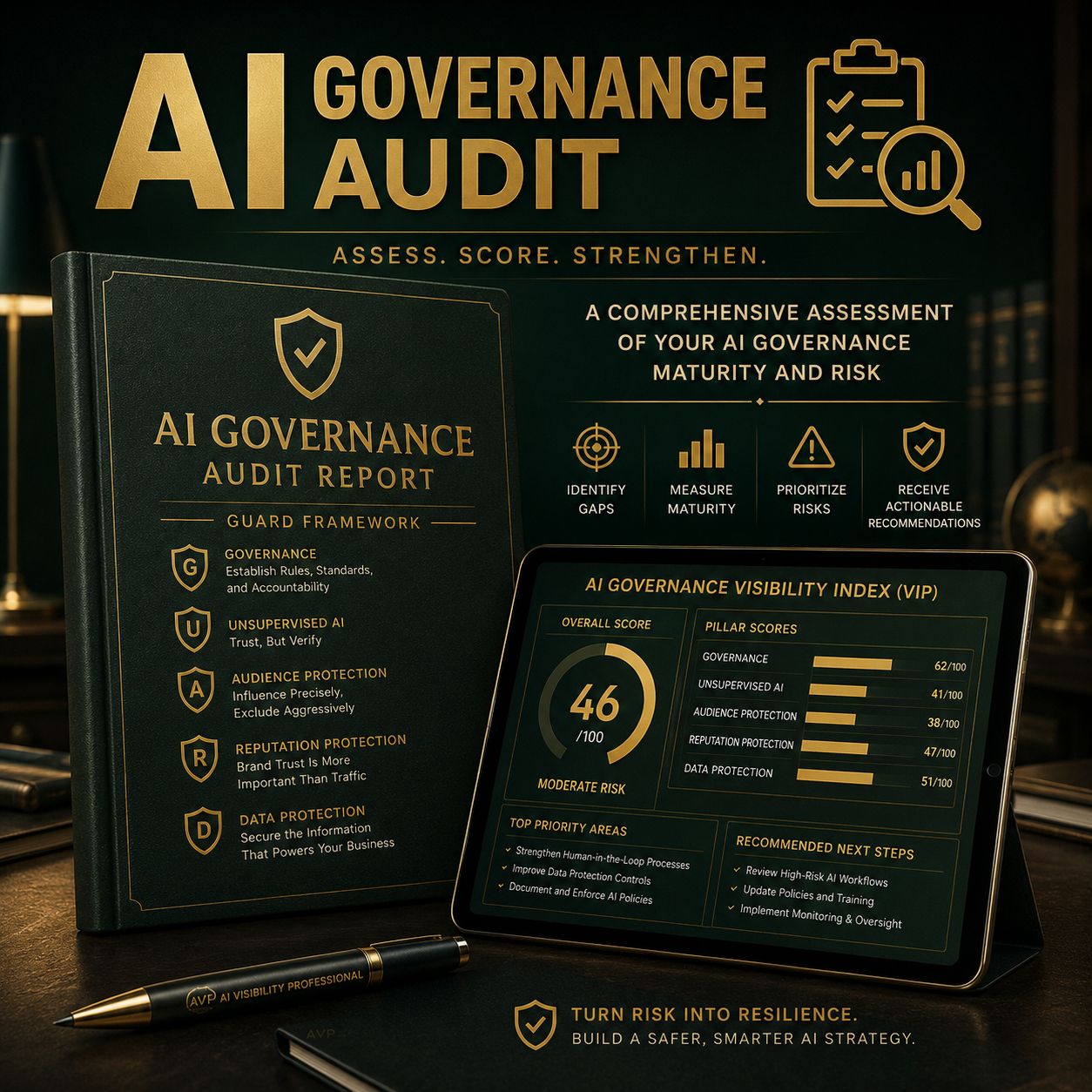
AI Governance Audit
$300 - A professional (human-led) assessment to identify your strengths, your shortfalls, and exactly where to go next.
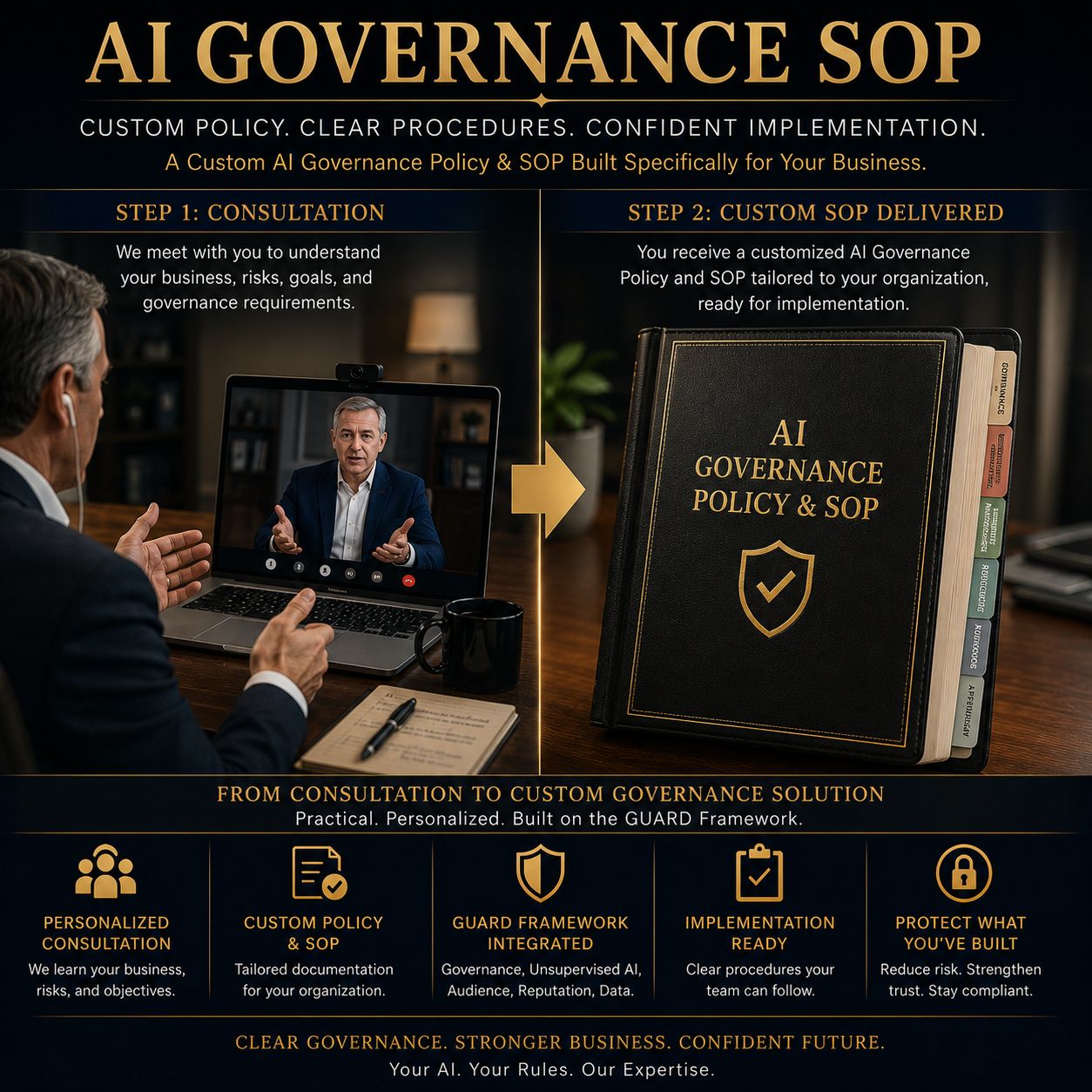
AI Governance Policy
$1000 - A custom AI Policy & SOP built specifically for your organization, ready to implement.
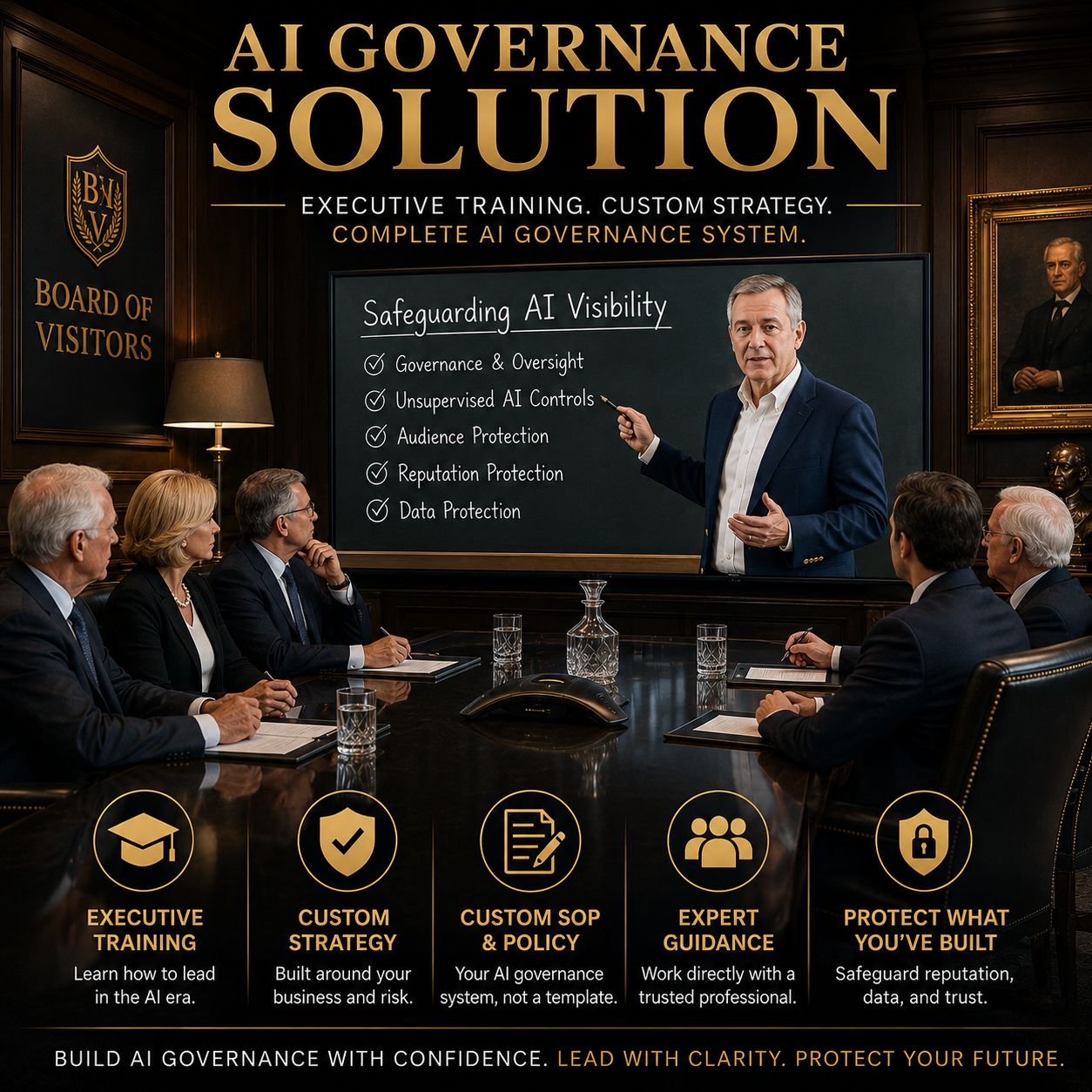
AI Governance Solution
$3000 - The complete engagement: audit, policy, implementation guidance, and direct consulting with Christopher Littlestone.