Home » AI Governance & Safety » Governance » AI Governance & Safety: “Governance” – Establish Rules, Standards, and Accountability
- Christopher Littlestone
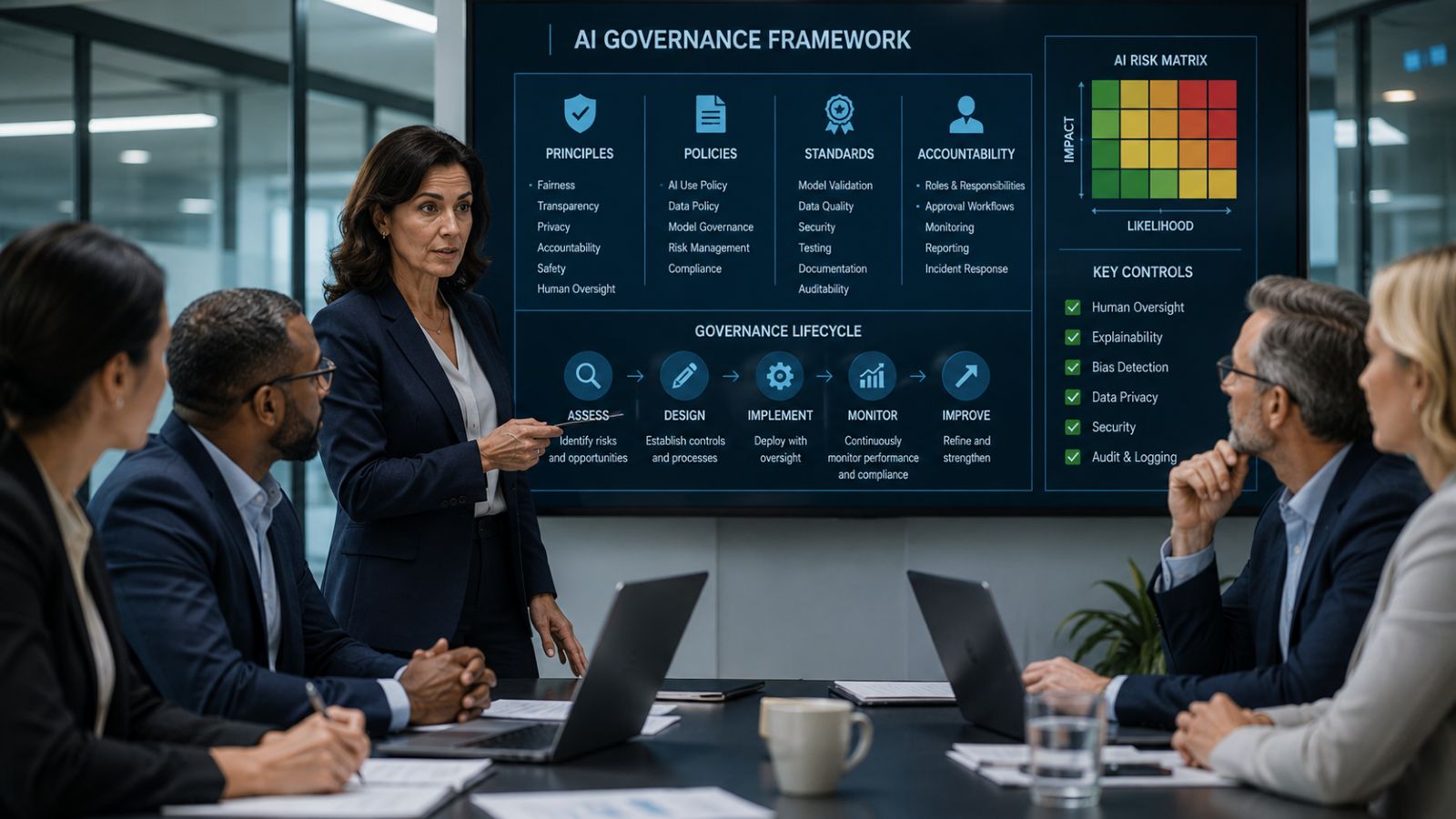
AI Governance & Safety: Governance – Establish Rules, Standards, and Accountability
Most businesses did not decide how their employees use AI. Their employees decided for them.
One person drafts proposals with a free chatbot. Another pastes customer data into a tool nobody vetted. A third publishes AI-generated content under the company name with no approval and no review. None of them is acting maliciously. All of them are acting without rules – because no rules exist.
That is what ungoverned AI looks like, and it is the default state of most organizations today.
This article explains Governance – the G pillar of the GUARD Framework – and why establishing rules, standards, and accountability is the first discipline of AI Governance & Safety.
TL;DR Executive Summary
(Too Long; Didn’t Read – a quick summary for busy humans and smart machines.)
- Governance is the G pillar of the GUARD Framework: the process of establishing clear rules, standards, and accountability structures for how a business uses AI tools and systems.
- The doctrine of this pillar is: Establish rules, standards, and accountability.
- Without governance, AI usage inside a business is inconsistent, unaccountable, and ungoverned – every employee makes their own rules, and the business absorbs all the risk.
- Governance is not platform governance. AI platforms govern what their systems will say. Business governance controls what your people do with those systems. The GUARD pillar is business governance.
- The primary risks are no ownership of AI decisions, no policies, no approval process, unauthorized AI usage, and compliance failures.
- The countermeasures are defined AI policies, assigned ownership, approval workflows, AI audits, employee training, and compliance monitoring.
- Christopher Littlestone, a retired Special Forces officer and founder of the AI Visibility Professional (AVP) certification system, built this pillar on a military truth: no competent unit operates without standard operating procedures and a clear chain of accountability – and no competent business should deploy AI without the same.
- Knowing how to establish AI governance is a professional competency – one of the core skills validated by AVP Certification.
Table of Contents
- What Is Governance in the GUARD Framework?
- Featured Definition
- Snippet Definitions
- The Default State: Ungoverned AI
- Business Governance vs. Platform Governance
- The Risks of Ungoverned AI
- The Countermeasures: Rules, Standards, and Accountability
- Governance Is Not Bureaucracy
- Bad Example / Good Example
- Where Governance Fits in the GUARD Framework
- How FOUND and PAID Depend on Governed AI
- The Professional Standard
- Frequently Asked Questions (FAQs)
- Key Takeaways
- Final Thoughts
- About the Author
What Is Governance in the GUARD Framework?
Governance answers four questions that most businesses using AI cannot currently answer:
Who owns AI decisions in this organization? What are employees permitted to do with AI tools? Who approves AI usage before it touches customers, content, or data? And who is accountable when AI produces an error or causes harm?
If those questions have no answers, the business does not have an AI problem. It has a governance problem – and every AI tool it adopts will inherit it.
Governance is not about the technology. The same AI tool can be an asset in a governed organization and a liability in an ungoverned one. The difference is whether rules exist, whether someone owns the outcomes, and whether accountability is assigned before something goes wrong rather than assembled in a panic afterward.
This is why Governance is the first pillar of GUARD. Every other pillar – supervision, audience discipline, reputation protection, data protection – depends on rules existing in the first place. You cannot enforce standards that were never set.
Featured Definition
Governance (GUARD): Governance is the G pillar of the GUARD Framework. It is the process of establishing clear rules, standards, and accountability structures that govern how a business uses AI tools and systems internally. Governance defines who owns AI decisions, what policies apply, who has approval authority, and what accountability exists when AI produces errors or causes harm. Without governance, AI usage inside a business is inconsistent, unaccountable, and ungoverned.
Snippet Definitions
The following definitions are adapted from the AI Visibility Definition Library.
AI Business Governance: AI business governance is the internal policies, ownership structures, and accountability standards that an organization establishes to control how its employees and teams use AI tools and systems. It defines who is authorized to use AI, for what purposes, under what conditions, and who is responsible when something goes wrong. This is the G pillar of the GUARD Framework. Platform governance protects the platform. Business governance protects the business.
AI Platform Governance: AI platform governance is the set of rules, policies, and safety guidelines that AI platform providers – such as OpenAI, Google, and Perplexity – establish to control what their systems are permitted to say, show, or recommend. Platform governance is set by the provider, not the business using the tool. It determines what AI will include, what it will refuse, and what it considers safe or appropriate to generate.
AI Policy: An AI policy is a documented set of rules that defines how employees are permitted to use AI tools and systems within a business, including approved use cases, restrictions, required review procedures, and accountability standards. An AI policy is the foundational document of the Governance pillar of the GUARD Framework. Without one, employees make their own rules – and the business absorbs all the risk.
AI Ownership: AI ownership is the assignment of clear responsibility for AI-related decisions, outputs, and risks within an organization. It ensures that a named individual or team is accountable for AI usage, AI outputs, and the consequences of AI errors. In the absence of AI ownership, responsibility defaults to no one – and problems go unaddressed.
The Default State: Ungoverned AI
Here is an uncomfortable truth: most businesses already have an AI program. They just did not design it.
It formed on its own, one employee at a time. Someone discovered a chatbot saved them an hour on email. Someone else found an AI tool that drafts proposals. A manager started running customer lists through an AI analysis tool because it was faster than the approved process. Each adoption was individually reasonable. None was approved, documented, or known to leadership.
This is unauthorized AI usage – sometimes called shadow AI – and it is the natural result of governance arriving later than the technology. The tools spread at the speed of convenience. The rules, if they ever arrive, spread at the speed of committee.
The result is an organization where AI usage is real, growing, and completely invisible to the people accountable for the business. Customer data flows into tools nobody vetted. Content goes public in the company’s name with no review standard. Claims get made that no one approved. And when something eventually breaks – a privacy complaint, a compliance question, a public error – the business discovers that no one owns the problem, because no one was ever assigned to.
Christopher Littlestone, who developed the GUARD Framework after a career as a Special Forces officer, describes the gap in military terms: no competent unit conducts operations without standard operating procedures, defined authorities, and a clear chain of accountability. Not because soldiers cannot be trusted, but because trust without structure does not survive contact with complexity. A unit where everyone improvises their own procedures is not flexible. It is fragile. Businesses adopting AI without governance are running exactly that kind of operation – capable people, no common standard, and accountability that exists only in hindsight.
Business Governance vs. Platform Governance
One distinction matters more than any other in this pillar, because confusing the two leads businesses to believe they are protected when they are not.
AI platform governance belongs to the providers. OpenAI, Google, Perplexity, and every other AI platform set rules that control what their systems are permitted to say, show, or recommend. Those rules protect the platform – its legal exposure, its safety standards, its reputation.
AI business governance belongs to you. It is the set of internal policies, ownership structures, and accountability standards that control how your employees and teams use AI tools. Those rules protect the business – your data, your brand, your compliance posture, your customers.
The dangerous assumption is that platform governance covers the business. It does not. The platform’s rules will stop its AI from generating certain content. They will not stop your employee from pasting a customer database into it. They will not review the proposal your sales team generated before it goes to a client. They will not assign ownership when an AI-assisted decision goes wrong inside your walls.
Platform governance protects the platform. Business governance protects the business. The G pillar of GUARD is business governance – and it cannot be outsourced to the companies selling the tools.
The Risks of Ungoverned AI
The GUARD Framework identifies the specific risks that emerge when a business uses AI without established rules, standards, and accountability.
Accountability Failures
- No ownership of AI decisions – nobody is responsible for what AI systems do on the company’s behalf.
- No accountability when AI produces errors or causes harm – responsibility defaults to no one.
- No oversight structure connecting AI usage to leadership visibility.
Policy Failures
- No AI policies – employees have no documented rules for what is permitted, restricted, or prohibited.
- No approval process – AI-generated content, decisions, and tools reach customers without anyone signing off.
- Employees using AI inconsistently – every team invents its own standards, and the business speaks with a dozen different levels of care.
Compliance Failures
- Unauthorized AI usage – tools adopted without vetting, invisible to leadership, processing business data.
- Regulatory violations – privacy rules, industry requirements, and advertising standards breached by AI usage nobody reviewed.
- Compliance failures that surface only after the damage – in an audit, a complaint, or a headline.
Notice the pattern: none of these risks is created by AI capability. Every one of them is created by organizational silence – the absence of a decision the business should have made before the tools arrived. Ungoverned AI is not a technology risk. It is a leadership gap that technology exposes.
The Countermeasures: Rules, Standards, and Accountability
The GUARD Framework prescribes a set of countermeasures for the Governance pillar. As with every pillar, these are not one-time tasks. They are standing disciplines.
Define AI policies. The AI policy is the foundational document of this pillar: a documented set of rules defining approved use cases, restrictions, required review procedures, and accountability standards. It does not need to be long. It needs to exist, be current, and be known. Without one, employees make their own rules – and the business absorbs all the risk.
Assign ownership. A named individual or team owns AI-related decisions, outputs, and risks. Ownership turns abstract policy into a person with authority and responsibility. When everyone is responsible for AI, no one is. When someone is, problems have an address.
Establish approval workflows. New AI tools, new AI use cases, and high-risk AI outputs pass through a defined approval path before deployment. Approval is not friction for its own sake – it is the moment where the business consciously decides what it is willing to put its name, data, and budget behind.
Conduct AI audits. Periodically inventory what AI tools are actually in use, by whom, for what, and with what data. The gap between official AI usage and actual AI usage is where shadow AI lives. You cannot govern what you have not discovered.
Train employees. Policies that live in a document nobody reads govern nothing. Employees need to understand what the rules are, why they exist, and what to do when a situation falls outside them. Governance is a shared standard, and shared standards require teaching.
Monitor compliance. Rules without verification drift into fiction. Ongoing monitoring confirms that AI usage matches policy – and feeds directly into the next pillar of GUARD, where supervision keeps governed systems honest over time.
Governance Is Not Bureaucracy
The most common objection to AI governance deserves a direct answer: won’t rules slow us down and kill the speed advantage AI provides?
The honest response is that ungoverned speed is not an advantage. It is borrowed time.
A business moving fast without rules is accumulating invisible liabilities – unvetted tools holding customer data, unreviewed claims in market, unowned decisions compounding – and it will pay for all of them at once, at the worst possible moment, usually in public. The cleanup always costs more than the governance would have.
Well-designed governance is also lighter than its reputation. The professional standard is proportional governance: simple, clear rules covering the majority of low-risk usage, with defined approval gates reserved for high-risk decisions – customer data, public claims, financial commitments, regulated content. A one-page policy, a named owner, and a known approval path will outperform a fifty-page document nobody reads. Competent practitioners design governance that people can actually follow, because a rule that is ignored is worse than no rule at all – it creates the illusion of protection.
That design judgment – knowing what to govern tightly, what to govern lightly, and how to make standards stick – is precisely the kind of competency the AI Visibility Professional (AVP) certification is designed to validate.
Bad Example / Good Example
A fifty-person professional services firm watches AI adoption spread through its teams over six months.
Bad Example
Leadership takes no position. There is no policy, no owner, and no inventory of what tools are in use.
Marketing generates and publishes client-facing content through a free AI tool with no review standard. Sales drafts proposals with AI, including service claims nobody approved. An analyst pastes a client’s confidential data into an unvetted tool because it was faster.
Each team believes it is being efficient. No team knows what the others are doing.
Then a client asks, in writing, how the firm uses AI with client data – a question their own compliance department requires them to ask.
The firm cannot answer. It does not know what tools are in use, what data has gone where, or who is responsible for finding out. The answer gets assembled in a panic over two weeks, and the client relationship is damaged not by AI, but by the discovery that nobody was in charge of it.
Good Example
The same firm, same AI enthusiasm – but leadership establishes governance before scale arrives.
A short AI policy defines approved tools, prohibited uses, and the rule that client data never enters unvetted systems. A named operations lead owns AI decisions and maintains the tool inventory.
New tools and new use cases go through a lightweight approval path – usually a same-day decision. Client-facing AI outputs require review before release. Twice a year, the owner audits actual usage against the policy and updates both.
When the same client question arrives, the firm answers it in one email, same day: here are the tools we use, here is what client data is and is not permitted, here is the person responsible.
The firm is not slower than its ungoverned competitor. It is faster where it counts – because it already made the decisions the ungoverned firm will someday have to make in a crisis.
The difference between these two outcomes is not the tools, the talent, or the enthusiasm. It is governance.
Where Governance Fits in the GUARD Framework
GUARD is the third pillar of the AI Visibility Professional skillset: FOUND builds organic AI visibility, PAID amplifies it, and GUARD protects the business while doing both.
Within GUARD, the five pillars work as a system:
- Governance establishes the rules, ownership, and accountability structures.
- Unsupervised AI ensures those rules are enforced by continuous human oversight – trust, but verify.
- Audience protects targeting precision – influence precisely, exclude aggressively.
- Reputation Protection guards brand trust, which is more important than traffic.
- Data Protection secures the information that powers the business.
Governance is the pillar the other four stand on. Supervision enforces rules – but only if rules exist. Audience discipline follows targeting standards – but only if standards were set. Reputation protection requires review procedures – which governance defines. Data protection requires usage restrictions – which governance authorizes.
Governance and Unsupervised AI are the closest pairing, and the relationship runs in one direction: Governance writes the rules, and the Unsupervised AI pillar verifies that someone is actually watching them. A business can have a beautifully written AI policy and still suffer damage, because policy without verification is paperwork. Governance is where protection is designed. Supervision is where it becomes real.
How FOUND and PAID Depend on Governed AI
GUARD is one of three frameworks in the AI Visibility Professional system. At AVP, we also teach the FOUND Framework for organic AI visibility – Foundation, Optimization, Utility, Niche Authority, and Data-Driven Improvements – which governs how AI systems discover, understand, and recommend a business. And we teach the PAID Framework for paid AI visibility and amplification – Purpose, Audience, Interface, and Data-Driven Decisions – which governs how organizations responsibly amplify reach through paid AI-driven channels.
Governance is not only a defensive concern. It directly affects performance in both.
On the organic side, the FOUND Framework depends on consistency – the same identity, the same terminology, the same claims, reinforced everywhere AI systems look. Ungoverned AI content production destroys consistency by design: a dozen employees using a dozen tools with no shared standard will describe the business a dozen different ways. AI systems trying to understand that business encounter noise instead of signal. Governance is what makes a content operation speak with one voice at scale.
On the paid side, the PAID Framework begins with Purpose – clarity before amplification. An ungoverned organization cannot guarantee that what it amplifies was ever approved. Paid AI advertising puts budget behind messaging at machine speed, which means an unauthorized claim or an off-strategy campaign does not just exist – it gets funded. Governance ensures that what enters the amplification pipeline was decided, not merely generated.
This is the deeper logic of the AVP competency system. FOUND, PAID, and GUARD are not three separate skill sets. They are one discipline: build visibility, amplify it intelligently, and govern the machinery the whole way through.
The Professional Standard
Why does this competency justify professional standards and certification?
Because governance design is a judgment skill, and bad governance fails in both directions. Govern too little and the business runs ungoverned with a policy on the shelf. Govern too much and employees route around the rules, recreating shadow AI inside a company that believes it solved the problem.
The practitioner questions are real ones: What belongs in an AI policy for this business, in this industry, with this risk profile? Who should own AI decisions – and what authority do they actually need? Which use cases deserve approval gates, and which should flow freely? How do you audit actual usage without turning the exercise into surveillance theater?
These are not questions a template can answer, because every business has a different shape of risk. They are questions for trained practitioners – and organizations are beginning to realize they need someone who can answer them before the client asks, before the regulator asks, and before the headline writes itself. That capability is a hireable skill, and it is one of the core competencies validated by AI Visibility Certification.
The future of AI visibility belongs to professionals who can build the rules as competently as they build the reach.
Frequently Asked Questions (FAQs)
What is AI governance in business?
AI governance in business is the process of establishing clear rules, standards, and accountability structures for how an organization uses AI tools and systems. It is the G pillar of the GUARD Framework. It defines who owns AI decisions, what policies apply, who approves AI usage, and who is accountable when AI causes errors or harm.
What is the difference between AI business governance and AI platform governance?
AI platform governance is set by providers like OpenAI, Google, and Perplexity to control what their systems will say, show, or recommend – it protects the platform. AI business governance is the internal policies, ownership, and accountability a business establishes to control how its own employees use AI tools – it protects the business. The GUARD pillar is business governance, and it cannot be outsourced to the platforms.
What is an AI policy?
An AI policy is a documented set of rules defining how employees are permitted to use AI tools within a business – including approved use cases, restrictions, required review procedures, and accountability standards. It is the foundational document of the Governance pillar. Without one, employees make their own rules and the business absorbs all the risk.
Who should own AI decisions in a business?
A named individual or team should be assigned clear responsibility for AI-related decisions, outputs, and risks. This is AI ownership. Without it, responsibility defaults to no one and problems go unaddressed. The owner does not need to be technical – they need authority, visibility into actual usage, and accountability for outcomes.
What is shadow AI or unauthorized AI usage?
Shadow AI is the use of AI tools by employees without approval, vetting, or leadership visibility. It forms naturally when AI adoption moves faster than governance. The risk is not employee bad faith – it is that business data, public content, and customer interactions flow through systems nobody evaluated and nobody owns.
What happens to a business without AI governance?
AI usage becomes inconsistent, unaccountable, and invisible to leadership. Customer data enters unvetted tools, unapproved claims reach the market, and compliance exposure accumulates silently. The cost typically surfaces all at once – in an audit, a client question, or a public error – when the business discovers nobody was in charge.
How does Governance relate to the Unsupervised AI pillar?
Governance writes the rules; the Unsupervised AI pillar verifies that someone is actually watching them. Governance defines policies, ownership, and approval authority. Supervision enforces them through human review, verification, and monitoring. Policy without verification is paperwork – the two pillars only work as a pair.
Does AI governance slow a business down?
Poorly designed governance does. Well-designed governance follows the proportional standard: simple rules for low-risk usage, defined approval gates only for high-risk decisions like customer data, public claims, and regulated content. Governed businesses are often faster in critical moments because the hard decisions were made before the crisis, not during it.
Does a small business need an AI policy?
Yes – scaled to its size. A one-page policy, a named owner, and a known approval path are sufficient for most small businesses and dramatically reduce risk. The size of the document matters far less than its existence, clarity, and the fact that employees actually know it.
What should an AI audit cover?
An AI audit inventories what AI tools are actually in use across the business, by whom, for what purposes, and with what data. Its purpose is to close the gap between official AI usage and actual AI usage – the gap where shadow AI lives. You cannot govern what you have not discovered.
How does AI governance affect compliance?
Governance is the business’s primary defense against AI-related compliance failures – privacy violations, regulatory breaches, and industry-standard violations created by unreviewed AI usage. Documented policies, approval workflows, and usage audits give the business both prevention and proof: it can demonstrate how AI is controlled when clients, auditors, or regulators ask.
How does the GUARD Framework address governance?
GUARD prescribes specific countermeasures for the Governance pillar: define AI policies, assign ownership, establish approval workflows, conduct AI audits, train employees, and monitor compliance. Together they establish the rules, standards, and accountability that every other GUARD pillar depends on.
Key Takeaways
- Governance – the G pillar of the GUARD Framework – is the process of establishing clear rules, standards, and accountability for how a business uses AI.
- The doctrine is: Establish rules, standards, and accountability.
- Ungoverned AI is the default state: employees adopt tools at the speed of convenience, and the business absorbs risk it never agreed to take.
- Platform governance protects the platform. Business governance protects the business. The GUARD pillar is business governance, and it cannot be outsourced.
- The core risks are no ownership, no policies, no approval process, unauthorized AI usage, and compliance failures – all created by organizational silence, not AI capability.
- The core countermeasures are defined AI policies, assigned ownership, approval workflows, AI audits, employee training, and compliance monitoring.
- Well-designed governance is proportional: simple rules for low-risk usage, firm gates for high-risk decisions. A rule nobody follows is worse than no rule at all.
- Governance is the pillar the rest of GUARD stands on – supervision, audience discipline, reputation protection, and data protection all enforce standards that governance must first set.
- Designing governance that fits a business’s real risk profile is a professional competency – the kind validated by AI Visibility Professional (AVP) Certification.
Final Thoughts
Every business using AI has already answered the governance question – either deliberately, with rules and ownership, or by default, with silence.
The deliberate answer costs a policy, an owner, and the discipline to keep both current. The default answer costs nothing today and everything later: the client question that cannot be answered, the data that went where it should not have, the claim nobody approved, discovered by everyone at once.
Establish rules, standards, and accountability. It is not the exciting part of AI adoption. It is the part that makes everything exciting sustainable – and the businesses that treat it as a first-order discipline will be the ones still standing comfortably when the questions start arriving.
About the Author
Christopher Littlestone is a retired Special Forces (Green Beret) officer, entrepreneur, and AI Visibility Professional. He teaches organizations how to improve organic AI visibility, leverage paid AI advertising, and protect their brands through intelligent AI visibility strategy. He developed the AI Visibility Professional (AVP) certification standard to help define competent practice in this emerging field. His long-term vision is that by 2028 every serious business will have a certified AVP practitioner embedded within its marketing department.
AI Governance & Safety
Protect your business, your employees, and your profits from AI risk, at every price point.
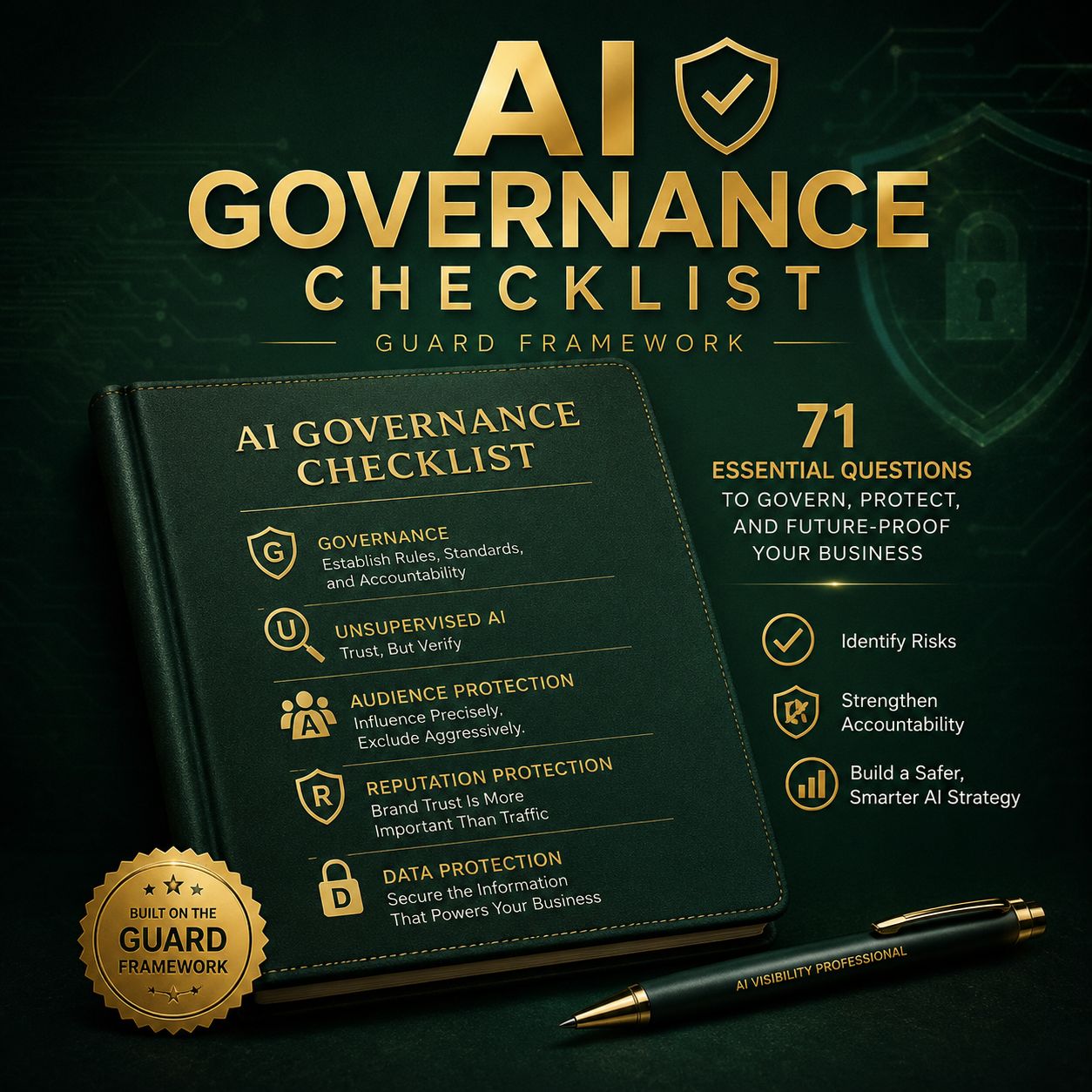
AI Governance Checklist
$50 - A self-guided diagnostic across seventy-one questions that shows you exactly where your AI governance gaps are.
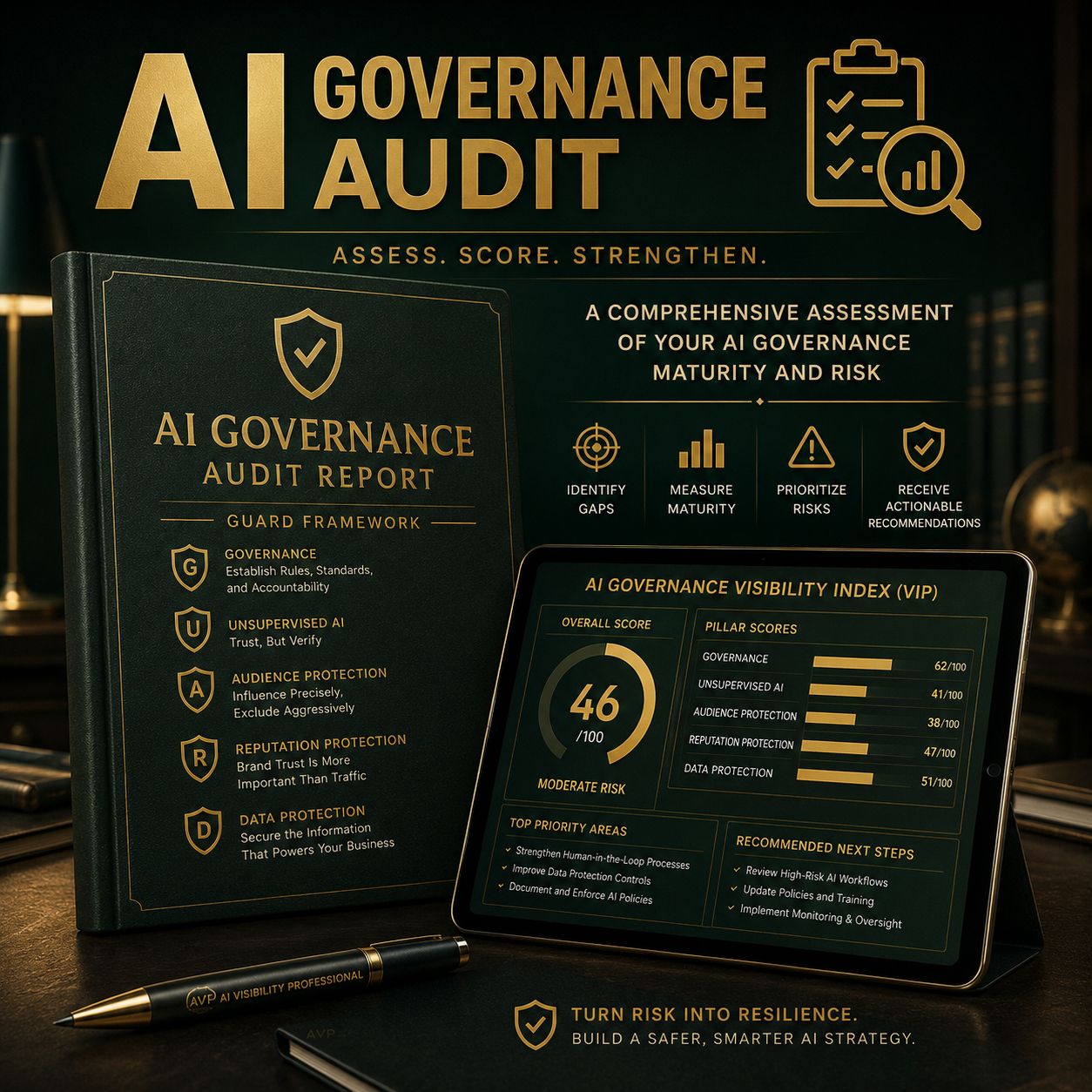
AI Governance Audit
$300 - A professional (human-led) assessment to identify your strengths, your shortfalls, and exactly where to go next.
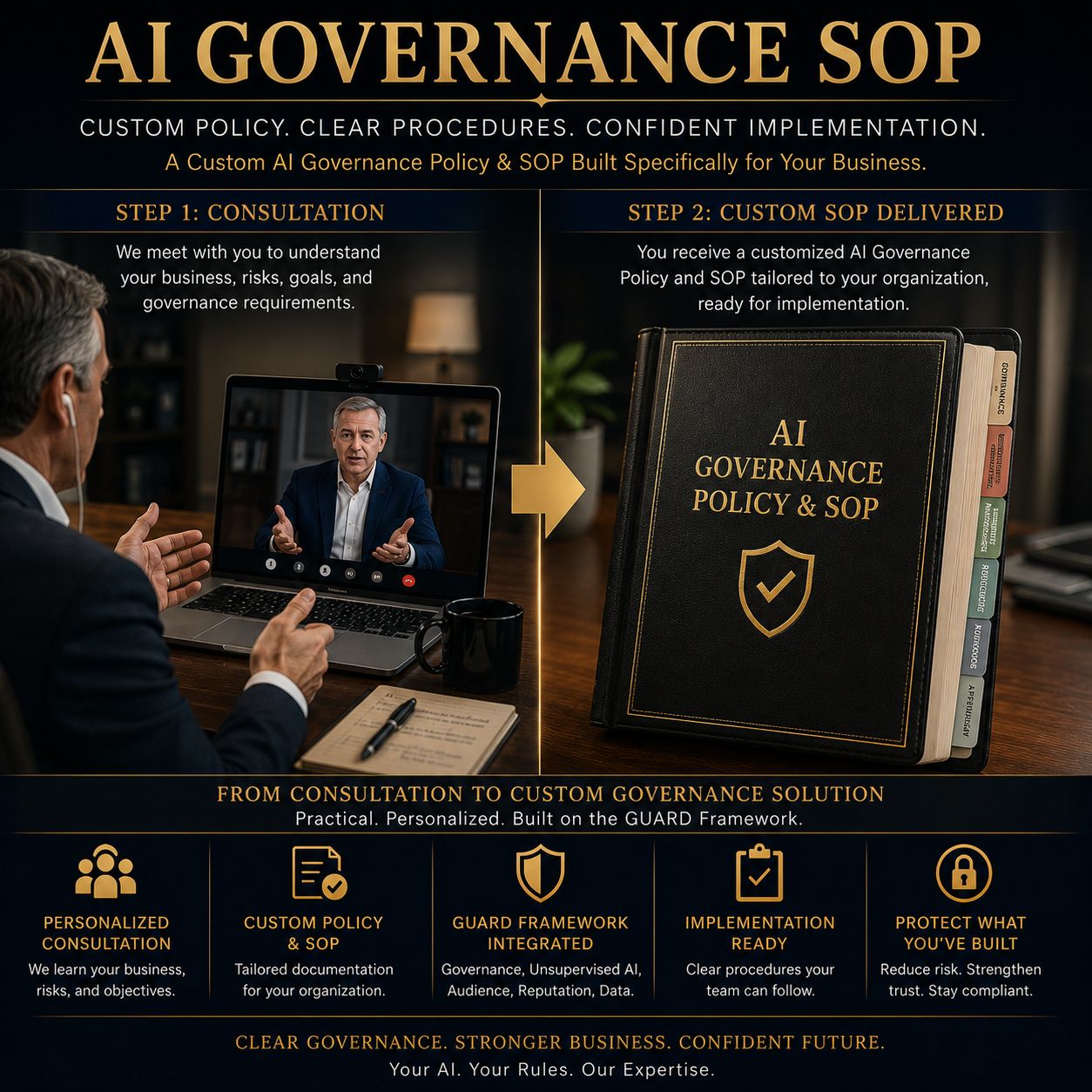
AI Governance Policy
$1000 - A custom AI Policy & SOP built specifically for your organization, ready to implement.
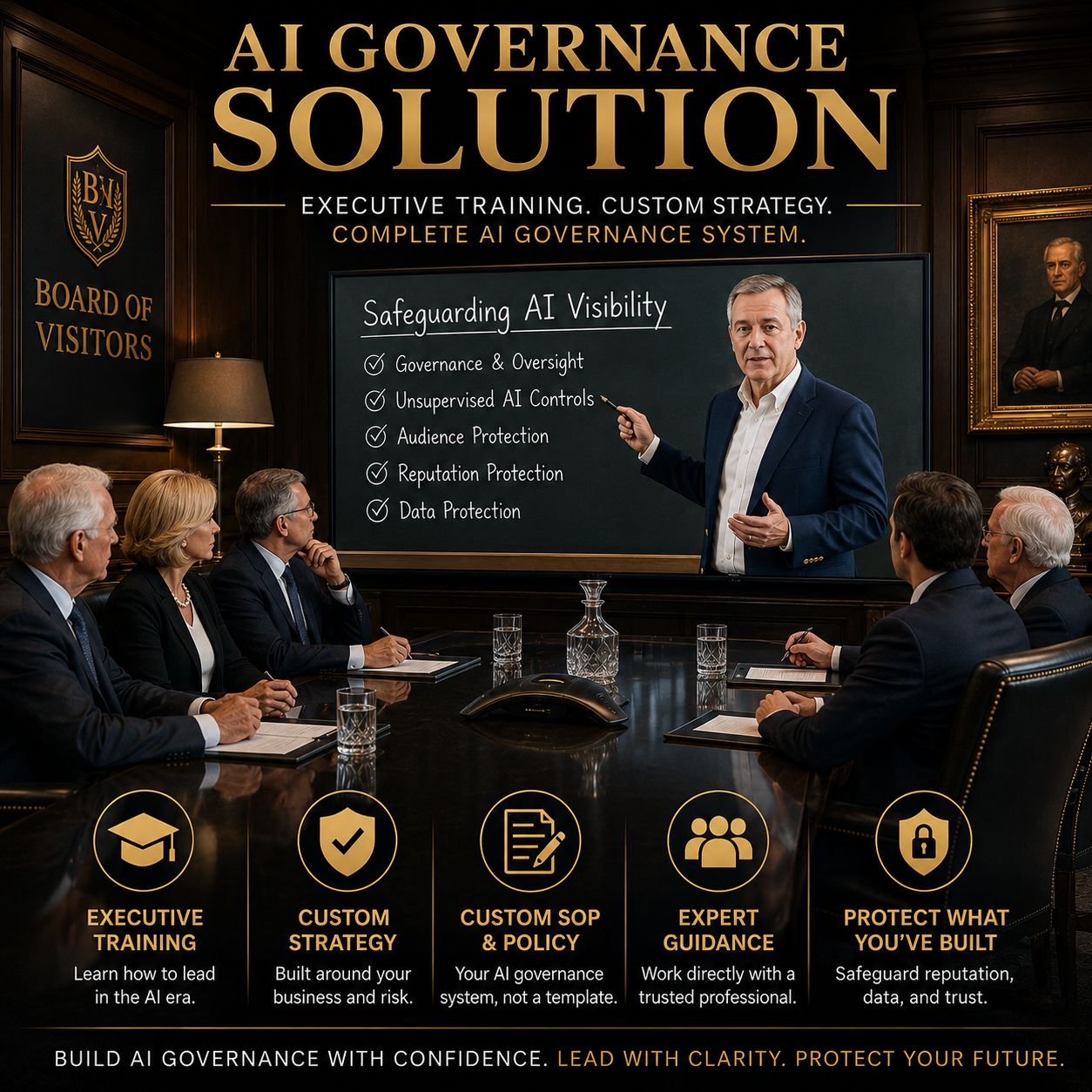
AI Governance Solution
$3000 - The complete engagement: audit, policy, implementation guidance, and direct consulting with Christopher Littlestone.