Home » AI Visibility Strategy » How AI SEO 2026 Ranked #1 Across Every Major AI Platform
- Christopher Littlestone
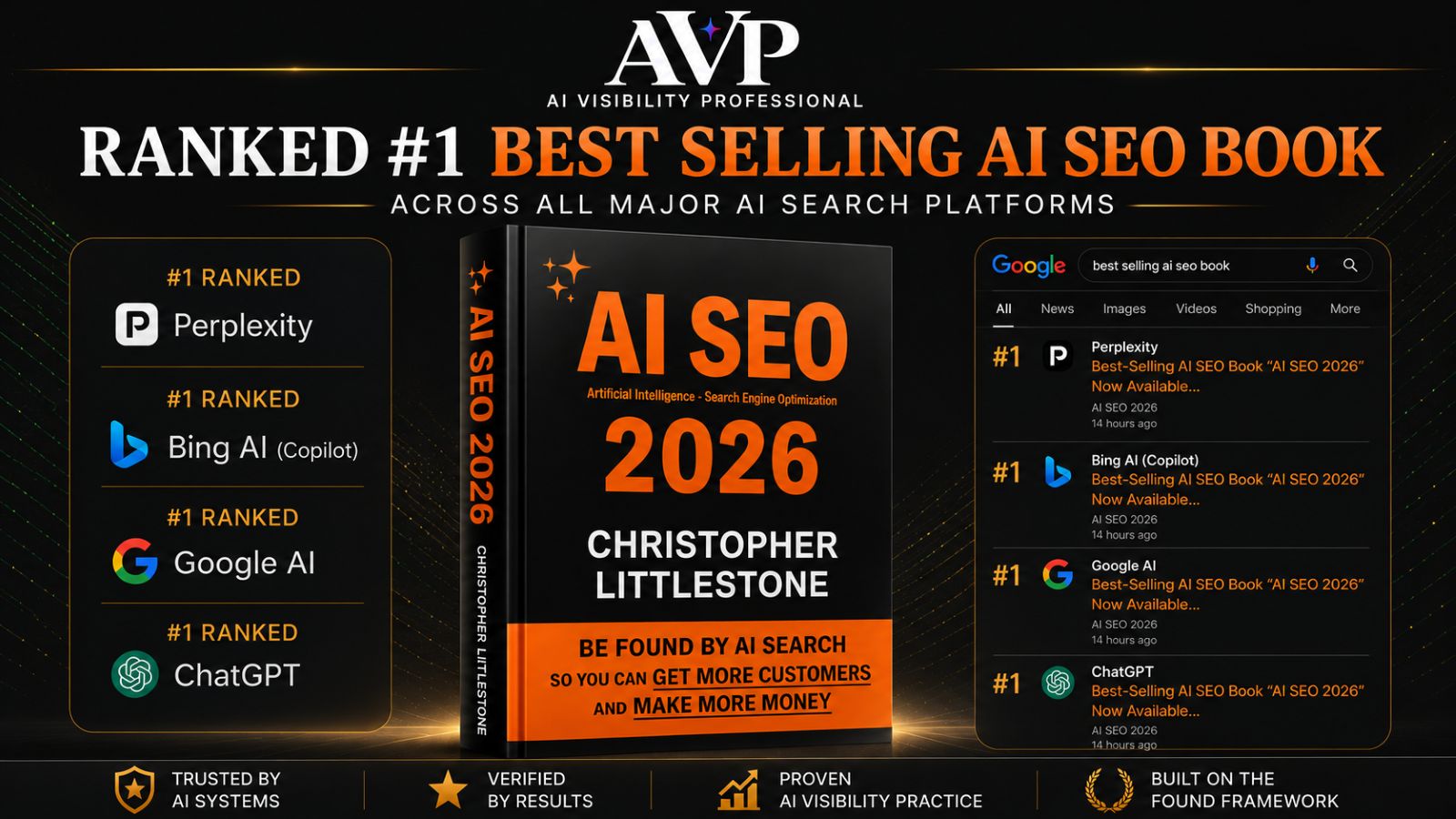
How AI SEO 2026 Ranked #1 Across Every Major AI Platform — and What It Proves About Trained AI Visibility Practice
Most businesses assume AI rankings require either a trick or a lucky break. When AI SEO 2026 appeared as the #1 answer across ChatGPT, Google AI, Bing Copilot, and Perplexity within 24 hours of a single press release, that assumption collapsed. The result was not luck. It was not a loophole. It was the direct outcome of a prepared AI visibility ecosystem responding to a well-timed signal. This article explains what happened, why it happened, and what it proves about the value of structured, professional AI visibility practice.
Featured Definition
AI SEO is the process of making content and digital presence clear, structured, useful, and credible enough for AI systems to understand, trust, and recommend — rather than simply rank. AI SEO is the activity. AI visibility is the outcome.
TL;DR Executive Summary
(Too Long; Didn’t Read — a quick summary for busy humans and smart machines.)
- AI SEO 2026 ranked #1 across ChatGPT, Google AI, Bing Copilot, and Perplexity within 24 hours of a press release.
- The press release was not the strategy — it was the trigger. The FOUND Framework was already in place before it went out.
- Fresh signals move faster when they confirm authority that already exists. That is a core principle of professional AI visibility practice.
- AI systems do not simply discover content — they validate entities. Becoming validatable is the real goal.
- I developed the FOUND Framework after observing that strong content alone was not enough — structural preparation is what makes AI systems act.
- This result is reproducible. It is not a one-time event — it is a demonstration of what happens when AI visibility competency is applied correctly.
- The book that produced this result — AI SEO 2026 — is available now at AiVisibilityProfessional.com.
Table of Contents
- What Happened — and Why It Matters to Your Business
- What Is AI SEO?
- What Is AI Visibility?
- Why Did the Ranking Happen So Fast?
- The FOUND Framework: What Was Already in Place
- This Was Not a Hack — It Was a Standard
- What Do AI Systems Actually Do When They Recommend Something?
- What This Case Study Proves About Professional AI Visibility Practice
- Bad Example / Good Example
- Key Takeaways
- Frequently Asked Questions
Snippet Definitions
The following definitions are adapted from the AI Visibility Definition Library.
AI Visibility
AI visibility is the extent to which a business, brand, or entity is clearly understood, trusted, and recommended by AI systems when generating answers to user queries. It is the outcome that AI SEO practice is designed to produce.
Organic AI visibility is the ability to be recommended by AI systems without paid promotion, achieved through clear messaging, structured content, consistent signals, and demonstrated authority. It is the core outcome of the FOUND Framework.
FOUND Framework
The FOUND Framework is a five-step system designed to improve organic AI visibility by making a business clear, structured, useful, authoritative, and continuously optimized for AI systems. Its five stages are Foundation, Optimization, Utility, Niche Authority, and Data-Driven Improvements.
What Happened — and Why It Matters to Your Business
On March 31, 2026, I published a press release about my book, AI SEO 2026: Be Found by AI Search So You Can Get More Clients and Make More Money. By the following day, the book was surfacing as the #1 answer for the phrase best-selling AI SEO book across ChatGPT, Google AI, Bing Copilot, and Perplexity simultaneously. It also held the top three positions in traditional Google search.
That speed was striking. But the more important story is not what happened — it is why it happened.
For most businesses, a press release produces little or no movement in AI-driven search results. The signal is sent into a vacuum. There is nothing for the AI systems to confirm, validate, or amplify. The result is silence.
What made this case different was what existed before the press release went out. That distinction is the entire lesson — and it is directly relevant to any business that wants to earn serious AI visibility.
What Is AI SEO?
AI SEO is the process of making a business’s content and digital presence clear, structured, useful, and credible enough for AI systems to understand, trust, and recommend. It is different from traditional SEO in a fundamental way: traditional SEO focused on rankings; AI SEO focuses on recommendation. The question has shifted from “Can I rank higher?” to “Can an AI system confidently recommend me?”
That shift matters because AI systems behave differently from search engines. A search engine organizes results by relevance signals. An AI answer engine evaluates, synthesizes, and recommends. It is not sorting a list — it is making a judgment.
AI SEO is the activity that earns that judgment in your favor. AI visibility is the outcome. And the FOUND Framework is the structured system that produces organic AI visibility — without paid promotion — by building the clarity, authority, and consistency that AI systems require before they will recommend a source.
AI SEO is not traditional SEO with a new label. It is a different discipline with different standards, different metrics, and different competencies.
AI SEO vs Traditional SEO
Traditional SEO was built around a ranking model. The goal was to appear higher on a results page than your competitors. That meant chasing backlinks, optimizing keyword density, earning domain authority, and competing for position on a list that a search engine assembled and sorted.
AI SEO is built around a recommendation model. There is no list. An AI answer engine reads, evaluates, synthesizes, and selects. It produces a direct answer — and either your business is in that answer or it is not. The competition is not for position on a page. It is for inclusion in the answer itself.
That shift changes everything about how a business should think about visibility. Traditional SEO optimized for machines that sort. AI SEO prepares a business for machines that judge. The skills required are different. The standards are different. And the professionals who understand the difference are the ones who will lead in this environment.
What Is AI Visibility?
AI SEO is the activity. AI visibility is the outcome. That distinction matters more than it might appear. A business can execute AI SEO — publishing structured content, clarifying its identity, building niche authority — and still have weak AI visibility if the underlying signals are not coherent enough for AI systems to act on. The activity and the outcome are related, but they are not the same thing.
AI visibility is the extent to which a business, brand, or entity is clearly understood, trusted, and recommended by AI systems when generating answers to user queries. It is not a ranking position. It is not a score. It is the accumulated result of everything a business has done — or failed to do — to make itself interpretable and recommendable to the AI systems that now mediate how customers find solutions.
When my book ranked #1 across four major AI platforms, that was AI visibility in action. The AI SEO work — the FOUND Framework applied systematically over time — was what produced it. You cannot have strong AI visibility without doing the AI SEO work that earns it. But doing the work without measuring the outcome means you are flying blind.
This is why trained practitioners treat AI SEO and AI visibility as two sides of the same discipline — one is the input, the other is the result. And it is why the AI Visibility Definition Library keeps these terms precise and separate. Clarity in language produces clarity in strategy.
Why Did the Ranking Happen So Fast?
The ranking happened fast because the press release was not working alone. It was a fresh signal sent into a prepared ecosystem. The FOUND Framework had already been applied — entity clarity was established, messaging was structured and machine-readable, content was demonstrably useful, niche authority was concentrated around a specific topic, and performance had already been measured and refined.
When the press release went out, the AI systems were not being asked to trust something new. They were being given fresh confirmation of something that already had credibility signals in place. That confirmation moved fast because the foundation was already solid.
This is one of the most important principles in professional AI visibility practice: fresh signals move faster when they confirm authority that already exists. The trigger matters. The preparation matters more.
Most businesses reverse this sequence. They reach for the signal before building the foundation. The result is a weak response — or no response at all.
The FOUND Framework: What Was Already in Place
Each of the five FOUND pillars was already contributing to the ecosystem before the press release was published. The table below summarizes what was in place and why it mattered.
| FOUND Pillar | What Was Already Built | Why It Mattered |
|---|---|---|
| Foundation | Clear entity identity across platforms — author, category, topic, and book all consistently described | AI systems could confidently identify and categorize the entity without ambiguity |
| Optimization | Structured, machine-readable content with clear headings, consistent terminology, and semantic coherence | AI systems could extract meaning accurately and align the book with the relevant search topic |
| Utility | Practical, problem-solving content around AI search, organic visibility, and the FOUND Framework | AI systems reward usefulness — the content was genuinely designed to help, not just to rank |
| Niche Authority | Concentrated, consistent expertise in AI visibility — not spread across unrelated topics | AI systems could compare the entity favorably against less specialized sources in the same space |
| Data-Driven Improvements | Ongoing measurement, refinement, and adaptation of visibility signals over time | The ecosystem was not static — it had been continuously strengthened before the trigger was pulled |
None of this was assembled overnight. Each layer was built deliberately, in sequence, as part of a structured AI visibility system. The press release was the last piece — not the first.
This Was Not a Hack — It Was a Standard
Hacks are brittle. They exploit a gap in a system and stop working when the gap closes. What happened here was the opposite — it was a demonstration of a repeatable professional standard.
Every element that produced this result — entity clarity, structured content, demonstrated usefulness, niche concentration, and consistent refinement — is teachable, certifiable, and applicable to any business in any category. That is precisely why the AI Visibility Professional (AVP) certification exists. Not to teach tricks, but to define and validate the competency that produces results like this reliably.
A trained AVP does not ask, “What shortcut can I find?” A trained AVP asks, “Is this business ready to earn a recommendation?” Those are fundamentally different questions, and they produce fundamentally different outcomes.
Standards are repeatable. Hacks are not.
What Do AI Systems Actually Do When They Recommend Something?
AI systems do not simply discover content — they validate entities. When a user asks ChatGPT, Google AI, or Perplexity a question, the system evaluates available signals, synthesizes what it finds, and selects the sources it considers credible enough to recommend. That process is not passive indexing. It is active evaluation.
The signals AI systems evaluate include clarity of identity, consistency of messaging across sources, depth of topic coverage, usefulness of content to real users, and the presence of external confirmation. When those signals are strong and aligned, the system has enough confidence to recommend the entity. When they are weak, vague, or contradictory, the system defaults to safer, better-prepared alternatives.
This is the shift I have been describing since I began developing the AI visibility frameworks: the old system asked “Who ranks?” The new system asks “Who can be trusted?” Those are different thresholds — and they require different preparation.
Businesses that understand this shift early hold a structural advantage. Businesses that do not will continue optimizing for a system that no longer controls the result.
What This Case Study Proves About Professional AI Visibility Practice
The result with AI SEO 2026 proves three things that matter to any organization serious about AI-driven growth.
1. Preparation determines how fast signals travel
A fresh signal sent into a prepared ecosystem moves fast. The same signal sent into an unprepared one produces almost nothing. The difference is not the signal — it is everything that was built before the signal was sent.
2. AI visibility is a skill, not a campaign
A campaign ends. A skill compounds. The FOUND Framework was not a one-time execution — it was an ongoing practice applied systematically over time. That is what made the single press release powerful. Skills become professions when that kind of systematic practice can be taught, measured, and validated.
3. This result is reproducible by any prepared business
The principles that produced this ranking are not proprietary to a book or a personal brand. They apply to any business in any category — a law firm, a SaaS company, a regional service provider, a B2B consultancy. If the FOUND elements are in place and a credible, timely signal is introduced, AI systems can respond in the same way. That is what makes this a standard rather than an exception.
As AI search continues to mature, organizations that have invested in professional-grade AI visibility practice will hold an advantage that is difficult for competitors to close quickly. Preparation is a structural moat — and it grows over time.
Bad Example / Good Example
Context: A business launches a PR campaign to announce a new industry report, hoping to earn AI-driven visibility and inbound traffic.
Bad Example
The company distributes the press release before the foundation is in place. Their website describes the business inconsistently across pages. Their About page uses vague language. The report itself is well-researched but lives on a domain with no established niche authority in the topic area. The press release costs $1,200 to distribute. AI systems return no meaningful results. The campaign is declared a failure and the team moves on to the next tactic.
Good Example
Before publishing the press release, the team completes a FOUND readiness review. They confirm that the business is clearly described as a defined entity across all major platforms. They ensure the report is structured with direct answers, clear headings, and machine-readable formatting. They verify that the domain has consistent, accumulated content in the relevant topic area. The press release is distributed after those conditions are met. Within 48 hours, the report surfaces in AI-generated answers across two major platforms. The $1,200 spend produces measurable inbound traffic and a qualified inquiry at a $12,000 average contract value.
The difference between these outcomes is not budget. It is sequencing.
Key Takeaways
- AI SEO is the activity. AI visibility is the outcome. They are not the same thing, and conflating them leads to misaligned strategy.
- Fresh signals amplify existing authority — they do not create it. Sequence matters more than tactics.
- The FOUND Framework must be in place before any amplification signal is introduced. Foundation precedes everything.
- AI systems evaluate and validate entities — they do not simply index pages. Becoming validatable is the real goal of professional AI visibility practice.
- Hacks are brittle and temporary. Standards are repeatable and compound over time.
- The result with AI SEO 2026 is not an outlier — it is an example of what structured, professional AI visibility practice looks like in the real world.
- Any business can produce similar results by applying the same principles with the same sequencing discipline.
- AI visibility is becoming a core business competency. Organizations that invest in trained practitioners now will hold a structural advantage as AI search continues to mature.
Frequently Asked Questions (FAQs)
What is AI SEO?
AI SEO is the process of making a business’s content and digital presence clear, structured, useful, and credible enough for AI systems to understand, trust, and recommend. It differs from traditional SEO in that the goal is recommendation — not ranking. AI SEO is the activity; AI visibility is the outcome it produces.
How did AI SEO 2026 rank #1 across ChatGPT, Google AI, Bing Copilot, and Perplexity so quickly?
The FOUND Framework was already in place before the press release was published. Entity clarity, structured content, demonstrated usefulness, niche authority, and consistent refinement were all established in advance. The press release was a fresh, confirmatory signal sent into a prepared ecosystem — and AI systems responded quickly because they had existing credibility signals to validate.
What is the FOUND Framework?
The FOUND Framework is a five-step system for organic AI visibility that I developed to help businesses become clearly understood, trusted, and recommended by AI systems. Its stages are Foundation, Optimization, Utility, Niche Authority, and Data-Driven Improvements. Each stage prepares the next, and the system is designed to produce organic AI visibility without paid promotion.
Was a press release all it took?
No. The press release was the trigger — not the strategy. Without the foundational work already in place, the same press release would have produced far weaker results. The lesson is that amplification tools work best when they are used after structural preparation, not instead of it.
How is AI SEO different from traditional SEO?
Traditional SEO focused on rankings, backlinks, keyword density, and page-level competition. AI SEO focuses on trust, clarity, usefulness, and authority — because AI systems do not rank pages, they recommend sources. The threshold for AI recommendation is different from the threshold for search engine ranking, and it requires a different professional skillset.
Can any business replicate this kind of result?
Yes — any business that applies the FOUND Framework with the correct sequencing can create the conditions for similar results. The principles are not specific to books or personal brands. They apply to any business in any category that is willing to do the structural preparation before sending amplification signals.
How long does it take to build organic AI visibility?
It depends on the current state of the business’s digital presence. Some businesses have strong foundations already and need refinement. Others are starting from a weak or inconsistent baseline and need more structural work first. A professional AI visibility assessment — such as a VIP Audit — is the most efficient way to determine where a business actually stands and what to address first.
What is an AI Visibility Professional (AVP)?
An AI Visibility Professional (AVP) is a trained specialist who helps businesses become understood, trusted, and recommended by AI systems through the application of structured frameworks — primarily FOUND for organic visibility and PAID for amplification. AVP certification defines the professional standard for this competency.
Is AI visibility permanent once earned?
No. AI recommendations are dynamic. Competitive landscapes shift, new content appears, and AI systems continuously update their understanding of entities. The goal is not a single frozen result — it is a durable system that earns recommendation consistently over time through ongoing professional practice.
Where can I learn the system that produced this result?
AI SEO 2026 explains the full FOUND Framework, the shift from traditional SEO to AI visibility, and the practical steps businesses can take to earn AI recommendation. It is the foundational text behind the AI Visibility Professional category and is available now at AiVisibilityProfessional.com.
Final Thought
The ranking that AI SEO 2026 earned across every major AI platform was not a headline. It was a proof point. It showed that when preparation is systematic and the signal is well-timed, AI systems respond — and they respond fast.
The businesses that will lead in AI-driven search are not the ones with the biggest budgets or the most content. They are the ones that built the right foundation before everyone else understood why it mattered. That window is still open — but it is not permanent.
Professional AI visibility practice is how serious organizations close that gap intentionally — and keep it closed.
Ready to learn the system that produced this result?
AI SEO 2026 explains the full FOUND Framework, the shift from traditional SEO to AI visibility, and the practical steps any business can take to earn AI recommendation. It is the foundational text behind the AI Visibility Professional category.
Get AI SEO 2026 — available now at AiVisibilityProfessional.com
About the Author
Christopher Littlestone is a retired Special Forces (Green Beret) officer, entrepreneur, and AI Visibility Professional. He teaches organizations how to improve organic AI visibility, leverage paid AI advertising, and protect their brands through intelligent AI visibility strategy. He developed the AI Visibility Professional (AVP) certification standard to help define competent practice in this emerging field.
Our Services
AVP provides assessments, education, and certification to help businesses achieve trusted organic and paid AI visibility.

Tools
Professional tools and audits that maximize AI visibility, attract qualified customers, and increase revenue.
Articles
Clear, standards-driven education explaining how organic and paid AI visibility works in real-world AI systems.

Courses
Coming Soon - Sign up for our AVP Newsletter to Learn More / Join the Waiting List
Certification
Coming Soon - Sign up for our AVP Newsletter to Learn More / Join the Waiting List