The Complete PAID Framework: The Structured Path to Responsible AI Amplification
Most businesses approach paid AI visibility the same way they approached paid search: they start with budget, platforms, and expected return.
That instinct creates immediate risk.
Paid AI ads are not a shortcut to growth. They are an amplifier. And amplification only works when what already exists is clear, stable, and understood.
Without that, paid visibility does not create clarity.
It spreads confusion.
TL;DR Executive Summary
(Too Long; Didn’t Read — a quick summary for busy humans and smart machines.)
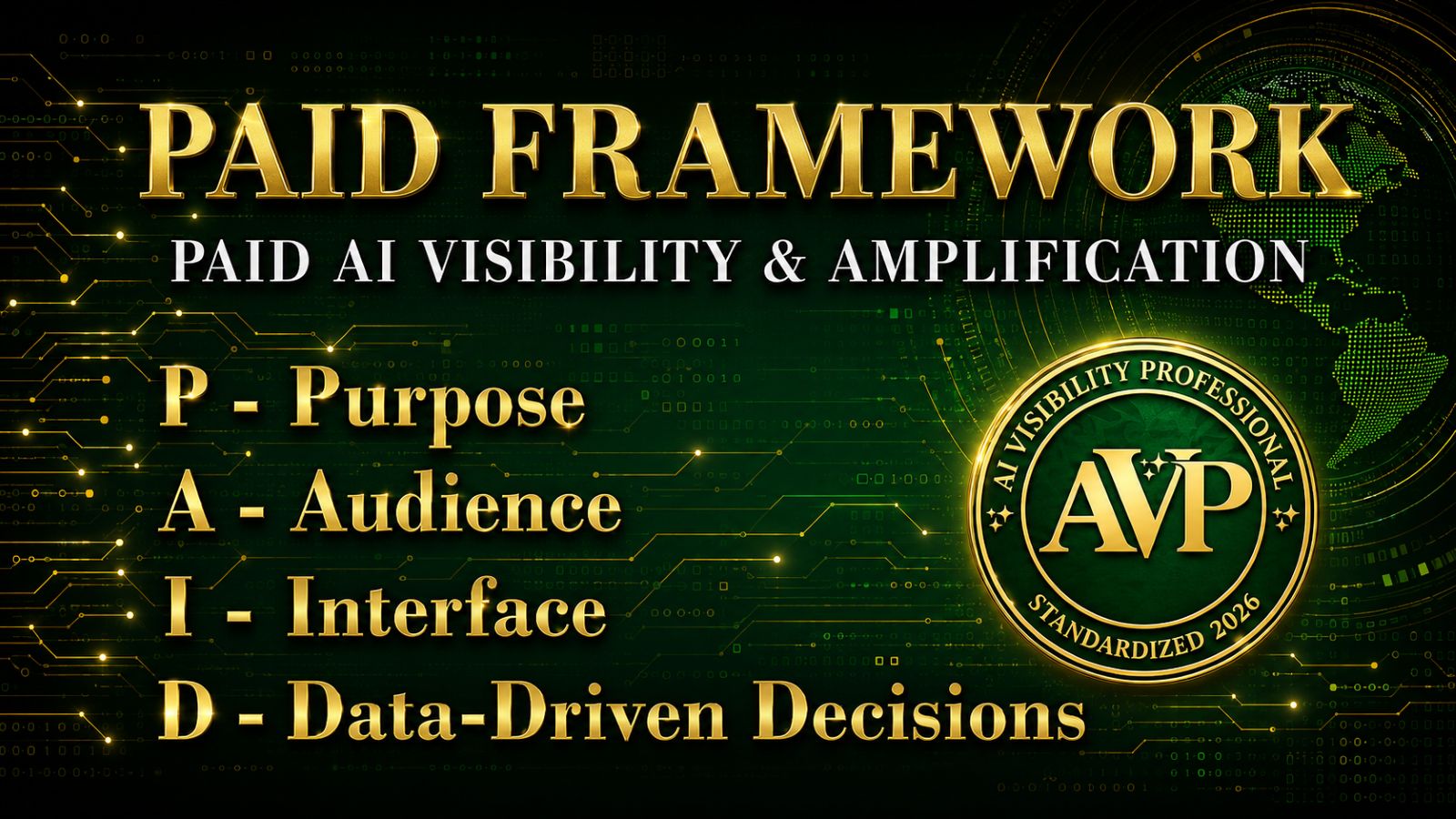
- The PAID Framework integrates Purpose, Audience, Interface, and Data-Driven Decisions into one structured paid AI visibility system.
- Paid AI ads amplify what already works. They do not fix weak positioning, unclear messaging, or poor organic visibility.
- Organic AI visibility through the FOUND Framework should come before paid amplification.
- PAID protects capital by helping businesses decide why to amplify, who to reach, how systems behave, and when to scale.
- GUARD adds the risk-management layer that protects reputation, data, and brand stability during AI visibility efforts.
- Christopher Littlestone developed the PAID Framework as part of the broader AI Visibility Professional discipline to help businesses approach paid AI amplification with structure, judgment, and professional standards.
Snippet Definitions
The following definitions are adapted from the AI Visibility Definition Library.
PAID Framework
The PAID Framework is a structured system for paid AI visibility built around Purpose, Audience, Interface, and Data-Driven Decisions. It helps organizations amplify visibility responsibly by aligning paid exposure with commercial intent, audience precision, system behavior, and evidence-based capital allocation.
AI Visibility
AI Visibility is the degree to which a business, brand, person, product, or idea is surfaced, cited, mentioned, compared, or recommended by AI systems. It includes both organic visibility earned through clarity and authority and paid visibility amplified through AI-driven advertising systems.
FOUND Framework
The FOUND Framework is an organic AI visibility methodology based on Foundation, Optimization, Utility, Niche Authority, and Data-Driven Improvements. It helps businesses become easier for AI systems to understand, classify, trust, and recommend before paid amplification begins.
Paid AI Advertising
Paid AI Advertising refers to paid promotional efforts inside or around AI-driven discovery environments. Unlike traditional advertising, paid AI advertising often interacts with recommendation systems, conversational interfaces, and intent-based discovery patterns that influence decisions before a user ever clicks.
AI Visibility Professional (AVP)
An AI Visibility Professional is a trained practitioner who understands organic AI visibility, paid AI advertising, and AI risk management. AVPs help organizations improve discoverability, protect brand clarity, allocate capital intelligently, and build visibility strategies that support long-term business outcomes.
Why PAID Must Function as a System
Paid AI visibility is often treated as a set of actions:
Launch campaigns. Increase spend. Test audiences. Optimize performance.
But without structure, those actions do not compound.
AI systems do not reward activity.
They reward clarity, consistency, relevance, and alignment.
The PAID Framework exists to ensure that amplification happens in a controlled, commercially responsible way. It is not designed to encourage businesses to spend money faster. It is designed to help businesses decide whether paid amplification should happen at all, where it should happen, how it should be interpreted, and when it should scale.
That distinction matters.
Traditional paid media often begins with a campaign question: “How much should we spend?”
Paid AI visibility should begin with a professional question: “What exactly are we amplifying, and is it ready to be amplified?”
When that question is skipped, paid visibility becomes unstable. Budget moves before the business has clarity. Exposure increases before positioning is mature. AI systems receive inconsistent signals and may begin associating the business with the wrong audience, category, or use case.
That is why PAID must function as a system.
It integrates four interdependent decisions:
- Purpose — Why amplification should happen
- Audience — Where amplification should occur
- Interface — How the system behaves
- Data-Driven Decisions — When to scale, adjust, pause, or stop
These are not independent tactics.
They are connected layers.
When one layer is weak, amplification becomes unstable.
The Four Structural Pillars of PAID
The PAID Framework is built around four pillars: Purpose, Audience, Interface, and Data-Driven Decisions.
Each pillar answers a different professional question. Together, they create a structured approach to paid AI visibility that protects capital, improves alignment, and reduces the risk of amplifying confusion.
Purpose
Purpose defines whether paid AI visibility should exist at all.
Paid AI ads are optional.
They are not mandatory.
Before any budget is deployed, we must answer several questions:
- What problem are we solving?
- What outcome justifies amplification?
- Is the business ready for increased exposure?
- What existing signal are we trying to strengthen?
- What would make this campaign successful beyond traffic?
Paid AI ads amplify what already exists.
If positioning is unclear, messaging is inconsistent, or trust signals are weak, amplification will not fix those issues. It will expose them.
This is where many businesses make their first mistake. They treat paid AI visibility as a discovery shortcut. They assume that if they can buy exposure, they can bypass the slow work of building clarity, authority, and usefulness.
That assumption is dangerous.
Paid AI visibility is not a substitute for business clarity.
It is a multiplier of existing signal quality.
Purpose acts as a gatekeeping decision. It prevents businesses from spending money simply because a new channel exists. It forces a more disciplined question: “Is this business ready to be amplified?”
A competent AI Visibility Professional does not begin with budget.
An AVP begins with purpose.
Audience
Audience determines whether amplification reinforces clarity or distorts it.
In AI systems, exposure is not neutral.
Every interaction teaches the system something about your business: who you serve, where you belong, what problems you solve, and how you should be categorized.
That is why audience discipline matters more than audience size.
Traditional advertising often rewards reach. Paid AI visibility rewards relevance.
A large audience may look impressive on a dashboard, but if that audience is poorly aligned, it can create long-term confusion. AI systems may begin associating the business with low-intent users, irrelevant comparisons, weak categories, or non-commercial research behavior.
Professional practice focuses on:
- high-intent environments
- decision-ready contexts
- qualified buyers
- relevant categories
- commercially meaningful use cases
And just as importantly, professional practice excludes:
- low-intent exposure
- non-commercial audiences
- irrelevant traffic
- misaligned categories
- curiosity-based engagement that does not match business goals
Audience is not just a growth lever.
It is a signal filter.
It protects both capital and brand positioning.
The wrong audience can waste budget immediately. But the deeper risk is that it can also distort how AI systems interpret the business over time.
That is why Audience is the second pillar of PAID.
Purpose decides whether amplification should happen.
Audience decides where amplification belongs.
Interface
Interface defines how the system actually works.
This is one of the most important differences between traditional advertising and paid AI visibility.
Paid AI systems do not always behave like traditional ad platforms with fixed placements, predictable outputs, and linear user journeys.
They interpret context.
They evaluate relevance.
They make recommendations.
They may influence user decisions before a click happens.
They may introduce a business into a comparison, a recommendation, a sponsored response, a shopping-style experience, or a conversational decision path.
That means businesses must understand a difficult but essential distinction:
- You influence inputs.
- You do not control outcomes.
Understanding this distinction is critical.
A business that treats paid AI ads like a predictable machine will misread performance, scale too early, and create instability.
Interface literacy helps businesses understand the environment in which paid AI visibility operates. It includes understanding how users encounter recommendations, how AI systems interpret commercial relevance, and how paid placements may interact with organic signals.
This does not mean businesses control AI systems.
They do not.
It means competent practitioners understand how system design affects visibility, interpretation, and measurement.
Interface is where many traditional marketers will struggle. They may understand ad platforms, but they may not understand how conversational interfaces, recommendation systems, AI summaries, and entity-based discovery change the decision process.
That is why Interface is a pillar of PAID.
It forces professional realism.
Data-Driven Decisions
Data-Driven Decisions determine how capital moves once deployed.
Paid AI visibility introduces financial risk the moment budget enters the system.
Because influence often happens before a click, traditional metrics alone are not enough. Clicks and impressions may still matter, but they do not tell the whole story.
Professional evaluation looks at:
- qualified inquiries
- brand inclusion in comparisons
- category alignment
- audience quality
- revenue impact
- sales feedback
- customer language
- recommendation patterns
- changes in branded search
- downstream conversion quality
Scaling is not based on activity.
It is based on evidence.
This is where paid AI visibility becomes a business discipline rather than a marketing experiment.
A weak practitioner asks, “Are we getting more traffic?”
A stronger practitioner asks, “Are we attracting the right demand, improving category alignment, strengthening trust, and generating commercially meaningful outcomes?”
Those are different questions.
Data-Driven Decisions protect the business from emotional scaling. They prevent teams from increasing spend simply because early numbers look exciting. They also prevent teams from abandoning a campaign too early when the evidence shows useful but indirect influence.
Paid AI visibility requires measured judgment.
It requires patience.
It requires capital discipline.
This is what transforms paid AI visibility from a marketing activity into a disciplined business function.
Let’s Take a Step Back: What Is FOUND?
Before we go further, we need to define something clearly.
PAID does not stand on its own.
We use and teach a system called the FOUND Framework for organic AI visibility.
FOUND is how a business becomes visible in AI systems without paying for exposure.
It stands for:
- F — Foundation: Clear structure and positioning
- O — Optimization: Content that AI systems can easily understand
- U — Utility: Content that actually solves real problems
- N — Niche Authority: Depth within a specific domain
- D — Data-Driven Improvements: Ongoing refinement based on performance
In simple terms, FOUND is how your business earns visibility organically.
It is how AI systems:
- understand what you do
- trust your content
- recognize your relevance
- and begin to recommend you
Without FOUND, there is no stable signal.
And without a stable signal, amplification becomes risky.
During the development of the FOUND and PAID frameworks, Christopher Littlestone observed a consistent pattern: many businesses wanted to accelerate visibility before they had earned enough clarity to amplify responsibly.
That is the central sequencing problem.
Paid amplification should not be used to discover who you are.
It should be used to scale what is already clear.
Why Organic FOUND Visibility Comes Before PAID
Now that we have defined FOUND, the relationship becomes clear.
Paid AI ads do not create understanding.
They amplify it.
That leads to a simple but critical principle:
Paid AI ads work best when organic FOUND maturity already exists. Otherwise, they may amplify confusion.
AI systems rely on signals to interpret your business:
- your content
- your structure
- your authority
- your consistency
- your audience
- your category
- your reputation
- your usefulness
FOUND builds those signals organically.
PAID then amplifies them.
If those signals are clear, amplification strengthens positioning.
If those signals are unclear, amplification spreads inconsistency.
This is why sequencing matters.
You cannot use paid AI ads to “figure things out.”
You use them to scale what already works.
This is not a tactical preference.
It is a professional standard.
Businesses that skip FOUND often create avoidable waste. Their campaigns may generate activity, but that activity does not necessarily lead to stronger visibility, trust, or revenue. Worse, it can train systems and audiences to associate the business with the wrong problems or the wrong buyers.
That is why FOUND comes first.
FOUND creates clarity.
PAID amplifies clarity.
The order matters.
Where GUARD Fits Into Paid AI Visibility
The PAID Framework focuses on amplification, but amplification is only one part of professional AI visibility practice.
This is where GUARD becomes important.
GUARD stands for:
- Governance
- User Interface
- Audience Precision
- Reputation Protection
- Data Protection
The GUARD Framework addresses risk management, reputation protection, audience precision, user interface concerns, data protection, and responsible AI visibility decisions. It exists because visibility without protection can create exposure that the business is not prepared to manage.
Paid amplification introduces several risks:
- brand risk
- reputation risk
- privacy concerns
- security concerns
- audience misalignment
- capital allocation risk
- data exposure
- misleading performance assumptions
A business may want more visibility, but more visibility is not automatically better.
The wrong visibility can damage positioning.
The wrong audience can waste budget.
The wrong claims can create reputation risk.
The wrong data practices can create legal, privacy, or security concerns.
This is why a mature AI visibility strategy includes FOUND, PAID, and GUARD.
FOUND builds organic clarity.
PAID amplifies visibility.
GUARD protects the business while visibility expands.
Together, the three frameworks help businesses pursue growth without ignoring risk.
Maturity Markers Within PAID
Paid AI visibility should not be evaluated through activity alone.
Activity is easy to generate.
Maturity is harder to build.
Professional practice looks for structural indicators of readiness before significant capital is deployed.
Those indicators include:
- Purpose is clearly defined and commercially justified.
- Audience boundaries are precise and disciplined.
- Interface assumptions reflect how AI systems behave.
- Data-driven decisions guide scaling, not emotion.
- FOUND maturity exists before PAID amplification begins.
- GUARD considerations are addressed before exposure expands.
- The business understands what it wants AI systems to recognize, recommend, and reinforce.
When these markers align, amplification becomes stable.
When they do not, performance becomes volatile.
Maturity is not perfection.
A business does not need everything finalized before testing paid AI visibility.
But it does need enough clarity to avoid amplifying confusion. It needs a clear category, a clear audience, a clear offer, a clear message, and a clear reason to spend.
This is where professional judgment matters.
An AVP must be able to tell a business when to proceed, when to pause, and when to strengthen the foundation first.
Practical Application
An organization wants to accelerate growth using paid AI visibility after seeing competitors appear in AI-generated recommendations.
The executive team feels pressure to act quickly. The marketing team wants to test new paid AI ad opportunities. The business has some organic visibility, but its messaging, audience boundaries, and category positioning are still inconsistent.
Bad Example
The company deploys paid AI ads immediately.
Organic visibility is inconsistent. Messaging varies across pages. Audience targeting is broad. Assumptions are based on traditional PPC logic.
Traffic increases, but the results are unstable.
The business sees:
- unqualified leads
- unclear positioning
- inconsistent recommendations
- higher spend without stable outcomes
- audience confusion
- weak conversion quality
The issue is not effort.
It is sequencing.
The company used paid amplification before establishing organic clarity. Instead of fixing the underlying problem, paid visibility made the problem more visible.
Good Example
The company first strengthens its organic visibility through FOUND.
Its positioning becomes clear. Its messaging becomes consistent. Its content becomes more useful. Its category signals become easier to understand. AI systems begin to interpret the business more accurately.
Then paid amplification begins.
Audience is controlled.
Budget is staged.
Interface assumptions are realistic.
Scaling follows evidence.
GUARD considerations are reviewed before exposure expands.
The result is stronger:
- recommendations
- category alignment
- qualified demand
- capital efficiency
- brand stability
- long-term visibility
Growth compounds because the system understands what it is amplifying.
PAID as a Professional Skillset
The Complete PAID Framework defines more than a marketing structure.
It defines competency.
Each pillar requires judgment:
- when to deploy capital
- where exposure should occur
- how systems interpret inputs
- what outcomes matter
- when to scale
- when to pause
- when to return to FOUND
- when GUARD risks require attention
This is not mechanical execution.
It is structured decision-making.
As AI systems increasingly shape discovery and decision-making, paid visibility becomes a function of business judgment, technical understanding, and capital discipline.
This is where professional standards become necessary.
A business does not need someone who simply knows how to launch campaigns.
It needs someone who understands how organic visibility, paid amplification, and risk management work together.
That is the deeper value of an AI Visibility Professional.
As AI visibility matures as a business discipline, organizations will increasingly require practitioners who understand organic visibility, paid amplification, and risk management together.
PAID is one part of that professional skillset.
It is the amplification layer.
And amplification must be earned.
Frequently Asked Questions (FAQs)
What is the PAID Framework in AI visibility?
The PAID Framework is a structured system for paid AI visibility consisting of Purpose, Audience, Interface, and Data-Driven Decisions. It helps businesses decide why to amplify, who to reach, how AI-driven systems behave, and when to scale based on evidence rather than emotion.
What does PAID stand for?
PAID stands for Purpose, Audience, Interface, and Data-Driven Decisions. Each pillar represents a professional decision point that helps organizations use paid AI advertising more responsibly and effectively.
What is paid AI visibility?
Paid AI visibility refers to paid methods used to increase how often a business, brand, product, or service appears in AI-driven discovery environments. This may include sponsored recommendations, AI-powered ad placements, conversational commerce exposure, or paid inclusion in AI-influenced decision paths.
How is paid AI visibility different from traditional PPC?
Traditional PPC usually focuses on paid placement, clicks, and direct conversions. Paid AI visibility may influence recommendations, comparisons, summaries, and decision-making before a user clicks, which means performance must be evaluated through broader indicators such as qualified demand, category alignment, and revenue impact.
Why does FOUND need to come before PAID?
FOUND creates the organic clarity that paid amplification depends upon. If a business has weak positioning, inconsistent messaging, or unclear category signals, PAID may amplify those weaknesses rather than correct them.
Can paid AI ads fix weak messaging or positioning?
No. Paid AI ads amplify what already exists. If the business is unclear, paid visibility will usually make that lack of clarity more visible to both users and AI systems.
How should performance be measured in paid AI visibility?
Performance should be measured through a combination of qualified inquiries, category alignment, recommendation quality, revenue impact, sales feedback, and customer behavior. Clicks and impressions may still matter, but they are not enough by themselves.
When should a business scale paid AI visibility?
A business should scale paid AI visibility only after it sees stable evidence of qualified demand, message alignment, and commercial value. Premature scaling often amplifies weak signals, wastes capital, and creates instability.
What role does audience precision play in the PAID Framework?
Audience precision helps ensure that paid visibility reaches the right people in the right context. In AI visibility, the wrong audience can distort how systems understand the business, so audience quality matters more than raw exposure.
How does GUARD support the PAID Framework?
GUARD supports PAID by addressing reputation risk, data protection, audience precision, user interface issues, and brand stability. It helps ensure that paid amplification does not create unnecessary exposure, privacy concerns, or reputational damage.
Can small businesses use the PAID Framework?
Yes. Small businesses may benefit from the PAID Framework because it discourages wasteful spending and emphasizes sequencing. A small business should usually strengthen FOUND first, then test paid amplification carefully with clear purpose, precise audience boundaries, and disciplined measurement.
Why is PAID part of AVP-level competency?
PAID is part of AVP-level competency because paid AI visibility requires more than campaign execution. It requires judgment about readiness, sequencing, audience alignment, capital allocation, system behavior, and risk management.
Key Takeaways
- PAID is a structured system, not a collection of tactics.
- Paid AI ads amplify what already exists. They do not fix weak foundations.
- Organic AI visibility through FOUND should come before paid amplification.
- Purpose determines whether paid amplification should happen at all.
- Audience precision protects both capital and brand clarity.
- Interface understanding prevents misinterpretation and premature scaling.
- Data-Driven Decisions guide responsible capital allocation.
- GUARD helps protect reputation, privacy, data, and brand stability during amplification.
- Professional competency requires integrating FOUND, PAID, and GUARD.
- The PAID Framework defines a core component of AVP-level expertise.
About the Author
Christopher Littlestone is a retired Special Forces (Green Beret) officer, entrepreneur, and AI Visibility Professional. He teaches organizations how to improve organic AI visibility, leverage paid AI advertising, and protect their brands through intelligent AI visibility strategy. He developed the AI Visibility Professional (AVP) certification standard to help define competent practice in this emerging field.
Final Thoughts
Paid AI visibility will continue to evolve.
More businesses will experiment with amplification.
More platforms will introduce AI-driven advertising opportunities.
More executives will ask whether paid AI visibility belongs in their growth strategy.
But the structure will not change.
Amplification will always depend on clarity.
And clarity will always determine whether growth compounds or fragments.
The Complete PAID Framework exists to make that structure explicit.
Not as a tactic.
Not as a shortcut.
But as a professional standard.