Home » AI Governance & Safety » Audience » AI Governance & Safety: “Audience” – Influence Precisely. Exclude Aggressively
- Christopher Littlestone

AI Governance & Safety: “Audience” – Influence Precisely. Exclude Aggressively.
Most organizations running paid AI campaigns think their biggest risk is not reaching enough people.
The real risk is reaching the wrong ones.
In AI-driven environments, audience misalignment is not just a performance problem – it is a protection problem. Every interaction with the wrong audience trains AI systems to form incorrect associations about your brand, misplace your business in the wrong category, and send you leads your team cannot close.
Audience Protection is the third pillar of the GUARD Framework, and it exists to prevent one of the most common – and most avoidable – forms of AI visibility damage.
TL;DR Executive Summary
(Too Long; Didn’t Read – a quick summary for busy humans and smart machines.)
- This article explains the Audience Protection pillar of the GUARD Framework and why reaching the wrong audience is a business risk – not just a budget inefficiency.
- In AI-driven systems, every exposure event is a signal. Wrong-audience exposure teaches AI systems incorrect things about your brand, and those lessons compound over time.
- Audience Protection requires two disciplines operating together: precise targeting of the right people and aggressive exclusion of the wrong ones.
- Budget waste is the visible symptom. Brand misclassification and sales team overload are the hidden ones – and they are harder to fix.
- Christopher Littlestone developed the GUARD Framework after observing that organizations consistently underestimate audience risk. They focus on who they want to reach and give almost no attention to who they need to keep out.
Table of Contents
- Snippet Definitions
- What Audience Protection Means in a GUARD Context
- Why Wrong-Audience Exposure Is a Risk, Not Just Waste
- The Eight Audience Risks GUARD Was Built to Address
- Influence Precisely: What Good Targeting Actually Looks Like
- Exclude Aggressively: The Half of Audience Strategy Most Organizations Skip
- The Relationship Between FOUND, PAID, and Audience Protection
- Brief Context: Bad Example / Good Example
- What Competent Practitioners Do
- Frequently Asked Questions (FAQs)
- Key Takeaways
- Final Thoughts
- About the Author
Snippet Definitions
The following definitions are from the AI Visibility Definition Library.
GUARD Framework
The GUARD Framework is a business protection methodology developed by Christopher Littlestone as the third pillar of AI Visibility Professional (AVP) practice. It addresses the organizational risks that arise from AI visibility activity, including governance failures, unsupervised AI outputs, audience misalignment, reputation damage, and data exposure. GUARD stands for: Governance, Unsupervised AI, Audience Protection, Reputation Protection, and Data Protection.
Audience Protection
Audience Protection, within the GUARD Framework, is the discipline of ensuring that AI visibility campaigns reach the right people and systematically exclude the wrong ones. It addresses risks including unqualified leads, budget waste, brand misalignment, geographic waste, and sales team overload. The governing principle is: Influence Precisely. Exclude Aggressively.
AI Visibility Professional (AVP)
An AI Visibility Professional (AVP) is a trained practitioner who understands organic AI visibility (FOUND), paid AI visibility (PAID), and AI risk management and brand protection (GUARD). AVPs help organizations improve how AI systems discover, interpret, and recommend their brands – while actively protecting the business from the risks that AI visibility activity creates.
Ideal Customer Profile (ICP)
An Ideal Customer Profile (ICP) is a detailed definition of the specific type of customer most likely to benefit from a product or service, most likely to convert, and most likely to generate long-term value. In AI visibility practice, the ICP is the foundation of audience targeting – it defines both who to influence and who to exclude. An ICP without exclusion criteria is incomplete.
What Audience Protection Means in a GUARD Context
Audience is not a new concept. Every marketing discipline has some version of it. What is new is the consequence of getting it wrong in AI-driven environments.
In traditional advertising, a poorly targeted ad reaches the wrong person. They ignore it. The money is wasted, but the damage ends there. The wrong impression does not follow you.
In AI systems, it does. Every interaction is a data point. AI platforms use engagement patterns, query contexts, and conversion signals to learn who your brand is for. When those signals come from the wrong audience, the AI learns the wrong lesson – and begins applying that lesson to future recommendations.
This is the core insight behind Audience Protection in the GUARD Framework. It is not simply about spend efficiency. It is about signal integrity. The audience you reach shapes the AI’s understanding of your business. Get it wrong consistently, and you have a brand classification problem that no amount of additional spending will fix.
Why Wrong-Audience Exposure Is a Risk, Not Just Waste
There is a meaningful difference between wasted budget and brand risk. Budget waste is recoverable. Brand risk accumulates.
Here is a simple example. A commercial roofing company runs paid AI campaigns without audience restrictions. Their ads reach homeowners looking for residential roof repairs – a completely different customer segment. The homeowners click, ask questions, and disengage when they realize the company does not serve residential customers.
From a budget perspective, that spend is wasted. But from an AI signal perspective, something worse is happening. The system is observing a pattern: this brand gets clicks from residential queries but does not produce conversions in that context. Over time, the AI associates the brand with residential roofing – the wrong category entirely. The company is now competing for visibility in a space it cannot serve, and losing ground in the commercial segment it actually owns.
No individual click caused that problem. The cumulative pattern did. This is why Audience Protection is a GUARD discipline and not just a PAID optimization – the damage outlasts the campaign.
The Eight Audience Risks GUARD Was Built to Address
The GUARD Framework identifies eight specific audience risks. Each one is distinct. Together, they represent the full range of ways audience misalignment damages a business.
Wrong Audience
The most fundamental risk. Reaching people who will never buy, can never buy, or have no reason to engage. This is not about reach volume – it is about reach relevance.
Unqualified Leads
Generating inquiries from people who cannot meet the basic requirements for purchase – budget, authority, geography, industry, or use case. Unqualified leads do not just waste marketing spend. They waste sales time, which is far more expensive.
Budget Waste
Capital deployed toward exposures that produce no commercial outcome. In AI visibility, budget waste is a symptom of the problem, not the problem itself. Fixing spend efficiency without fixing audience definition produces cleaner numbers and the same underlying damage.
Geographic Waste
Showing paid AI visibility content to users in regions the business cannot serve. A company licensed in three states does not benefit from national AI visibility. It benefits from visibility in those three states – and only those three.
Wrong Customer Segments
Reaching customers who are adjacent to the ideal profile but fundamentally misaligned – a B2B company reaching B2C audiences, an enterprise platform reaching small businesses, a premium service brand reaching price-sensitive buyers. Adjacent is not the same as qualified.
Brand Misalignment
The AI begins associating the brand with contexts, categories, or customer types that do not match the brand’s actual positioning. This is one of the hardest audience risks to reverse because it is an AI interpretation problem, not a campaign problem.
Compliance Issues
Some industries have strict regulations on who can be marketed to and how. Financial services, healthcare, legal, and alcohol are common examples. Reaching prohibited audiences through AI visibility campaigns creates legal exposure, not just business risk.
Sales Team Overload
Generating high volumes of unqualified inquiries buries the sales team under leads they cannot close. This is one of the most underappreciated audience risks. It degrades team morale, slows response times for qualified leads, and creates pressure to lower qualification standards just to hit activity metrics.
Influence Precisely: What Good Targeting Actually Looks Like
Precise influence starts with a complete Ideal Customer Profile. Not a demographic sketch. A fully defined profile that includes the industry, company size, job title, decision-making authority, geographic location, budget range, and the specific problem the customer needs to solve.
Here is the difference in practice. A vague ICP says: “We target marketing managers at mid-size companies.” A precise ICP says: “We target VP-level marketing decision-makers at B2B software companies with 50-500 employees, in the United States, who are actively evaluating marketing automation platforms and have a demonstrated budget for enterprise tools.”
That level of precision does two things. First, it dramatically improves the quality of every exposure event. Second, it gives the AI system clear, consistent signals about who the brand is for – which improves future recommendation accuracy.
Precision is not restrictive. It is protective. A smaller, more accurate audience produces better outcomes than a large, diffuse one – in both human conversion rates and AI signal quality.
Exclude Aggressively: The Half of Audience Strategy Most Organizations Skip
Most organizations spend significant effort defining who they want to reach. Very few spend equivalent effort defining who they need to keep out. This is the gap that creates most audience risk.
Aggressive exclusion means making deliberate, documented decisions about categories of users who should never see your paid AI visibility campaigns – regardless of how they might superficially match your targeting criteria.
A few clear examples of what deliberate exclusion looks like:
A cybersecurity firm serving enterprise clients excludes small business queries even though small businesses have security needs. Why? Because a small business lead is unqualified, wastes sales time, and trains the AI to associate the brand with small business contexts – weakening the enterprise positioning the company has spent years building.
A premium legal services firm excludes price-comparison queries. Users asking “cheapest attorney near me” are not the firm’s customer. Reaching them produces no conversion and signals to the AI that the firm competes on price – which it does not.
A regional medical device company excludes all geographies outside its licensed territory. Full stop. Visibility outside that territory generates inquiries the company legally cannot fulfill and trains AI systems to associate the brand with national reach it does not have.
Exclusion is not a sign of narrow thinking. It is a sign of professional discipline. The GUARD Framework treats aggressive exclusion as a non-negotiable component of audience strategy – not an optional refinement.
The Relationship Between FOUND, PAID, and Audience Protection
Audience Protection does not operate in isolation. It connects directly to both FOUND and PAID.
The FOUND Framework establishes the organic signals that AI systems use to understand who a brand is for. When Foundation is strong and Niche Authority is well-defined, AI systems already have clear category signals to work from. Paid audience targeting reinforces those signals. When Foundation is weak or Niche Authority is diffuse, paid amplification reaches a broader, less qualified audience by default – because the AI has no clear signal to filter against.
The PAID Framework addresses audience from an amplification perspective – how to reach the right people to scale visibility intelligently. The GUARD Framework addresses audience from a protection perspective – how to prevent the wrong people from distorting brand signals and consuming capital. These are two sides of the same discipline. A practitioner who understands PAID audience strategy but ignores GUARD audience risk is managing half the problem.
Christopher Littlestone designed the GUARD Framework to close that gap. In his observation, organizations that excel at PAID targeting frequently overlook exclusion. They know who they want. They rarely document who they don’t. That omission is where audience risk is created.
Brief Context: What Audience Failures Look Like in Practice
Let’s look at two businesses running paid AI visibility campaigns for the same type of product.
Bad Example
A B2B accounting software company targets broadly – small business owners, bookkeepers, accounting students, freelancers, CPAs, anyone searching for accounting software. Their logic: more reach means more sales.
Month one results: 3,000 clicks at $1.00 per click. Total spend: $3,000. Total sales: 4. Cost to acquire one customer: $750.
The clicks were real. The buyers were not. Most of the traffic came from students researching for class, freelancers who could not afford enterprise pricing, and bookkeepers with no purchasing authority. The sales team chased leads that could never close. The AI platform learned that this brand belongs in the general “accounting software” category – not the enterprise segment the company actually serves.
Good Example
A competitor spent two weeks before launch defining who to exclude – no students, no freelancers, no bookkeepers, no one searching for “free,” “cheap,” or “affordable” accounting software. Their target: CFOs and finance directors at mid-size manufacturing companies actively evaluating enterprise platforms.
Month one results: 200 clicks at $1.00 per click. Total spend: $200. Total sales: 20. Cost to acquire one customer: $10.
Same product. Same cost per click. One-fifteenth of the traffic. Five times the sales.
The difference was not the ad. It was the exclusion list.
What Competent Practitioners Do
Competent AI Visibility Professionals treat audience as a protection discipline, not just a targeting exercise. That distinction shapes how they approach every campaign.
They start with a complete Ideal Customer Profile (ICP) – not a demographic sketch but a full definition that includes both who qualifies and who does not. They document exclusion criteria with the same rigor they apply to inclusion criteria. They review lead quality regularly, not just click metrics, because lead quality is the signal that audience discipline is working.
They also understand the relationship between organic and paid audience signals. They do not launch paid AI campaigns until FOUND maturity is sufficient to provide clear category signals. Paid amplification before organic clarity is capital deployed against an ambiguous target.
This is the standard that AI Visibility Certification evaluates. A practitioner who can target effectively but cannot protect against audience risk has half the competency the AVP standard requires. Organizations that hire certified practitioners benefit from both halves – the growth discipline and the protection discipline – operating together.
As AI systems become more central to how customers discover and evaluate businesses, audience discipline will become a recognized organizational competency. The difference between a brand that AI systems recommend accurately and one they misclassify consistently will often trace back to audience management decisions made – or not made – during paid AI visibility campaigns.
Frequently Asked Questions (FAQs)
What is Audience Protection in the GUARD Framework?
Audience Protection is the third pillar of the GUARD Framework. It is the discipline of ensuring paid AI visibility campaigns reach only qualified, relevant audiences while systematically excluding those who are misaligned. It addresses risks including unqualified leads, budget waste, brand misclassification, and sales team overload.
Why is reaching the wrong audience a brand risk and not just a budget problem?
In AI-driven systems, every exposure is a signal. When AI platforms observe consistent engagement from the wrong audience – even engagement that does not convert – they begin associating the brand with that audience context. Over time, this reshapes how the AI categorizes and recommends the brand, creating a brand classification problem that budget increases cannot solve.
What is the difference between targeting and exclusion in audience strategy?
Targeting defines who should receive amplified exposure. Exclusion defines who must not. Both are required for professional audience discipline. Most organizations invest heavily in targeting and give minimal attention to exclusion. The GUARD Framework treats both as equally important because wrong-audience exposure causes damage that outlasts wasted spend.
What is an Ideal Customer Profile and why does it matter for AI visibility?
An Ideal Customer Profile (ICP) is a complete definition of the customer type most likely to convert and generate long-term value. In AI visibility, the ICP is the foundation of audience targeting. It defines both who to reach and – critically – who to exclude. A vague ICP produces diffuse signals. A precise ICP produces clean, consistent signals that improve AI recommendation accuracy over time.
What happens if a business uses broad audience targeting in paid AI campaigns?
Broad targeting introduces noise into the signal environment. The AI platform learns from a wide range of interactions, many of which are misaligned with the brand’s actual customer. Over time, this weakens category positioning, reduces recommendation quality, overwhelms sales teams with unqualified leads, and trains the AI to associate the brand with contexts it cannot serve.
How does Audience Protection connect to the FOUND Framework?
FOUND establishes the organic signals that define who a brand is for. Strong FOUND maturity – clear entity identity, defined niche authority – gives AI systems accurate category signals to filter paid audience targeting against. When FOUND is weak, paid campaigns default to broader, less accurate audience associations. Audience Protection in GUARD depends on FOUND clarity as its foundation.
Why is geographic exclusion important for businesses with limited service areas?
A business that serves defined geographies has no commercial use for visibility outside those areas. Geographic waste is pure budget loss – and it also creates misleading AI signals about service reach. A regional business that generates national AI visibility trains the AI to present it as a national option, producing inquiries the business cannot fulfill and eroding trust when customers discover the limitation.
How does sales team overload connect to audience risk?
High volumes of unqualified leads are a direct product of poor audience discipline. When sales teams spend the majority of their time on leads that cannot close, they have less time for qualified ones. This lowers conversion rates on good leads, increases cost per acquisition, and creates internal pressure to lower qualification standards. The root cause is almost always an audience definition problem, not a sales performance problem.
What industries face compliance risks from poor audience targeting?
Financial services, healthcare, legal services, alcohol and cannabis, and pharmaceutical companies all operate under strict regulations governing who can be marketed to and how. In these industries, reaching prohibited audiences through AI visibility campaigns creates legal exposure in addition to business risk. Audience Protection in GUARD includes compliance-aware exclusion as a non-negotiable standard in regulated sectors.
Can a business recover from brand misclassification caused by audience misalignment?
Yes, but it takes time and deliberate effort. Recovery requires strengthening accurate organic signals through the FOUND Framework, tightening paid audience definitions, and building a sustained pattern of correct-audience interactions for AI systems to learn from. The sooner the misalignment is identified and corrected, the less accumulated damage there is to reverse.
How does Audience Protection differ from the Audience pillar in the PAID Framework?
The PAID Framework’s Audience pillar addresses audience from an amplification strategy perspective – how to define and reach the right audience to scale paid AI visibility effectively. The GUARD Framework’s Audience Protection pillar addresses the same topic from a risk perspective – what happens when audience discipline fails and how to prevent it. One is about growth. The other is about protection. Professional competency requires both.
Why do organizations consistently underestimate audience risk?
Because the damage is not always immediately visible. Budget waste shows up in campaign reports. Brand misclassification and weakened AI recommendations accumulate slowly, without a clear alert or metric change. By the time the problem is identifiable, the signal damage is already compounded. This is why the GUARD Framework treats audience risk as a proactive protection discipline, not a reactive performance fix.
Key Takeaways
- Audience Protection is the third pillar of the GUARD Framework. It addresses the business risks – not just the budget inefficiencies – created by reaching the wrong audience in paid AI visibility campaigns.
- In AI systems, every exposure is a signal. Wrong-audience exposure teaches AI systems incorrect things about the brand, and those associations compound over time into category and recommendation problems.
- Audience discipline requires two equal halves: precise targeting of the right people and aggressive exclusion of the wrong ones. Most organizations do one well and ignore the other.
- An Ideal Customer Profile without explicit exclusion criteria is incomplete. Exclusion is not restrictive – it is protective.
- The eight audience risks in GUARD are: wrong audience, unqualified leads, budget waste, geographic waste, wrong customer segments, brand misalignment, compliance issues, and sales team overload.
- Budget waste is the visible symptom of audience misalignment. Brand misclassification is the hidden damage – and it is harder to fix.
- FOUND maturity is the prerequisite for effective audience targeting. Without clear organic signals, paid campaigns default to broader, less accurate audience patterns.
- Sales team overload is an audience management failure, not a sales performance failure. The root cause is almost always a targeting discipline problem.
- Competent AI Visibility Professionals treat audience as a protection discipline and document exclusion criteria with the same rigor they apply to inclusion criteria.
Final Thoughts
Reaching more people has never been the goal. Reaching the right people has always been the goal. In AI-driven search environments, that principle carries more weight than ever – because the people you reach are teaching AI systems how to understand your business.
Audience Protection in the GUARD Framework is built on a simple observation: most organizations define their target audience with care and define their excluded audience not at all. That gap is where signal damage begins. It grows quietly, without obvious alerts, until the brand finds itself recommended for problems it cannot solve and overlooked for problems it can.
The professional standard for AI visibility practice is clear. Influence precisely. Exclude aggressively. Treat every exposure as a signal, and treat every exclusion decision as capital protection. That discipline – applied consistently and reviewed regularly – is what keeps AI systems aligned with the business the brand actually is.
About the Author
Christopher Littlestone is a retired Special Forces (Green Beret) officer, entrepreneur, and AI Visibility Professional. He teaches organizations how to improve organic AI visibility, leverage paid AI advertising, and protect their brands through intelligent AI visibility strategy. He developed the AI Visibility Professional (AVP) certification standard to help define competent practice in this emerging field.
AI Governance & Safety
Protect your business, your employees, and your profits from AI risk, at every price point.
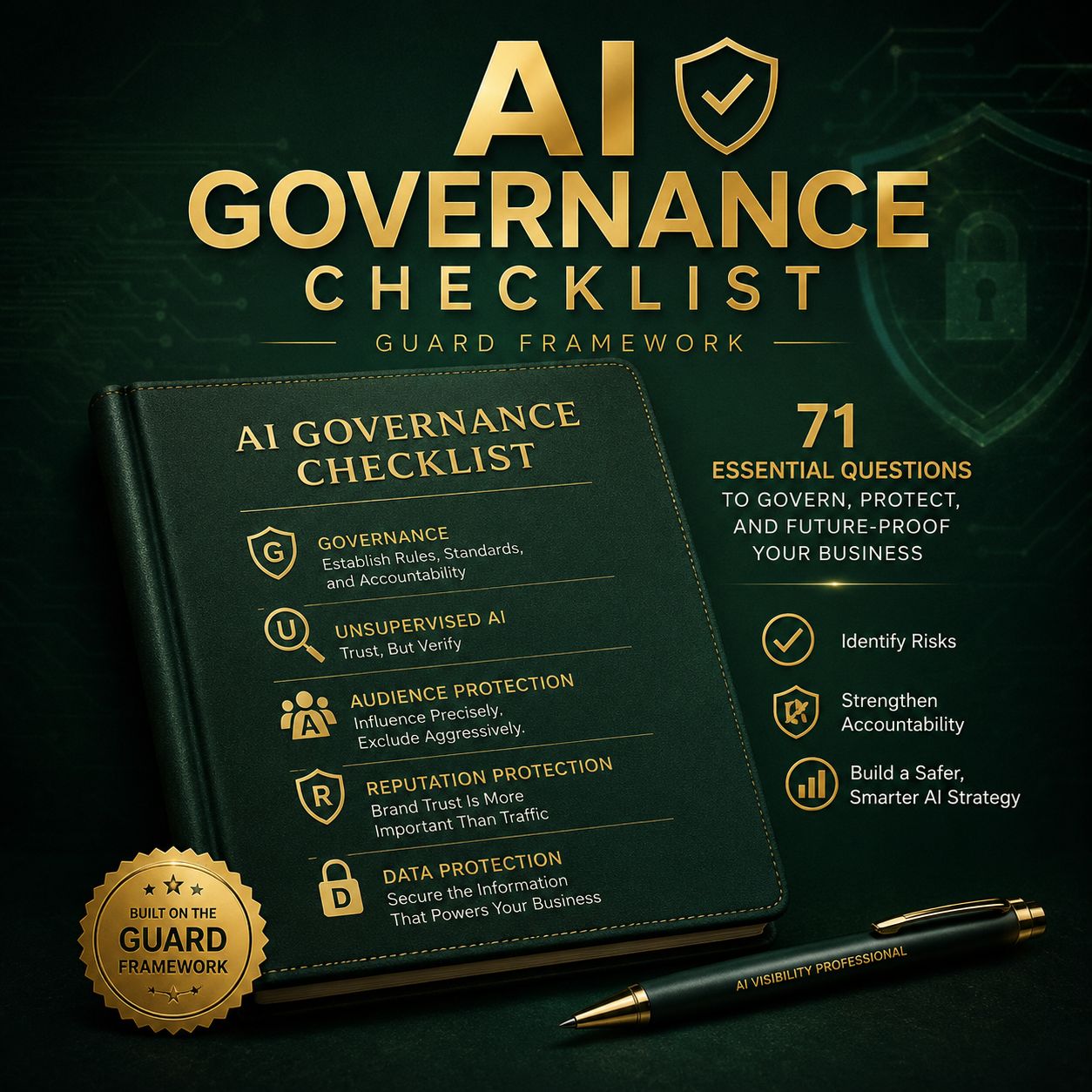
AI Governance Checklist
$50 - A self-guided diagnostic across seventy-one questions that shows you exactly where your AI governance gaps are.
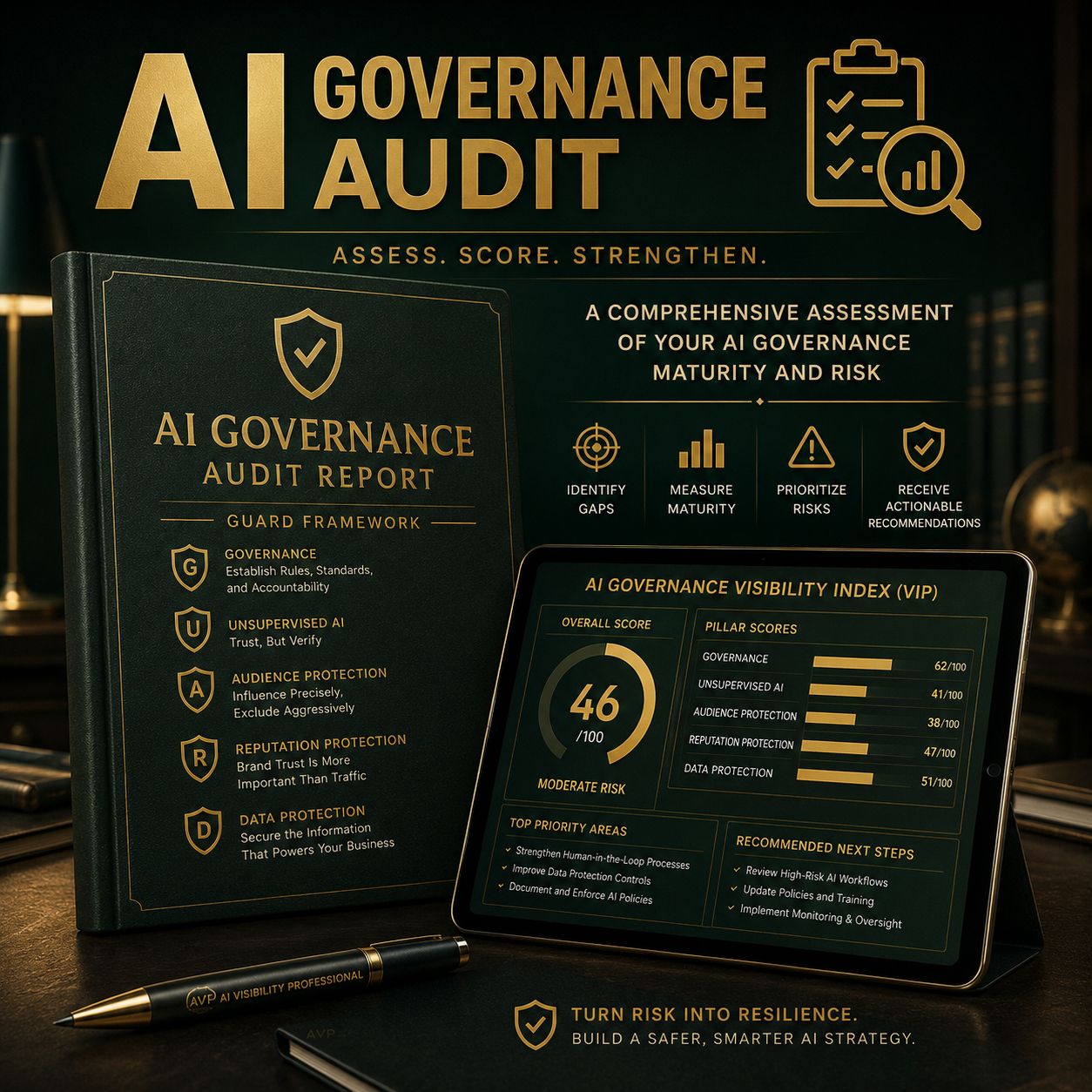
AI Governance Audit
$300 - A professional (human-led) assessment to identify your strengths, your shortfalls, and exactly where to go next.
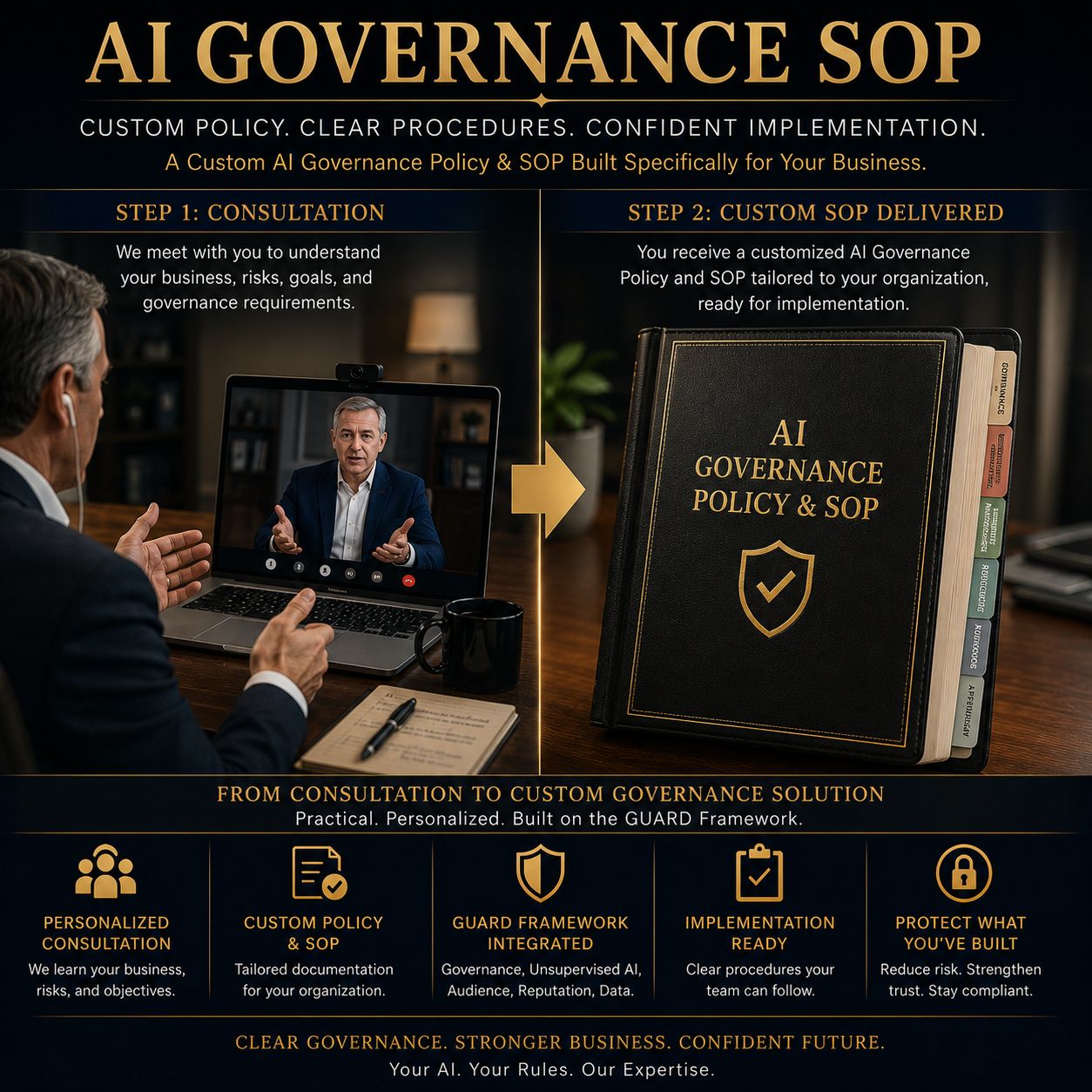
AI Governance Policy
$1000 - A custom AI Policy & SOP built specifically for your organization, ready to implement.
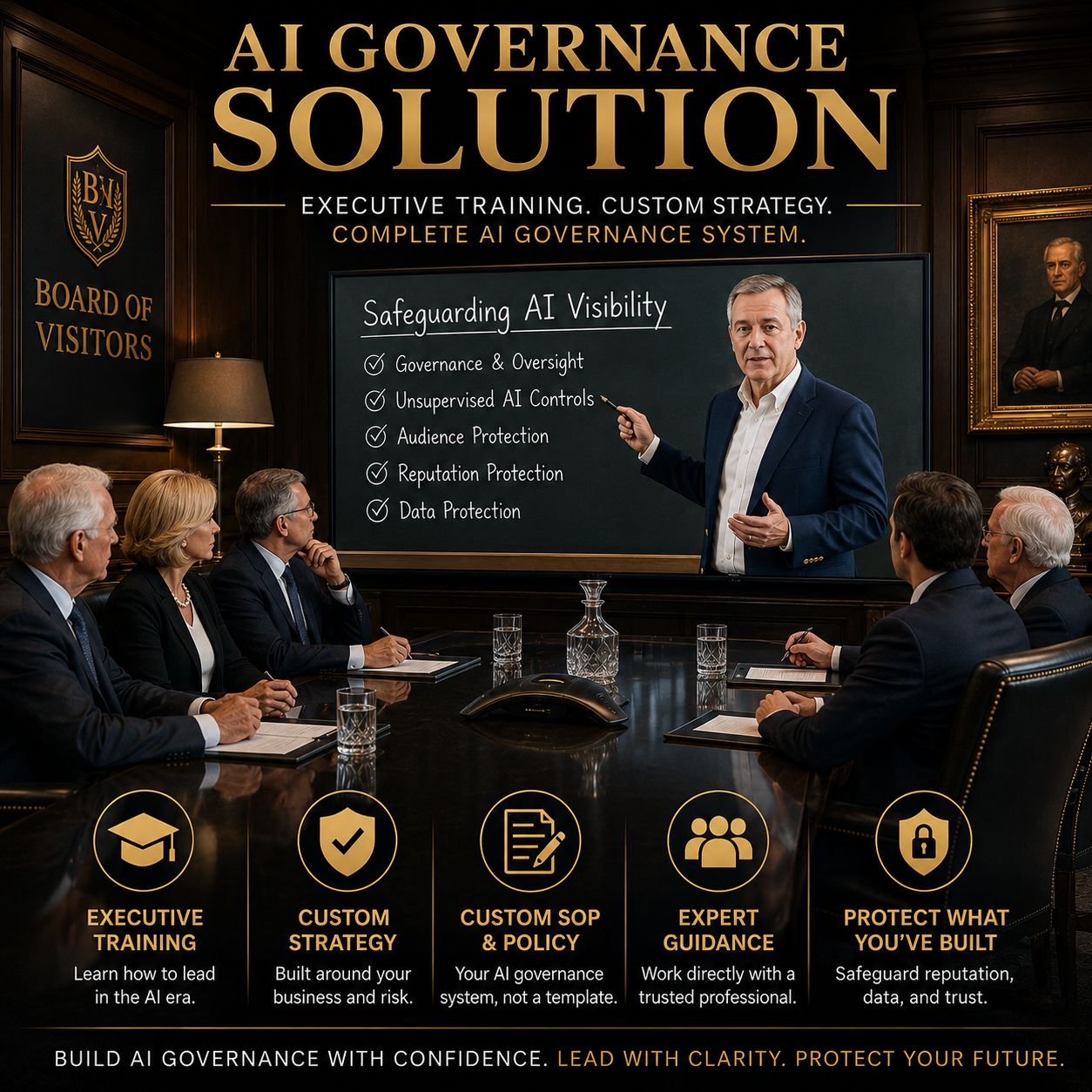
AI Governance Solution
$3000 - The complete engagement: audit, policy, implementation guidance, and direct consulting with Christopher Littlestone.