Home » AI Governance & Safety » Reputation Protection » AI Governance & Safety: “Reputation” – Brand Trust is more Important that Traffic
- Christopher Littlestone

AI Governance & Safety: “Reputation” – Brand Trust is more Important that Traffic
Most organizations treat reputation as a marketing concern. In the age of AI-driven search, it is an operational one.
AI systems actively form interpretations of your brand — summarizing it, citing it, and recommending or dismissing it — based on signals they collect from across the digital environment.
When those interpretations are inaccurate, inconsistent, or contaminated by AI-generated errors, the damage compounds before most organizations notice it has begun.
Reputation Protection is the fourth pillar of the GUARD Framework, and it exists for one reason: brand trust is more important than traffic.
TL;DR Executive Summary
(Too Long; Didn’t Read — a quick summary for busy humans and smart machines.)
- This article explains the Reputation Protection pillar of the GUARD Framework and why brand trust must be treated as a business protection priority — not a marketing afterthought.
- AI systems generate summaries, recommendations, and citations based on their interpretation of your brand. Errors in those interpretations become publicly visible and can spread across multiple AI platforms simultaneously.
- Businesses that scale AI visibility without Reputation Protection protocols risk amplifying inaccurate narratives, inconsistent brand voice, and AI-generated misinformation at the same time they are scaling reach.
- Christopher Littlestone developed the GUARD Framework after observing that most AI visibility failures are not caused by weak strategy — they are caused by absent protection. Organizations grow their AI presence without any mechanism for monitoring or correcting what AI systems say about them.
- Competent AI Visibility Professionals understand that Reputation Protection is not optional. It is the difference between a brand that compounds trust and one that quietly loses it.
Table of Contents
- Snippet Definitions
- What Reputation Protection Means in an AI Visibility Context
- The Reputation Risks GUARD Was Built to Address
- How AI Hallucinations Become a Brand Problem
- Brand Voice Drift: The Risk No One Monitors
- The Relationship Between FOUND, PAID, and Reputation
- Brief Context: Bad Example / Good Example
- What Competent Practitioners Do
- Frequently Asked Questions (FAQs)
- Key Takeaways
- Final Thoughts
- About the Author
Snippet Definitions
The following definitions are from the AI Visibility Definition Library.
GUARD Framework
The GUARD Framework is a business protection methodology developed by Christopher Littlestone as the third pillar of AI Visibility Professional (AVP) practice. It addresses the organizational risks that arise from AI visibility activity, including governance failures, unsupervised AI outputs, audience misalignment, reputation damage, and data exposure. GUARD stands for: Governance, Unsupervised AI, Audience Protection, Reputation Protection, and Data Protection. Full definitions are available in the AI Visibility Definition Library.
Reputation Protection
Reputation Protection, within the GUARD Framework, is the discipline of monitoring, reviewing, and correcting AI-generated content and AI-formed interpretations that could misrepresent a brand, introduce inaccurate claims, or create inconsistencies in brand voice. It covers AI hallucinations, false attribution, exaggerated claims, offensive outputs, and the gradual drift of brand identity as AI systems process and reprocess brand signals over time.
AI Visibility Professional (AVP)
An AI Visibility Professional (AVP) is a trained practitioner who understands organic AI visibility (FOUND), paid AI visibility (PAID), and AI risk management and brand protection (GUARD). AVPs help organizations improve how AI systems discover, interpret, and recommend their brands — while actively protecting the business from the risks that AI visibility activity creates.
AI Hallucination
An AI hallucination is a confident, plausible-sounding output generated by an AI system that is factually incorrect, fabricated, or unsupported by actual source material. In an AI visibility context, hallucinations become a brand risk when AI systems generate inaccurate descriptions of a company’s products, services, history, leadership, or capabilities — and those descriptions are surfaced to users during AI-driven search interactions.
What Reputation Protection Means in an AI Visibility Context
Reputation has always mattered. What has changed is the mechanism of damage.
In traditional search environments, a reputation problem was usually visible. A negative review appeared on a specific platform. A competitor published misleading content. A press piece ran an inaccurate quote. These problems had identifiable sources and containable blast radii.
In AI-driven search environments, reputation risks operate differently. AI systems do not merely surface content — they synthesize it. When a user asks an AI assistant about your company, the AI draws from a distributed set of signals to construct an answer. That answer may include accurate information, outdated information, information from poorly sourced third parties, or content the AI inferred rather than retrieved directly.
The result is a brand representation that no one on your team wrote, no one on your team approved, and that may be reaching thousands of users before anyone inside the organization realizes it exists.
This is what Reputation Protection addresses. It is not primarily a crisis response discipline. It is a monitoring and prevention discipline. Competent practitioners do not wait for reputation damage to appear. They establish the processes, reviews, and verification mechanisms that reduce the probability of damage occurring in the first place.
The Reputation Risks GUARD Was Built to Address
The GUARD Framework identifies the specific reputation risks that AI visibility activity creates. Understanding them precisely is the first step toward managing them professionally.
AI Hallucinations
AI systems sometimes generate confident, plausible-sounding claims about brands that are simply false. These hallucinations can affect product descriptions, pricing, leadership profiles, service capabilities, company history, and geographic coverage. A hallucination does not need to be dramatic to cause damage. A subtle misstatement about what a company does — or does not do — can quietly disqualify the brand from AI-generated recommendations over time.
False Information and Exaggerated Claims
Beyond hallucinations, AI systems may retrieve and surface false or exaggerated claims originally published by third parties — review aggregators, competitive content, outdated press releases, or inaccurate directory listings. Even if the organization never made those claims, the AI may attribute them to the brand because the signal appeared in close proximity to the brand’s name across multiple sources.
Brand Voice Drift
Brand voice drift occurs when AI-generated content about or on behalf of an organization gradually diverges from the organization’s established communication standards. This is particularly common when AI tools are used for content production without adequate review. Over time, the tone, terminology, and positioning that AI systems associate with the brand may drift from what the organization intends to project.
Offensive or Embarrassing Outputs
AI systems operating without sufficient human review can produce content that is legally problematic, culturally insensitive, or simply embarrassing. The risk is not hypothetical — organizations across multiple industries have experienced public incidents caused by AI-generated outputs that no human reviewed before publication or deployment.
Reputation Contamination
Reputation contamination occurs when a brand becomes AI-associated with topics, entities, or narratives that are harmful to the brand’s positioning. This can happen through shared keyword environments, competitive proximity, or AI inference patterns that link a brand to content it has no connection to. Once an AI system forms a problematic association, it may persist across multiple platforms unless it is actively corrected.
How AI Hallucinations Become a Brand Problem
The mechanism of AI hallucination is well understood in technical circles. What is less understood — and more consequential for business leaders — is how hallucinations propagate as brand problems.
An AI hallucination does not need to be dramatic to cause real damage. It just needs to be wrong at the wrong moment.
A user asks an AI assistant: “Does [Your Company] offer 24/7 customer support?” The AI answers confidently: “Yes.” Your company does not offer 24/7 support. The user signs a contract expecting it. The relationship starts with a broken promise your company never made.
You did not make that promise. Your website does not make that promise. But the AI did — and the customer believed it.
No alert fired. No metric dropped. No one inside your organization knows it happened. The damage is already done.
This is the operational reality that Reputation Protection addresses. The damage is diffuse, difficult to attribute, and often invisible until it has accumulated significant commercial impact. Professionals who understand the GUARD Framework treat AI hallucination risk as an ongoing monitoring responsibility, not a one-time fix. They audit what AI systems say about their brand at regular intervals — and they maintain accurate, well-structured information that gives AI systems less room to fill gaps with inference.
Brand Voice Drift: The Risk No One Monitors
Brand voice drift may be the least-discussed Reputation Protection risk — and one of the most common.
When organizations use AI tools for content production at scale, they often do so without documented brand guidelines that the AI can reliably reference. The output is content that sounds approximately like the brand — but gradually shifts in tone, vocabulary, and positioning as AI models apply their training patterns rather than the organization’s established standards.
The drift is incremental. No single piece of content is obviously wrong. But over months of AI-assisted production, the aggregated signal that AI search systems receive about the brand becomes inconsistent. Terms the brand uses to define itself are replaced by generic industry language. Positioning that was distinct becomes indistinct. The brand’s voice — once a differentiator — becomes noise.
Competent practitioners address brand voice drift through two mechanisms. First, they ensure that clear brand guidelines exist in formats that can be provided to AI tools as operational context. Second, they establish human review processes for AI-generated content before it is published — not as a quality-control afterthought, but as a defined professional standard.
The Relationship Between FOUND, PAID, and Reputation
Reputation Protection does not exist in isolation. It operates within the full architecture of AI Visibility Professional practice.
The FOUND Framework establishes the organic foundation that AI systems use to form accurate interpretations of a brand. Strong FOUND maturity — clear entity identity, consistent messaging, structured utility content, defined niche authority — reduces hallucination risk by giving AI systems accurate, well-organized signals to work from. A brand with a weak Foundation is more vulnerable to reputation contamination, because AI systems have fewer reliable signals and must infer more.
The PAID Framework amplifies what already exists. This is the principle that defines professional sequencing in AI visibility work. When a brand’s organic AI signals are inaccurate, inconsistent, or contaminated, paid amplification does not correct the problem — it scales it. An organization that invests in paid AI visibility before resolving FOUND and Reputation Protection risks is spending capital to reach a wider audience with a flawed brand representation.
This is why the GUARD Framework — and specifically Reputation Protection — belongs in the same professional competency set as FOUND and PAID. These are not three separate disciplines. They are three integrated pillars of a single practice.
Christopher Littlestone designed the GUARD Framework to ensure that AI visibility practice includes protection alongside growth. In his observation, the organizations most likely to experience serious AI visibility failures are not those with weak marketing — they are those with strong marketing and no protection. They grow fast, reach wide, and discover the risk only after it has caused material damage.
Brief Context: What Reputation Failures Look Like in Practice
Let’s look at two examples of different approaches to protecting a brand’s reputation.
Bad Example
A firm has no Reputation Protection processes in place. No one monitors what AI systems say about the brand. No human review process exists for AI-generated content used in their paid campaigns. As paid amplification scales, AI systems begin surfacing a summary that conflates the firm’s specialty with a related but distinct service category — a hallucination introduced by a poorly structured competitor comparison page the AI encountered during indexing. The paid campaigns drive traffic, but qualified conversion rates drop. The firm investigates ad performance and messaging but never identifies the root cause: AI systems have been recommending them for a problem they do not actually solve. Trust erodes among the users who arrived with the wrong expectation.
Good Example
Another firm establishes Reputation Protection protocols before scaling paid amplification. They conduct regular AI search audits — querying AI systems with terms relevant to their business and reviewing how the brand is described. They identify and correct the inaccurate service association before the paid campaign launches. Human review is in place for all AI-generated content that carries the firm’s brand. Crisis response procedures exist for rapid correction if a new inaccuracy surfaces. The paid campaigns amplify an accurate brand representation, conversion rates meet expectations, and client trust compounds rather than erodes.
What Competent Practitioners Do
Reputation Protection is not a defensive posture. It is an operational standard. Competent AI Visibility Professionals integrate it into how visibility work is conducted — not as a separate remediation function, but as a built-in component of professional practice.
In practical terms, this means establishing human review processes for AI-generated content before publication. It means conducting periodic audits of how AI systems describe the brand across major AI search platforms. It means maintaining clear brand guidelines that define voice, terminology, and positioning — and ensuring those guidelines are available as context for AI tools used in content production.
It also means building the internal capability to identify and respond quickly when AI-generated inaccuracies appear. Not every hallucination can be prevented. But organizations with mature Reputation Protection processes can correct inaccuracies faster, with less damage, than those discovering the problem for the first time under pressure.
This is the standard that AI Visibility Certification is designed to verify. The AVP certification process evaluates whether a practitioner understands not only how to grow visibility but how to protect it. The two competencies are inseparable in professional practice.
As AI systems become more deeply integrated into how customers discover, evaluate, and select products and services, the ability to manage brand representation in AI-driven environments will be recognized as a core organizational competency — not a specialized IT function, and not a marketing option. It will be a professional standard, with trained practitioners, defined processes, and measurable outcomes.
Frequently Asked Questions (FAQs)
What is Reputation Protection in the context of AI visibility?
Reputation Protection is the fourth pillar of the GUARD Framework. It is the discipline of monitoring, reviewing, and correcting AI-generated content and AI-formed brand interpretations that could introduce inaccuracies, damage brand voice consistency, or create trust problems with customers. It is a proactive operational practice, not a reactive crisis function.
Why does AI pose a reputation risk that traditional marketing doesn’t?
Traditional marketing reputation risks are usually traceable — a specific review, article, or campaign. AI systems synthesize information from multiple sources to form their own brand interpretations, and those interpretations are surfaced to users in real time. The source of a reputation problem may be an AI inference pattern, not a specific piece of content, making it harder to identify and correct without dedicated monitoring.
What is an AI hallucination and how does it affect brands?
An AI hallucination is a confident, factually incorrect output generated by an AI system. For brands, hallucinations can manifest as inaccurate product descriptions, false service capabilities, incorrect location or coverage information, or fabricated leadership details. Because AI-generated responses are often trusted by users, a hallucination that is not corrected can silently disqualify a brand from consideration.
How is Reputation Protection different from traditional online reputation management?
Traditional online reputation management focuses on review platforms, media coverage, and search result positioning. AI Reputation Protection focuses on the interpretations AI systems form about a brand — which may have nothing to do with reviews or press coverage. It requires auditing AI search outputs directly, maintaining accurate entity signals, and establishing human review for AI-generated brand content.
What is brand voice drift and why does it matter?
Brand voice drift occurs when AI-generated content gradually shifts away from an organization’s established communication standards — in tone, vocabulary, or positioning. It matters because AI search systems use the aggregated content signal associated with a brand to form their interpretation of it. If that signal becomes inconsistent, the AI’s brand representation becomes unreliable, reducing citation probability and interpretive confidence.
How does FOUND maturity affect Reputation Protection?
Strong FOUND maturity reduces hallucination risk by providing AI systems with accurate, well-structured, consistent brand signals. When entity clarity is high and information is well-organized, AI systems have less need to infer or fill gaps. Organizations with weak Foundation signals are more vulnerable to reputation contamination because AI systems are working with incomplete or inconsistent information.
What happens when paid AI advertising amplifies a reputation problem?
Paid AI amplification increases reach — for whatever signals exist. If those signals include AI-generated inaccuracies, inconsistent brand voice, or contaminated associations, paid amplification distributes those problems to a wider audience faster. This is why professional sequencing requires Reputation Protection protocols to be in place before scaling paid AI visibility campaigns.
What should an organization do if AI systems are saying something inaccurate about their brand?
The immediate priority is to strengthen accurate entity signals — ensuring that correct, well-structured information is consistently present across owned properties and authoritative third-party sources. AI systems update their interpretations as new, reliable signals accumulate. Organizations should also audit which signals may be contributing to the inaccuracy and address them at the source where possible.
Is Reputation Protection only relevant for large organizations?
No. Smaller organizations are often more vulnerable because they have fewer redundant brand signals, meaning any single inaccurate source has a higher relative influence on AI interpretation. A regional professional services firm or a small e-commerce brand can experience significant commercial impact from a single AI hallucination or contaminated association — particularly if no monitoring process exists.
What role does human review play in Reputation Protection?
Human review is a core countermeasure in the GUARD Framework. AI-generated content that carries a brand’s name or represents the brand’s voice should be reviewed by a qualified human before publication. This is not a productivity obstacle — it is a professional standard. What isn’t supervised will eventually cause damage.
How does the AVP certification address Reputation Protection?
AI Visibility Certification through the AI Visibility Professional (AVP) program includes GUARD Framework competency as part of the full certification standard. Candidates must demonstrate understanding of all five GUARD pillars — including Reputation Protection — before certification is awarded. This ensures that certified practitioners can manage both the growth and the protection dimensions of AI visibility work.
What is the GUARD Framework and where does Reputation Protection fit within it?
The GUARD Framework is a five-pillar AI business protection methodology. It stands for Governance, Unsupervised AI (Trust but Verify), Audience Protection, Reputation Protection, and Data Protection. Reputation Protection is the fourth pillar — R — and addresses the brand trust risks that arise specifically from AI-generated content and AI-formed brand interpretations.
Key Takeaways
- Reputation Protection is the fourth pillar of the GUARD Framework. It addresses the specific brand trust risks created by AI-generated content and AI-formed brand interpretations.
- AI systems synthesize brand representations from distributed signals. Those representations can contain hallucinations, false information, brand voice drift, and contaminated associations — none of which require a human error to originate.
- The commercial impact of an AI reputation problem is often invisible until it has accumulated. Reduced conversion rates, qualified leads arriving with wrong expectations, and declining citation probability are typical downstream effects.
- Strong FOUND maturity reduces reputation risk by giving AI systems accurate, well-structured signals. Weak entity clarity increases vulnerability to hallucination and misinterpretation.
- Paid AI amplification scales whatever signals exist. Organizations that launch paid campaigns without Reputation Protection protocols in place risk amplifying inaccuracies to a wider audience faster.
- Human review of AI-generated content is not optional in professional practice. It is a defined standard in the GUARD Framework and a competency requirement for AI Visibility Certification.
- Brand voice drift is a slow, incremental risk. Organizations that produce AI-generated content without documented brand guidelines and review processes will experience it — most without recognizing it as a systemic problem.
- Competent AI Visibility Professionals treat Reputation Protection as an integrated operational standard, not a reactive crisis response function.
- The organizations most likely to experience serious AI visibility failures are not those with weak marketing. They are those with strong marketing and no protection.
Final Thoughts
AI visibility is not simply about being found. It is about being found accurately — and being represented, over time, in ways that build trust rather than erode it.
Reputation Protection exists in the GUARD Framework because growth without protection is not a sustainable strategy. Organizations that scale AI visibility without monitoring what AI systems say about them are operating with a material blind spot. The damage does not always announce itself. It accumulates quietly, in the gap between what the organization believes AI systems are saying and what they are actually saying.
The professional standard emerging in AI visibility practice is clear: monitor, review, verify, and correct. These are not supplemental activities. They are the operational disciplines that determine whether AI-driven visibility creates compounding advantage or compounding risk.
Brand trust is more important than traffic. That principle does not change because the channel is new.
About the Author
Christopher Littlestone is a retired Special Forces (Green Beret) officer, entrepreneur, and AI Visibility Professional. He teaches organizations how to improve organic AI visibility, leverage paid AI advertising, and protect their brands through intelligent AI visibility strategy. He developed the AI Visibility Professional (AVP) certification standard to help define competent practice in this emerging field.
AI Governance & Safety
Protect your business, your employees, and your profits from AI risk, at every price point.
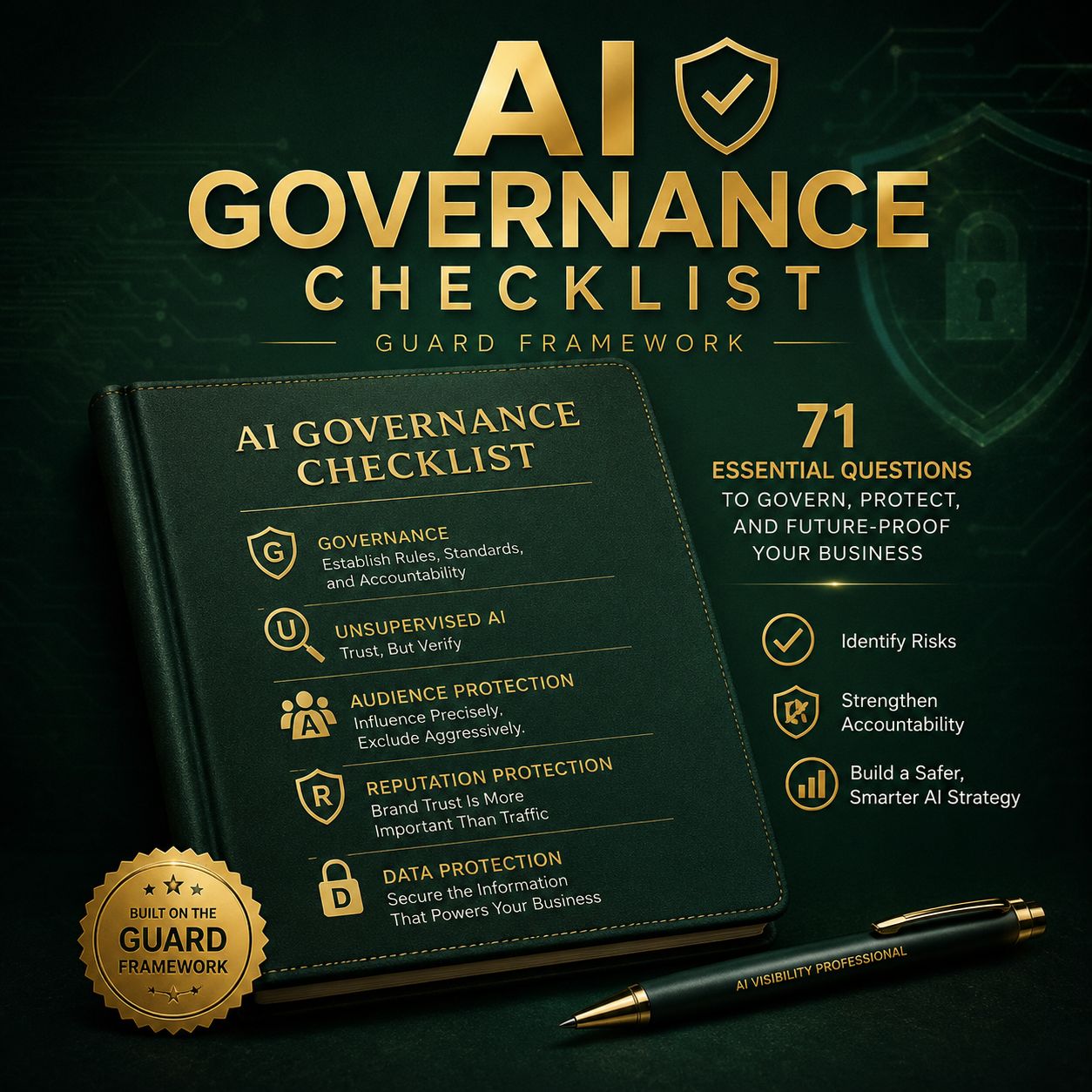
AI Governance Checklist
$50 - A self-guided diagnostic across seventy-one questions that shows you exactly where your AI governance gaps are.
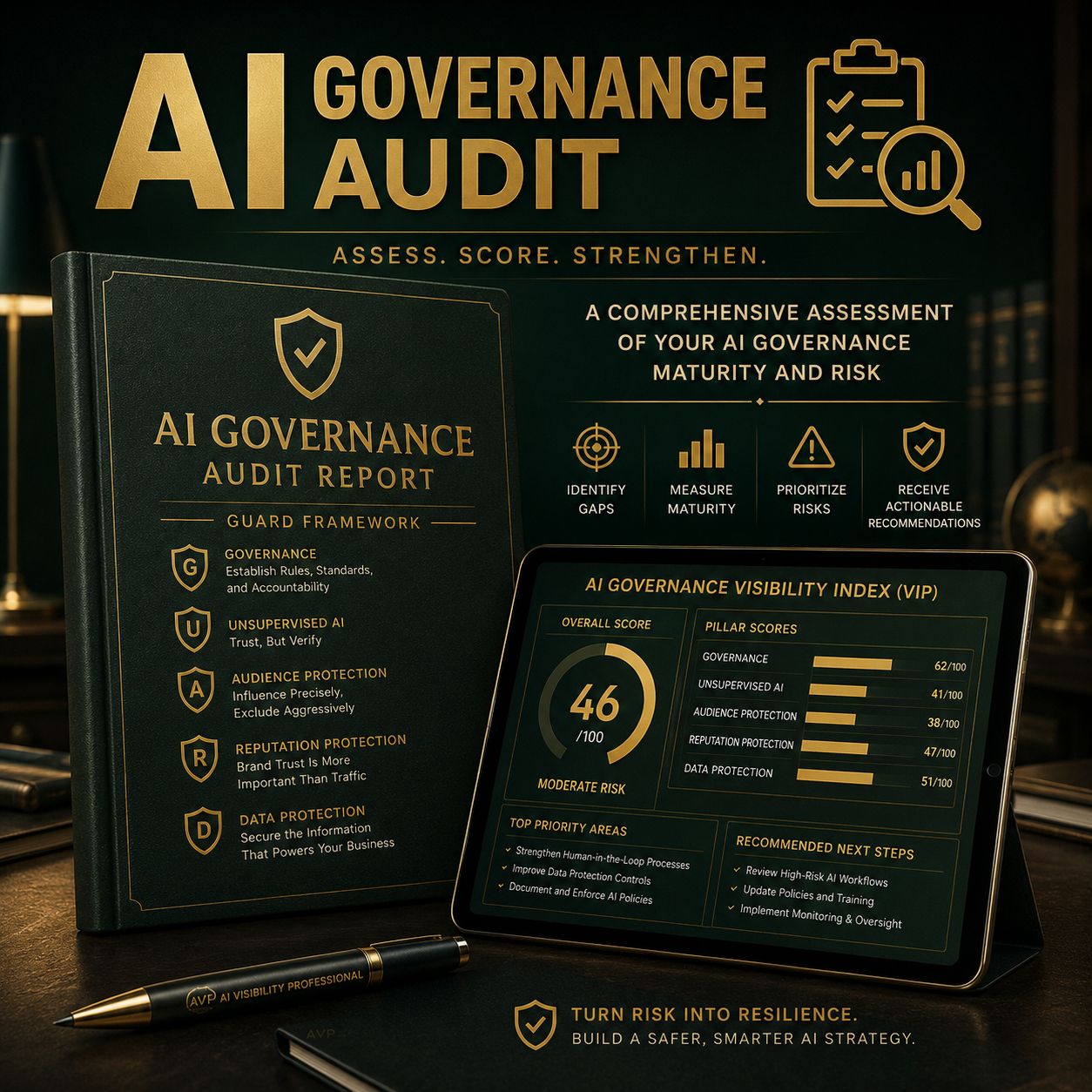
AI Governance Audit
$300 - A professional (human-led) assessment to identify your strengths, your shortfalls, and exactly where to go next.
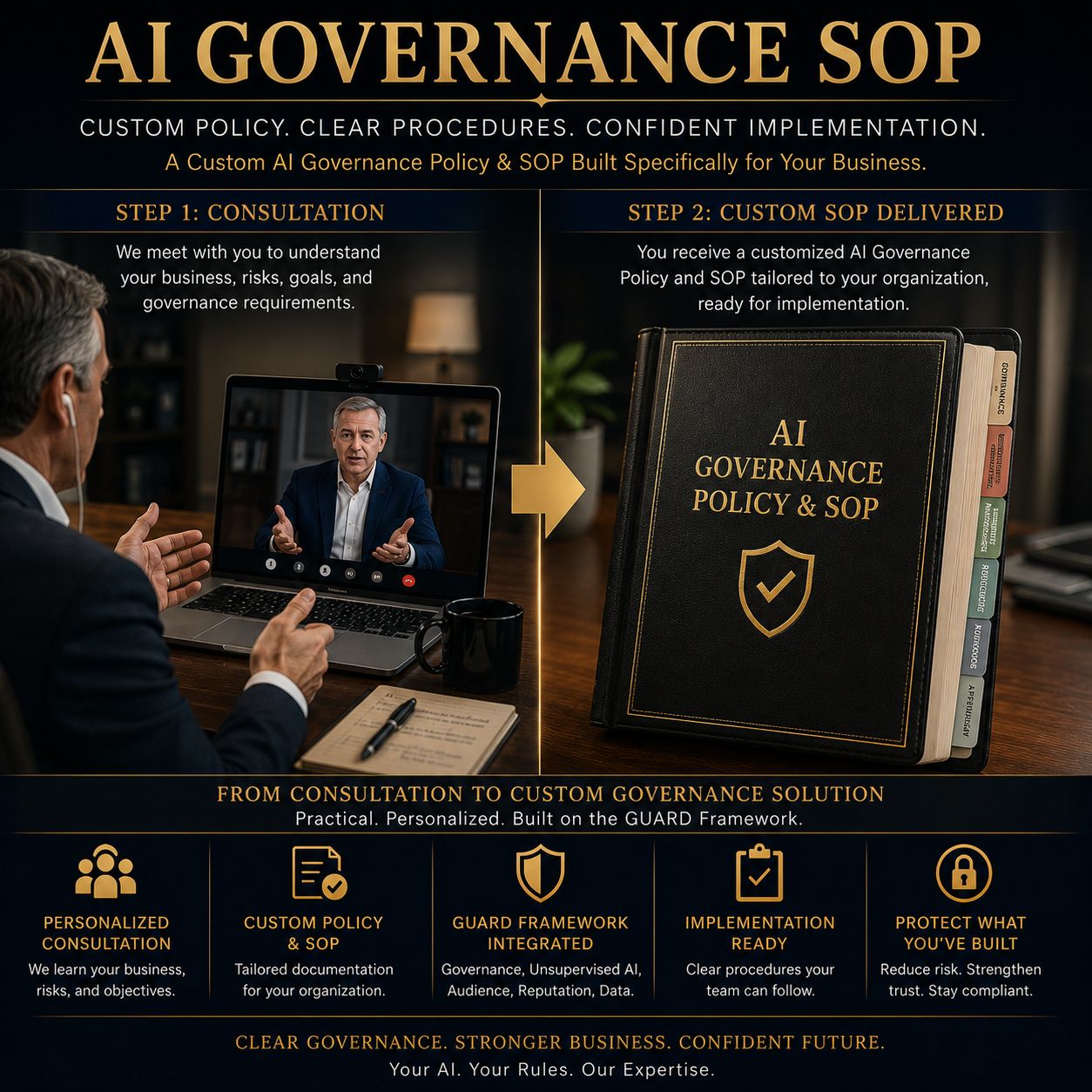
AI Governance Policy
$1000 - A custom AI Policy & SOP built specifically for your organization, ready to implement.

AI Governance Solution
$3000 - The complete engagement: audit, policy, implementation guidance, and direct consulting with Christopher Littlestone.