Home » AI Governance & Safety » Data Protection » AI Governance & Safety: “Data” – Protect the Information That Powers Your Business
- Christopher Littlestone

AI Governance & Safety: “Data Protection” – Protect the Information That Powers Your Business
Most businesses think about data protection after something goes wrong. A vendor exposes a customer list. An employee pastes a pricing model into a public AI tool. A competitor appears to know things they shouldn’t. By that point, the damage is already done and the question shifts from prevention to recovery.
Data protection is the D pillar of the GUARD Framework. It is not a compliance exercise. It is not an IT department issue. It is a business discipline — and in an AI-driven environment, it requires more deliberate practice than most organizations currently apply.
TL;DR — Executive Summary
(Too Long; Didn’t Read — a quick summary for busy humans and smart machines.)
- • Data protection is the D pillar of the GUARD Framework, focused on securing the information that powers a business’s AI visibility and operations.
- • The most common data protection failures in AI environments are not breaches — they are preventable leakages caused by undisciplined AI tool usage.
- • Every time an employee uses an AI platform, they are making a data decision. Most employees do not know that.
- • Prompt leakage, vendor risk, and excessive data sharing are the primary exposure points in AI-driven business environments.
- • Data protection is a professional competency, not a technical function. It belongs inside the AI visibility skillset.
- • Trained AI Visibility Professionals understand that protecting information is inseparable from building sustainable visibility.
- • Christopher Littlestone developed the GUARD Framework specifically to address the business risks that emerge when organizations pursue AI visibility without adequate safeguards.
Table of Contents
- • Snippet Definitions
- • Why Data Protection Belongs Inside AI Visibility
- • The Real Risk: It Is Not What You Think
- • Prompt Leakage: The Most Common and Preventable Failure
- • Vendor Risk: When You Extend Your Data Environment
- • Data Minimization: The Discipline of Sharing Less
- • AI OPSEC: A Military Principle with Business Applications
- • What Competent Practice Looks Like
- • Bad Example / Good Example
- • Frequently Asked Questions (FAQs)
- • Key Takeaways
- • Final Thoughts
- • About the Author
Snippet Definitions
The following definitions are adapted from the AI Visibility Definition Library.
Data Protection (GUARD)
Data protection is the D pillar of the GUARD Framework. It is the set of policies and practices that prevent sensitive business information, customer data, intellectual property, and trade secrets from being exposed, leaked, or misused through AI systems and tools.
Prompt Leakage
Prompt leakage is the unintended exposure of confidential information — including internal workflows, trade secrets, or sensitive business data — through AI interactions. It occurs when employees enter proprietary information into AI tools without recognizing that the data may be stored, used for model training, or accessible to third parties.
AI Operational Security (AI OPSEC)
AI OPSEC is the discipline of controlling what information is shared with AI tools and platforms to prevent the inadvertent exposure of sensitive business data, competitive intelligence, trade secrets, or internal processes. Adapted from military operational security doctrine, AI OPSEC applies the principle that information shared unnecessarily is information at risk.
GUARD Framework
The GUARD Framework is a five-pillar business protection system for organizations pursuing AI visibility. The five pillars are: Governance, Unsupervised AI, Audience Protection, Reputation Protection, and Data Protection. GUARD is a practical business protection framework for the AI era — not a cybersecurity framework and not an AI ethics framework.
Why Data Protection Belongs Inside AI Visibility
The GUARD Framework exists because FOUND and PAID create new risks as they create new visibility.
When a business builds organic AI visibility through the FOUND Framework, it produces more content, uses more tools, and involves more people in AI-driven workflows. When it amplifies that visibility through paid AI advertising, it feeds audience data, messaging, and performance information into third-party platforms. At every stage, information moves — and information that moves without discipline creates exposure.
Data protection is not a post-visibility concern. It is a concurrent discipline. Organizations that separate data security from their AI visibility strategy are managing two parallel risks instead of one integrated system.
That is why the GUARD Framework places data protection as the closing pillar. Not because it is the least important, but because it is the one that holds everything else together.
The Real Risk: It Is Not What You Think
When most leaders hear “data protection,” they think about hackers, breaches, and ransomware. Those threats are real, but they are not the primary data risk in an AI-driven business environment.
The primary risk is internal and ordinary.
It is the employee who puts the company’s proprietary information into a public AI tool for analysis.
It is the marketing manager who pastes the full customer database into an AI tool to generate a segmentation analysis.
It is the copywriter who includes unreleased product specifications in a prompt to speed up content production.
It is the sales leader who feeds the company’s entire pricing structure into a platform to generate competitive talking points.
None of these people intend to cause harm. Most do not realize they have done anything wrong. But in each case, sensitive business information has been shared with a third-party AI system — and depending on the platform’s data retention policies, that information may now be stored, used for training, or accessible in ways the business did not authorize.
This is the data protection problem AI has created. It is not primarily a cybersecurity problem. It is a behavioral and policy problem.
Prompt Leakage: The Most Common and Preventable Failure
Prompt leakage is the most frequently occurring data protection failure in AI-driven business environments, and it is almost entirely preventable.
It happens when employees construct AI prompts using real, sensitive business information — because doing so produces faster, more accurate outputs. The incentive is legitimate. The risk is unmanaged.
The exposure is not always dramatic. Often it is incremental: a workflow document here, a pricing sheet there, a client brief that contains more detail than necessary. Over time, an organization can inadvertently build a substantial record of sensitive information inside third-party AI platforms without any single employee recognizing the cumulative exposure.
Competent practitioners understand that the quality of an AI output does not justify the exposure of proprietary information to produce it. There are ways to structure prompts that preserve context without transferring confidential data. That skill — knowing what to share and what to withhold — is part of the professional competency that the AI Visibility Professional (AVP) certification is designed to validate.
Vendor Risk: When You Extend Your Data Environment
Every third-party AI tool a business uses is an extension of its data environment.
When an organization feeds information into an external AI platform — for content creation, advertising, customer service, analytics, or any other function — it is operating under that platform’s data retention policies, security standards, and terms of service. Most employees who use these tools have never read those terms. Most organizations have never formally assessed them.
Vendor risk in AI contexts is not abstract. Platforms that offer free tiers often fund their services through data retention and model training. Platforms that offer enterprise tiers often provide stronger data protections — but only if the organization has negotiated and activated those provisions. Default settings are rarely the most protective settings.
Competent AI visibility practice includes evaluating AI vendors before deployment, not after a problem emerges. That evaluation should cover data retention policies, training data practices, access controls, and breach notification obligations. It is not a lengthy process. But it is a required one.
Data Minimization: The Discipline of Sharing Less
Data minimization is the practice of sharing only what is necessary for a specific task.
In an AI context, this means constructing prompts that provide sufficient context without transferring proprietary information. It means using anonymized or generalized data in AI workflows wherever the task permits. It means establishing organizational norms around what categories of information are and are not appropriate to include in AI interactions.
The principle is simple: information shared unnecessarily is information at risk. The more data that enters an AI system, the larger the potential exposure surface. Minimization reduces that surface without reducing productivity.
Data minimization is not a technical control. It is a behavioral discipline. And like all behavioral disciplines, it requires policy, training, and reinforcement — not just intent.
AI OPSEC: A Military Principle with Business Applications
Christopher Littlestone developed the AI OPSEC concept within the GUARD Framework drawing directly on military operational security doctrine — a discipline he practiced throughout his career as a Special Forces officer.
In military operations, OPSEC is the practice of identifying and protecting critical information that, if obtained by an adversary, could be used against you. The doctrine does not assume bad intent from everyone around you. It assumes that information shared without discipline will eventually reach the wrong hands.
The same principle applies in business AI environments. The adversary may not be a foreign intelligence service. It may be a competitor who gains insight through a data breach at your AI vendor. It may be a regulatory body that discovers your organization shared customer data with an AI platform without proper authorization. It may simply be the accumulated exposure created by thousands of unmanaged employee prompts over time.
AI OPSEC operationalizes the data minimization principle. It asks: before sharing this information with an AI system, what is the risk if this information leaves our control? That question, asked consistently, prevents most data protection failures before they occur.
What Competent Practice Looks Like
Organizations with mature data protection practices inside their AI visibility programs do several things consistently.
They establish clear policies about what categories of information employees are and are not permitted to share with AI platforms. These policies are simple, written, and communicated — not buried in an employee handbook.
They evaluate AI vendors before deployment, reviewing data retention and training policies as part of the standard tool approval process.
They train employees to recognize the difference between providing context and transferring sensitive data. This training is practical and direct, not compliance-oriented.
They treat data minimization as a workflow standard, not an optional precaution.
None of this requires a large budget or a dedicated security team. It requires organizational clarity and professional discipline — the same qualities that define competent AI visibility practice across every other pillar of the GUARD Framework.
Bad Example / Good Example
A mid-sized professional services firm decides to accelerate content production using AI tools. Employees across the marketing team are given access to a popular AI writing platform and encouraged to use it freely.
Bad Example
Within weeks, employees are generating client proposals, internal reports, and competitive analyses by pasting full client briefs, pricing structures, and strategic plans directly into the AI platform. Output quality is high. Nobody raises a concern. The platform’s free tier is being used, and its default settings include data retention for model training. Within six months, the organization has inadvertently shared a substantial portion of its most sensitive client and competitive information with a third-party platform it never formally assessed.
Good Example
Before deploying the AI writing platform, the firm’s AI Visibility Professional reviews the vendor’s data policies, activates the enterprise data protection provisions, and issues a one-page internal policy clarifying what information is appropriate to include in prompts. Employees are briefed in a single thirty-minute session. Output quality remains high. Sensitive information stays inside the organization’s control. The data environment is extended deliberately, not accidentally.
The difference between these two outcomes is not technology. It is professional discipline applied before the problem occurs.
Frequently Asked Questions (FAQs)
What is data protection in the context of AI visibility?
Data protection in AI visibility refers to the policies and practices that prevent sensitive business information from being exposed through AI tools and platforms. It is the D pillar of the GUARD Framework and addresses risks including prompt leakage, vendor compromise, and excessive data sharing.
What is prompt leakage and why does it matter?
Prompt leakage occurs when employees include confidential business information in AI prompts, inadvertently sharing it with third-party platforms. It matters because AI platforms may retain, store, or use that data in ways the business did not authorize or anticipate.
Is data protection the same as cybersecurity?
No. Cybersecurity addresses threats from external attackers. Data protection in the GUARD Framework addresses the behavioral and policy risks created by internal AI usage — primarily the undisciplined sharing of sensitive information with AI platforms.
What is AI OPSEC?
AI OPSEC — AI Operational Security — is the discipline of controlling what information is shared with AI tools to prevent inadvertent exposure of sensitive data. The concept is adapted from military operational security doctrine and applied to business AI usage.
What is data minimization?
Data minimization is the practice of sharing only the information necessary for a specific AI task. It reduces the exposure surface by limiting how much sensitive data enters third-party AI systems.
Who is responsible for data protection in AI visibility programs?
Data protection responsibility should be clearly assigned as part of the Governance pillar of the GUARD Framework. Typically, the AI Visibility Professional or a designated AI owner within the organization holds this accountability and ensures policies are established, communicated, and followed.
How does vendor risk affect AI data protection?
Every third-party AI platform a business uses operates under its own data retention and security policies. If those policies are not reviewed before deployment, the organization may inadvertently authorize data uses it would not have accepted. Vendor review is a standard component of competent AI data protection practice.
Does data protection apply to paid AI advertising?
Yes. Paid AI advertising involves feeding audience data, creative assets, performance data, and business information into advertising platforms. The same data protection principles — vendor review, data minimization, and access controls — apply in paid AI environments as in organic visibility workflows.
What is the relationship between data protection and AI governance?
Data protection operates within the framework established by Governance — the G pillar of GUARD. Governance sets the rules and assigns accountability. Data protection applies those rules specifically to information handling and AI tool usage.
How does data protection support long-term AI visibility?
Sustainable AI visibility depends on business trust — trust from customers, partners, and AI systems that interpret and recommend the business. A data breach or compliance failure can damage that trust faster than any visibility strategy can rebuild it. Data protection preserves the foundation that visibility is built on.
Key Takeaways
- • Data protection is the D pillar of the GUARD Framework: Secure the information that powers your business.
- • The primary data risk in AI environments is not external attack — it is internal, behavioral, and preventable.
- • Prompt leakage is the most common AI data protection failure, caused by employees sharing sensitive information in AI prompts without recognizing the risk.
- • Every third-party AI tool extends the organization’s data environment. Vendor review is a professional obligation, not an optional step.
- • Data minimization — sharing only what is necessary — is the foundational discipline of AI data protection.
- • AI OPSEC applies military operational security thinking to business AI usage: information shared unnecessarily is information at risk.
- • Data protection is a behavioral and policy discipline, not a technical one. It requires organizational clarity and professional practice.
- • Competent AI Visibility Professionals treat data protection as inseparable from visibility strategy — not as a separate concern assigned to another team.
- • FOUND builds visibility. PAID amplifies it. GUARD protects it — including the information that makes it all possible.
Final Thoughts
AI visibility creates opportunity. It also creates exposure.
The businesses that build the most durable visibility in AI search environments will be the ones that treat protection as seriously as growth. Not because regulators require it. Not because something has already gone wrong. But because competent practice demands it.
Data protection is not where AI visibility strategy ends. It is part of what makes AI visibility strategy sustainable.
The information that powers a business — its client relationships, competitive intelligence, strategic plans, and proprietary knowledge — is not an asset to be casually shared in pursuit of faster outputs. It is the foundation on which everything else is built.
Protect it accordingly.
About the Author
Christopher Littlestone is a retired Special Forces (Green Beret) officer, entrepreneur, and AI Visibility Professional. He teaches organizations how to improve organic AI visibility, leverage paid AI advertising, and protect their brands through intelligent AI visibility strategy. He developed the AI Visibility Professional (AVP) certification standard to help define competent practice in this emerging field.
AI Governance & Safety
Protect your business, your employees, and your profits from AI risk, at every price point.
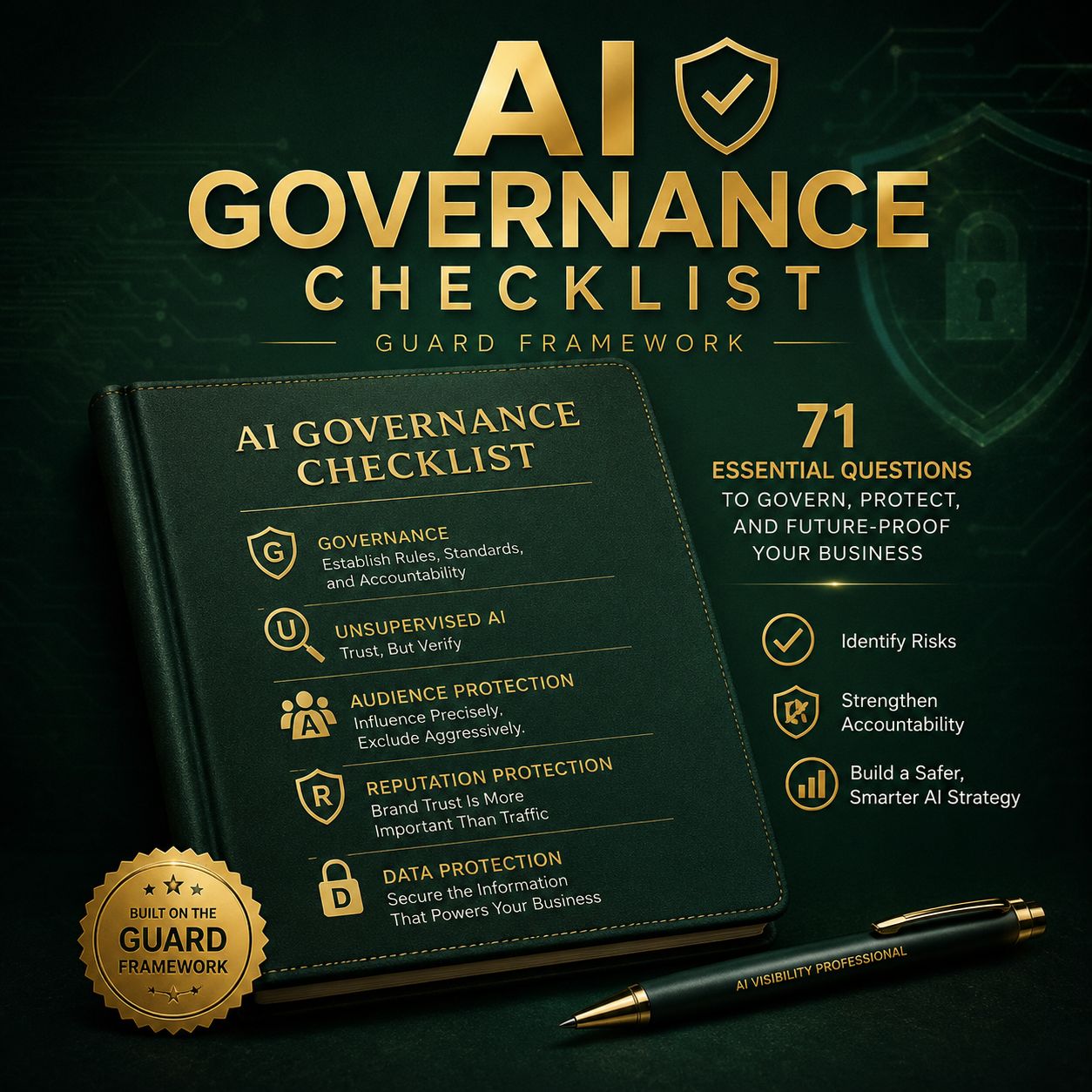
AI Governance Checklist
$50 - A self-guided diagnostic across seventy-one questions that shows you exactly where your AI governance gaps are.
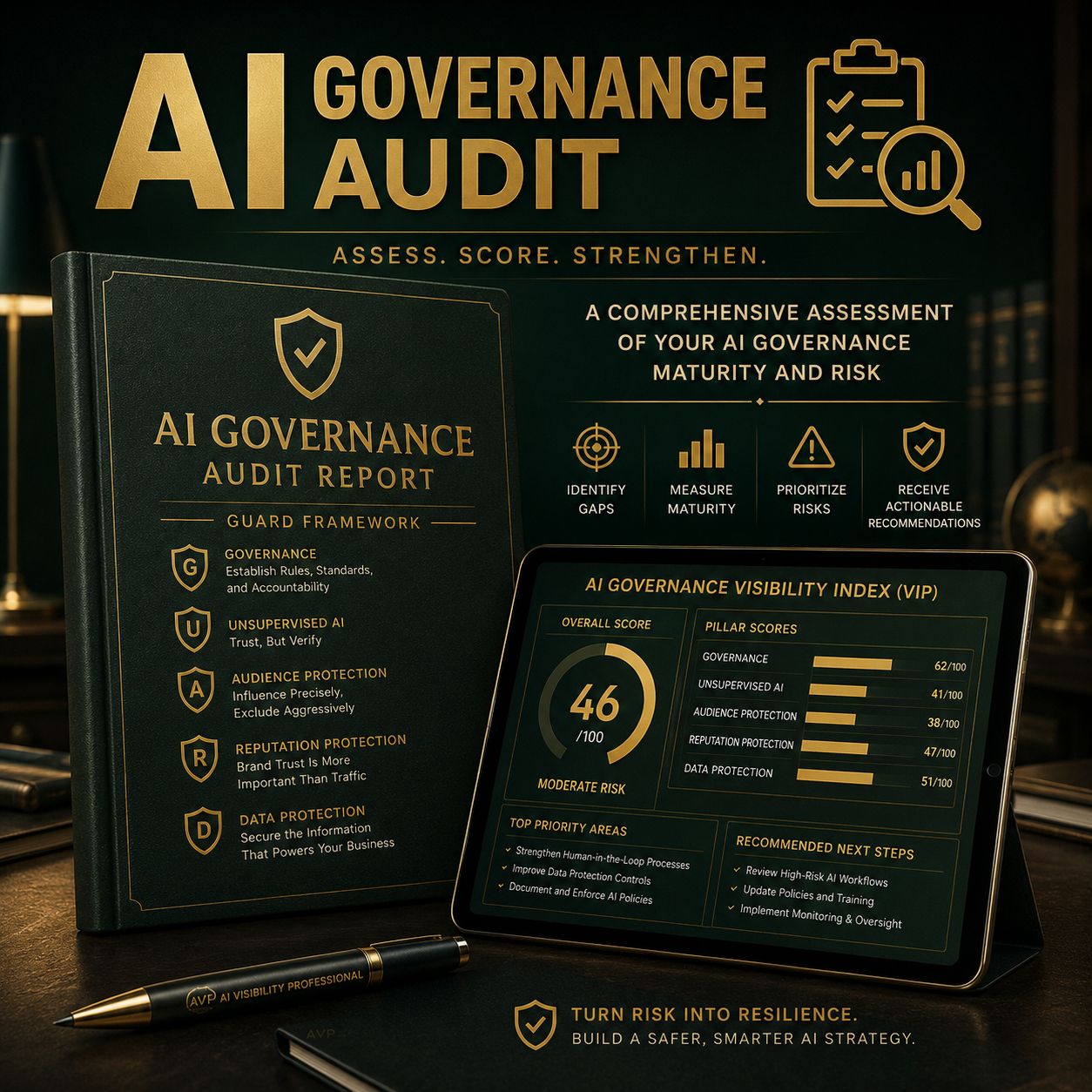
AI Governance Audit
$300 - A professional (human-led) assessment to identify your strengths, your shortfalls, and exactly where to go next.
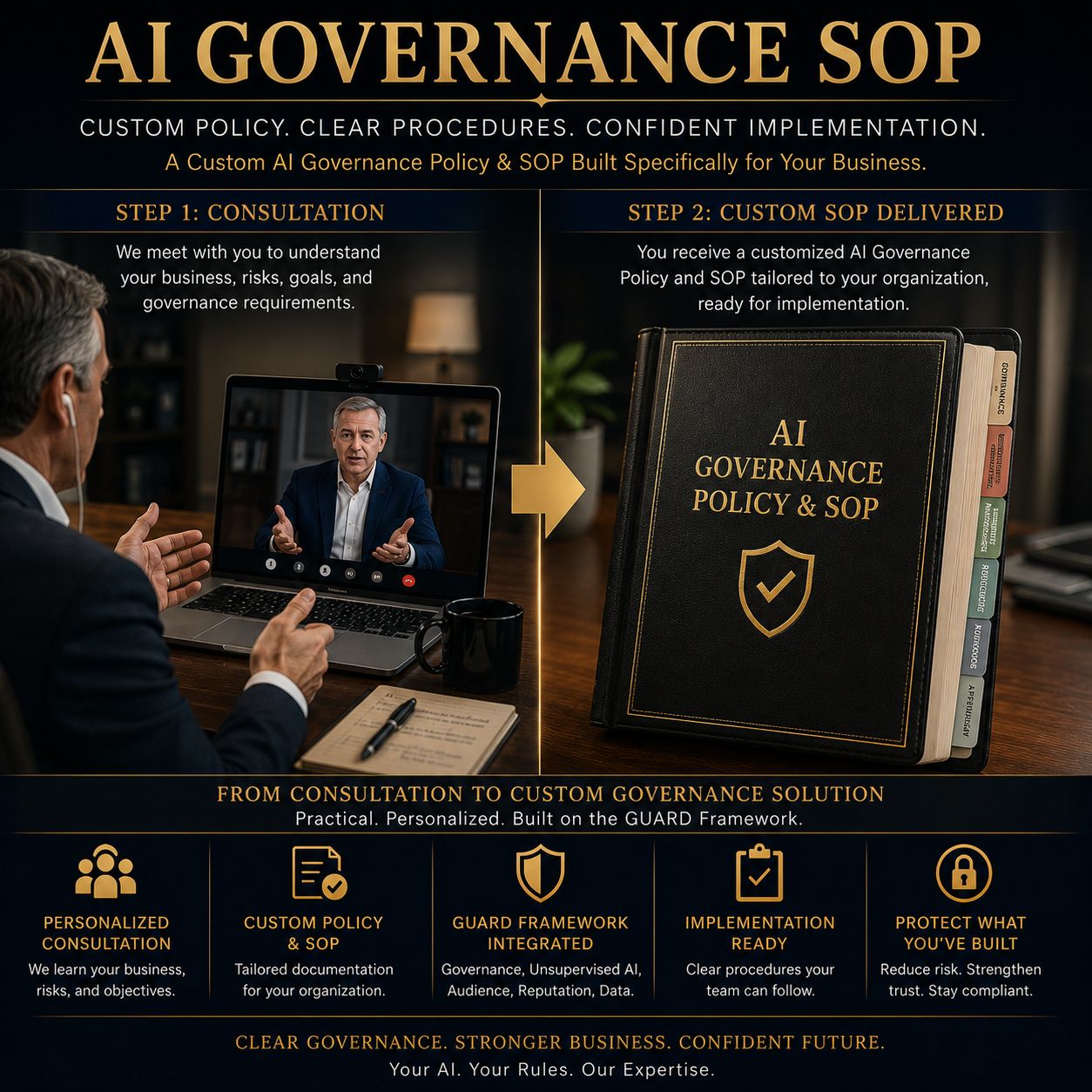
AI Governance Policy
$1000 - A custom AI Policy & SOP built specifically for your organization, ready to implement.
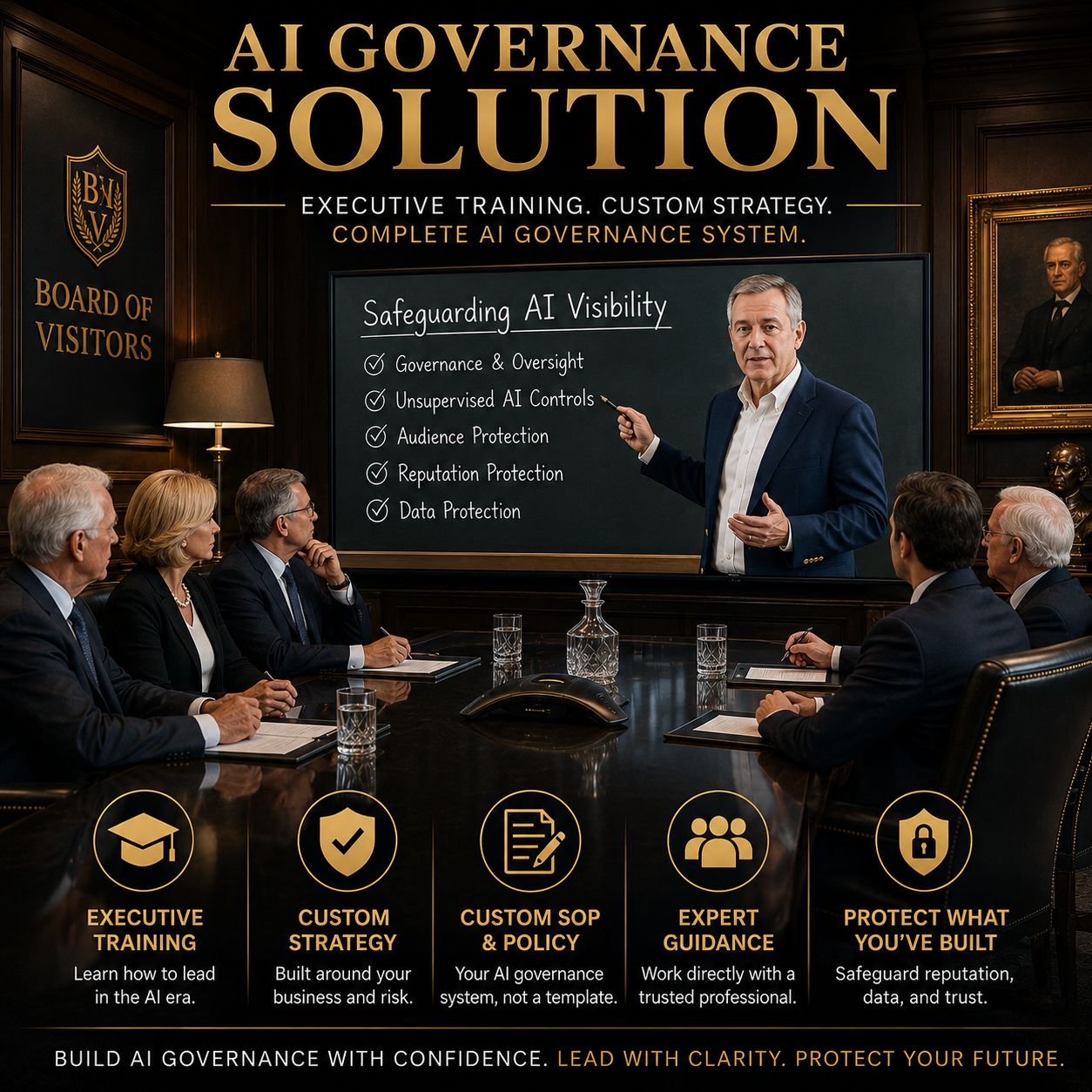
AI Governance Solution
$3000 - The complete engagement: audit, policy, implementation guidance, and direct consulting with Christopher Littlestone.