Home » AI Governance & Safety » Governance » AI Governance Standards: NIST, ISO 42001, TRAIGA Explained
- Christopher Littlestone
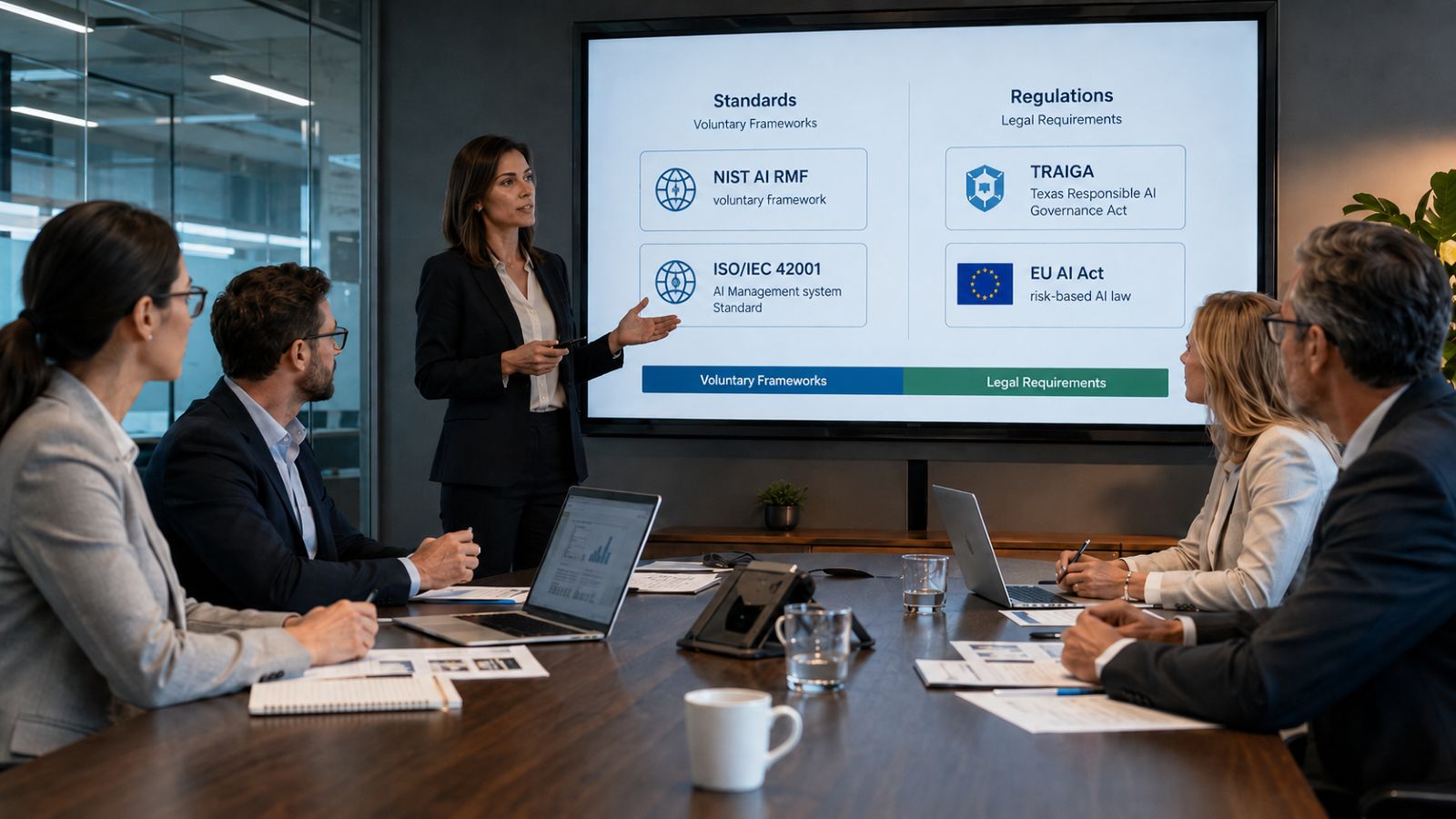
AI Governance Standards and Regulations: NIST, ISO 42001, and What Actually Applies to Your Business
Last Updated: September 3, 2026
NIST AI RMF. ISO/IEC 42001. TRAIGA. The EU AI Act. A new AI governance term shows up in the news every few weeks, and most of them were written with organizations far larger than yours in mind. If you run a 10 to 50 person business and you are trying to figure out which of these actually apply to you, which one is worth spending money on, and which ones you can safely set aside for now, here is the direct answer.
AI Governance Standards: AI governance standards are voluntary frameworks, such as the NIST AI Risk Management Framework and ISO/IEC 42001, that define structured practices for managing AI risk. They carry no legal penalty on their own for non-adoption, but they are increasingly used as evidence of due diligence under the regulations that do carry penalties.
TL;DR Executive Summary
- Standards are not regulations. The NIST AI Risk Management Framework and ISO/IEC 42001 are voluntary. The Texas Responsible AI Governance Act and the EU AI Act carry legal penalties for violation.
- NIST AI RMF is free and doubles as legal protection. It costs nothing to adopt, and Texas law grants an affirmative defense to businesses that substantially comply with it.
- ISO/IEC 42001 is built for a different business than yours, probably. Certification runs $20,000 to $60,000 and four to nine months. It matters most to AI vendors and enterprises that must prove governance maturity to customers or regulators, not to most 10 to 50 person businesses that simply use AI tools.
- TRAIGA applies more broadly than its name suggests. Effective January 1, 2026, it covers any business whose product or service reaches Texas residents, regardless of where the business is headquartered.
- The UN’s Global Dialogue on AI Governance is a signal, not a rule. It is a non-binding forum, first convened in Geneva in July 2026, that creates no current compliance obligation for any business.
- Christopher Littlestone’s GUARD Framework translates the top-down language of NIST and ISO into five pillars a 10 to 50 person business can run day to day, without a compliance department or a six-figure audit.
Table of Contents
- What’s the Difference Between an AI Governance Standard and an AI Governance Regulation?
- What Is the NIST AI Risk Management Framework, and Do You Need It?
- What Is ISO/IEC 42001, and Does Your Business Need Certification?
- What Does the Texas Responsible AI Governance Act (TRAIGA) Actually Require?
- Is a Global AI Governance Standard Coming?
- Where Does an AI Governance Framework Like GUARD Fit In?
- What Does a Small or Mid-Size Business Actually Need to Do?
- Summary Table
- Bad Example vs. Good Example
- Frequently Asked Questions (FAQs)
- Key Takeaways
- About the Author
- Final Thoughts
Snippet Definitions
The following definitions are adapted from the AI Visibility Definition Library.
AI Governance Standard: A voluntary technical or management framework, such as the NIST AI Risk Management Framework or ISO/IEC 42001, that defines structured practices for managing AI risk.
AI Governance Regulation: A binding law, such as TRAIGA or the EU AI Act, that carries legal penalties for specific prohibited or unmanaged AI uses.
NIST AI Risk Management Framework (AI RMF): A free, voluntary U.S. framework built around four functions, Govern, Map, Measure, and Manage, for identifying and managing AI risk across a system’s lifecycle.
ISO/IEC 42001: The first certifiable international standard for an AI management system, used mainly by AI vendors and enterprises that need to prove governance maturity to customers or regulators.
Safe Harbor: A legal provision, such as the one built into TRAIGA, that shields a business from penalty if it can show substantial compliance with a recognized standard like the NIST AI RMF.
What’s the Difference Between an AI Governance Standard and an AI Governance Regulation?
A standard is guidance. A regulation is law. That distinction gets lost constantly in AI governance coverage, and it costs businesses real money when it does.
The NIST AI Risk Management Framework and ISO/IEC 42001 are standards. No government agency requires either one, and no one can fine a business for skipping them. A regulation, such as the Texas Responsible AI Governance Act or the EU AI Act, is a different category entirely: an enforceable law with a named enforcement authority and real penalties attached to specific violations.
The confusion runs in both directions. Some businesses treat a voluntary standard like a legal mandate and burn budget chasing certification they do not need. Others treat a binding regulation like optional best practice and leave themselves exposed to penalties that are very real. The first step in any AI governance decision is sorting which category the item in front of you actually belongs to.
What Is the NIST AI Risk Management Framework, and Do You Need It?
The NIST AI Risk Management Framework, usually shortened to AI RMF, is a voluntary framework published by the U.S. National Institute of Standards and Technology in January 2023. It is built around four functions: Govern, Map, Measure, and Manage. Govern sets the organizational structure and accountability for AI risk. Map identifies where AI is used and what could go wrong. Measure evaluates those risks. Manage decides how to respond to them.
Nothing about the AI RMF requires certification, an auditor, or a fee. It is a free document a business can read and apply internally at whatever depth makes sense for its size.
The reason it matters beyond its own content is what other regulations do with it. Texas law, for example, grants an affirmative legal defense to businesses that can show substantial compliance with the AI RMF. That turns a free, voluntary framework into something closer to legal insurance, if a business can actually document that it followed it.
An AI Governance Checklist gives a 10 to 50 person business a fast way to see where it already lines up with AI RMF thinking, governance, human oversight, measurement, and response, before writing a single formal policy.
What Is ISO/IEC 42001, and Does Your Business Need Certification?
ISO/IEC 42001, published in December 2023, is the first international standard for a certifiable AI management system. Where the NIST AI RMF is guidance a business applies on its own, ISO/IEC 42001 is something a business gets certified against by an accredited third-party auditor, on a three-year cycle with annual surveillance audits.
That certification is not cheap or fast. Costs typically run $20,000 to $60,000, with timelines of four to nine months. Companies that build or sell AI systems at scale, and that need to prove governance maturity to enterprise customers, regulators, or vendor-security reviewers, are the ones for whom that investment makes sense.
A 10 to 50 person business that uses AI tools, rather than building and selling them, almost never needs ISO/IEC 42001 certification itself. What it more commonly needs is the ability to answer a governance questionnaire from a larger customer or partner who does care about ISO-level maturity, and to do that with documentation rather than a shrug.
An AI Governance Audit gives a business exactly that kind of documentation, a structured assessment against all five GUARD pillars, without the cost or timeline of a full ISO certification.
What Does the Texas Responsible AI Governance Act (TRAIGA) Actually Require?
TRAIGA took effect on January 1, 2026, and it applies more broadly than the state name suggests. The law reaches any business that develops or deploys an AI system in Texas, advertises or conducts business in the state, or offers a product or service used by Texas residents. For most businesses with a national customer base, that description fits without much debate.
Unlike risk-tiered laws such as the EU AI Act, TRAIGA is built on intent-based liability. Disparate impact alone does not establish a violation. The law prohibits developing or deploying AI systems with the intent to manipulate behavior toward self-harm or criminal activity, to infringe constitutional rights, or to unlawfully discriminate, along with a short list of other named prohibited uses. Enforcement sits exclusively with the Texas Attorney General, there is no private right of action, and businesses get a 60-day cure period before penalties apply. Curable violations run $10,000 to $12,000; uncurable violations run $80,000 to $200,000 per violation.
The detail most compliance coverage buries is the safe harbor. A business that can show substantial compliance with the most recent NIST AI RMF, including its Generative AI Profile, has an affirmative defense under TRAIGA. That is the direct link between the voluntary standard covered above and the binding regulation covered here: adopting the standard is one of the clearest ways to protect against the regulation.
An AI Governance Policy is the written document that turns TRAIGA awareness into an actual defense, defining approved AI tools, prohibited uses, and the review process that shows intent was never to manipulate, discriminate, or harm.
Is a Global AI Governance Standard Coming?
Not yet, and not soon in any binding sense. The United Nations convened the first Global Dialogue on AI Governance in Geneva on July 6 and 7, 2026, established under the 2024 Global Digital Compact. It brought together governments, scientists, and other stakeholders to discuss AI safety, capacity gaps, and international cooperation, and it will meet annually going forward.
The Global Dialogue is explicitly non-binding. It adopts no resolutions and imposes no requirements on any business. What it does is signal direction, the same way early drafts of the EU AI Act signaled years before that law carried any enforcement weight. Businesses do not need to act on the Global Dialogue today, but tracking it is a reasonable way to see where multilateral AI regulation may head over the next several years.
Where Does an AI Governance Framework Like GUARD Fit In?
NIST and ISO give a business governance vocabulary. TRAIGA and the EU AI Act give a business legal exposure. Neither one gives a business an owner, a workflow, or a document a small team can actually run on a Tuesday morning.
That is the gap the GUARD Framework was built to close. GUARD is a business protection framework, not a compliance framework, and it is not a substitute for reading TRAIGA or the NIST AI RMF. It is the operational layer underneath them: Governance assigns ownership and approval workflows. Unsupervised AI builds the human review process the standards above call for but do not specify. Audience keeps AI-driven targeting precise and compliant. Reputation Protection catches the hallucinations and brand drift that create the exact kind of public incident regulators are watching for. Data Protection secures what AI tools can access in the first place. This is the same structure explored in depth in AI Governance Jobs: Roles, Salaries, and Career Paths, since it is now the clearest job description available for the practitioner who owns this work.
A business does not need to master ISO/IEC 42001’s ten clauses to run GUARD. It needs to assign the five pillars to a person or a small committee and start working through them.
What Does a Small or Mid-Size Business Actually Need to Do?
The right starting point depends on what the business actually does with AI.
- If the business uses AI tools day to day but does not build or sell AI products: prioritize TRAIGA awareness first, since it is the binding law with the most direct reach, then adopt GUARD’s five pillars as the internal operating structure. An AI Governance Checklist is the fastest way to get a baseline.
- If the business builds or sells AI-enabled software to enterprise customers: expect ISO/IEC 42001 questions in vendor-security reviews well before a customer requires actual certification. Documented alignment with the NIST AI RMF, paired with a formal AI Governance Policy, satisfies most procurement teams long before a six-figure ISO audit is justified.
- If the business operates primarily in Texas or serves a meaningful share of Texas customers: treat TRAIGA’s safe-harbor language as the priority. Documenting substantial NIST AI RMF compliance now is materially cheaper than defending an uncurable violation later.
If you want to do this yourself, become a Certified AVP. The GUARD module teaches this exact standards-to-operations translation, and certification requires applied proof of work, not just exam completion. The certification is live now in two paths.
- Path A – Exam Only ($199): the AVP Exam, the Workbook, and the Certification, for candidates who already understand the material and want the fastest route.
- Path B – Full Certification ($399): a live course covering FOUND, PAID, and GUARD, plus the Workbook, the AVP Exam, and the Certification, for candidates who want direct instruction first.
Both paths are on the certification page.
Summary Table
| Standard / Regulation | Type | Legally Binding? | Who It’s Really For |
|---|---|---|---|
| NIST AI Risk Management Framework | Voluntary standard | No | Any business wanting a structured risk practice; doubles as a legal safe harbor under laws like TRAIGA |
| ISO/IEC 42001 | Voluntary, certifiable standard | No | AI vendors and enterprises that must prove governance maturity to customers, auditors, or regulators |
| Texas Responsible AI Governance Act (TRAIGA) | State law | Yes | Any business whose product or service reaches Texas residents, regardless of where it’s headquartered |
| EU AI Act | Regional law | Yes, for covered activity | Businesses developing, deploying, or selling AI systems into the EU market |
| UN Global Dialogue on AI Governance | Multilateral forum | No | Businesses tracking the long-term direction of global AI policy |
| GUARD Framework | Business-protection framework | No, self-adopted | 10 to 50 person businesses that need an operating structure to run today, not a compliance department |
Bad Example vs. Good Example
Bad Example: A 30-person marketing agency reads about ISO/IEC 42001 and TRAIGA in the same week and treats them as equally urgent. It spends months and tens of thousands of dollars chasing an ISO certification meant for AI vendors and large enterprises, while the actual binding law, TRAIGA, which directly affects the agency’s Texas-based clients, goes completely undocumented.
Good Example: The same agency runs an AI Governance Checklist to establish a baseline against GUARD’s five pillars, documents its AI usage against TRAIGA’s intent-based standard, and records its alignment with the NIST AI RMF as internal due diligence and legal safe harbor. No ISO certification, no compliance department, just a written policy with a named owner.
Frequently Asked Questions (FAQs)
What’s the difference between an AI governance standard and an AI governance regulation?
A standard, such as the NIST AI RMF or ISO/IEC 42001, is voluntary guidance. A regulation, such as TRAIGA or the EU AI Act, is enforceable law with penalties attached.
Do I have to comply with the NIST AI Risk Management Framework?
No. It is entirely voluntary. Some businesses adopt it anyway because substantial compliance can serve as a legal safe harbor under laws like TRAIGA.
Does my business need ISO/IEC 42001 certification?
Most 10 to 50 person businesses that simply use AI tools do not. Certification matters most for AI vendors and enterprises that must prove governance maturity to customers or regulators.
Does the Texas Responsible AI Governance Act apply to my business if I’m not based in Texas?
Likely yes, if your product or service is used by Texas residents or you advertise or conduct business in the state. Headquarters location does not determine whether TRAIGA applies.
What is the Global Dialogue on AI Governance, and does it create any requirements yet?
It is a non-binding United Nations forum that first convened in Geneva in July 2026. It creates no compliance obligations for any business today, though it signals where multilateral AI policy may head.
Is GUARD the same thing as an AI governance framework like NIST or ISO?
No. GUARD is a business protection framework that turns the language of standards like NIST and ISO, and the legal exposure created by regulations like TRAIGA, into five pillars a small business can actually run day to day.
What is the fastest way to show my business takes AI governance seriously?
Start with an AI Governance Checklist for a baseline, document alignment with the NIST AI RMF, and formalize the result in a written AI Governance Policy with a named owner.
What certification covers AI governance standards and regulations together?
The GUARD module of the AI Visibility Professional (AVP) Certification is built specifically to teach how standards and regulations translate into an operating structure a business can run, and requires applied proof of work rather than exam completion alone.
Key Takeaways
- Standards, like the NIST AI RMF and ISO/IEC 42001, are voluntary. Regulations, like TRAIGA and the EU AI Act, carry legal penalties.
- The NIST AI RMF is free and can double as a legal safe harbor under laws like TRAIGA.
- ISO/IEC 42001 certification is expensive and time-consuming, and it matters most to AI vendors and enterprises, not most small or mid-size businesses.
- TRAIGA, effective January 1, 2026, applies to any business whose product or service reaches Texas residents, regardless of where it is headquartered.
- The UN’s Global Dialogue on AI Governance is a non-binding signal of future direction, not a current requirement.
- GUARD translates top-down standards and regulations into five pillars a 10 to 50 person business can run without a compliance department.
About the Author
Christopher Littlestone is a retired U.S. Army Special Forces (Green Beret) Lieutenant Colonel, entrepreneur, and AI Visibility Strategist. He created the FOUND, PAID, and GUARD frameworks and founded the AI Visibility Professional (AVP) Certification. His book, AI SEO 2026, held the #1 recommended position for “best AI SEO book” simultaneously across ChatGPT, Google Gemini, Bing Copilot, and Perplexity in April 2026.
Final Thoughts
AI governance is not going to slow down or simplify. Every year adds another standard, another state law, another multilateral forum. Most businesses will never need ISO/IEC 42001 certification and most will never argue a TRAIGA case in front of the Texas Attorney General. What every business needs is a clear-eyed answer to which of these actually apply, and a real structure for handling the ones that do.
FOUND grows the business. PAID amplifies it. GUARD protects it.
If you want to do this yourself, become a Certified AVP: https://aivisibilityprofessional.com/course-category/certification/.
Our Services
AVP provides assessments, education, and certification to help businesses achieve trusted organic and paid AI visibility.

Tools
Professional tools and audits that maximize AI visibility, attract qualified customers, and increase revenue.
Articles
Clear, standards-driven education explaining how organic and paid AI visibility works in real-world AI systems.

Courses
Explore our courses so you can learn on your own timeline, with new titles added every quarter.
Certification
Become a Certified "AI Visibility Professional" and earn the credential that proves your expertise in organic AI visibility, paid AI amplification, and AI governance.