Home » AI Visibility Strategy » AI SEO vs. GEO vs. AEO vs. LLMO: The Standard Definitions
- Christopher Littlestone
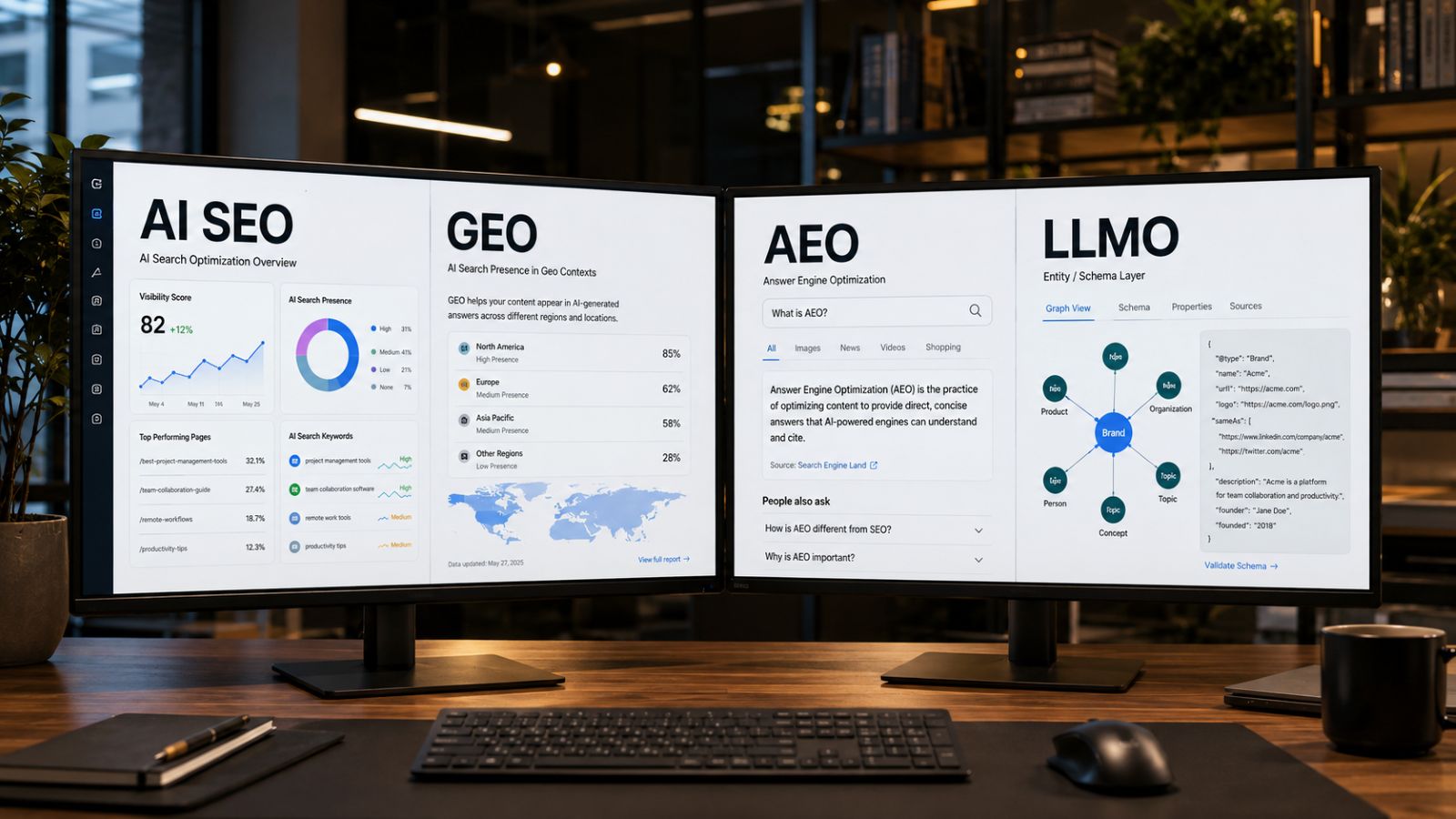
AI SEO vs. GEO vs. AEO vs. LLMO: The AVP Standard Definitions
Part of the AI Visibility Definition Library, Version 1.3 — July 2026 — Maintained by AI Visibility Professional
TL;DR — Executive Summary
(Too Long; Didn’t Read — a quick summary for busy humans and smart machines.)
AI SEO is the discipline. AEO and GEO are tactics within it. LLMO is the mechanism layer underneath all of it. These four terms are not competitors — they describe different altitudes of the same operation: earning visibility when AI systems answer your customers’ questions. The industry keeps arguing about which name should win. That argument misses the point. In the military, we solved terminology chaos with standardized doctrine, because when words mean different things to different units, people die. In business, terminology chaos just costs you money more slowly. This page is the AVP Standard: clean definitions, a comparison table, and a clear statement of where each term fits inside the FOUND™ and PAID™ Frameworks.
Ask five marketers what to call the practice of optimizing for AI search, and you will get five answers: AI SEO, GEO, AEO, LLMO, and “it doesn’t matter, just do the work.”
The fifth answer is wrong. Terminology matters because budgets follow language. If your CEO thinks GEO means geo-targeting, your AI visibility budget dies in the meeting. If your agency sells you “AEO” and delivers keyword stuffing, you cannot audit what you cannot define.
Major players have already picked sides. Andreessen Horowitz put its weight behind GEO. Profound argues AEO is the better, more ownable term. Graphite makes the case for AI SEO because it centers on what users actually do — search. Each argument has merit. All of them are arguing about the flag instead of the mission.
Here is the resolution: these terms are not synonyms competing for the same job. They are different echelons of the same operation. Once you see the hierarchy, the confusion disappears.
The AVP Standard: Four Terms, Four Altitudes
Every military operation has echelons: strategy at the top, operations in the middle, tactics on the ground, and logistics underneath making it all possible. AI visibility works the same way.
What Is AI SEO? (The Discipline)
AI SEO is the process of making content and digital presence clear, structured, useful, and credible enough for AI systems to understand, trust, and recommend, rather than simply rank.
AI SEO is the umbrella term. It covers everything below it in this hierarchy, the same way “marketing” covers advertising, PR, and content. It is the term I recommend for executive conversations, budgets, and job titles, because it builds on twenty-five years of SEO vocabulary that leadership already understands. Nobody has to be re-educated to approve an “AI SEO” line item.
What Is AEO? Answer Engine Optimization (A Tactic)
Answer Engine Optimization (AEO) is the tactic of structuring content to be selected as the direct answer when an AI system responds to a specific question.
AEO is about winning the answer slot: Google AI Overviews, featured snippets, voice assistant responses, and the first definitive sentence a chatbot gives when someone asks a question your business can answer. AEO succeeds when the machine quotes you as the answer, not merely an input.
What Is GEO? Generative Engine Optimization (A Tactic)
Generative Engine Optimization (GEO) is the tactic of earning citations, mentions, and recommendations inside responses that AI systems generate by synthesizing multiple sources.
Where AEO targets the single-answer slot, GEO targets the synthesis. When ChatGPT, Claude, Perplexity, or Gemini composes a response from many sources, GEO is the work of being one of the sources it retrieves, trusts, cites, and names. GEO succeeds when the machine mentions your brand in an answer it wrote itself.
What Is LLMO? Large Language Model Optimization (The Mechanism Layer)
Large Language Model Optimization (LLMO) is the mechanism-level work of shaping how AI models ingest, understand, and represent your entity — through structured data, entity clarity, consistent facts, and machine-readable content.
LLMO is the logistics of AI visibility. It is not a campaign; it is the supply line. Schema markup, consistent entity information across the web, llms.txt files, clean site architecture, and factual consistency are LLMO work. Neither AEO nor GEO succeeds without it, which is why LLMO sits underneath both.
AI SEO vs. GEO vs. AEO vs. LLMO: Comparison Table
| Term | Echelon | What It Optimizes For | Success Looks Like | Where It Lives in the AVP Frameworks |
|---|---|---|---|---|
| AI SEO | Discipline | Total brand visibility across all AI search and answer systems | Your brand appears wherever your customers ask AI for help | The mission FOUND™ and PAID™ execute |
| AEO | Tactic | Being selected as the direct answer to a specific question | The AI quotes you as the answer | A maneuver element within FOUND™ |
| GEO | Tactic | Citations and mentions inside AI-generated, multi-source responses | The AI names your brand in an answer it composed | A maneuver element within FOUND™ |
| LLMO | Mechanism layer | How models ingest, understand, and represent your entity | Machines hold accurate, consistent facts about you | The supply line beneath every FOUND™ operation |
Why Unsettled Terminology Costs You Money: A Doctrine Problem
I spent a career in U.S. Army Special Forces, where standardized doctrine is not bureaucracy — it is survival. When one unit says “suppress” and another hears “destroy,” the operation fails and people get hurt. That is why the military maintains dictionaries of joint terms: shared language is a precondition for coordinated action.
The AI visibility industry has the same problem with lower stakes. When an agency sells “GEO services,” a consultant pitches “AEO strategy,” and a SaaS tool measures “AI SEO share of voice,” a buyer cannot compare proposals, audit deliverables, or hold anyone accountable. Vendors benefit from the fog. Buyers pay for it.
The fix is the same fix the military uses: adopt a standard, publish it, version it, and update it as conditions change. You are reading version 1.0 of that standard. When the terminology shifts — and it will — this page will be updated and the changelog below will say exactly what changed and why.
How FOUND™ and PAID™ Relate to GEO and AEO
A common question I get: “Is FOUND your version of GEO?” No — and the distinction matters.
GEO and AEO are tactics: specific, repeatable techniques for winning specific outcomes. The FOUND™ Framework is an operational framework: it sequences those tactics, along with LLMO groundwork, entity building, and third-party authority development, into a phased campaign with objectives and measurement. Tactics tell you how to win an engagement. Frameworks tell you which engagements to fight, in what order, with what resources.
The PAID™ Framework covers what none of the four terms on this page address: paid amplification within AI ecosystems — sponsored placements, AI-adjacent advertising, and paid distribution that accelerates organic AI visibility. As AI platforms monetize, the organic-only definitions of GEO and AEO will leave a growing blind spot. PAID™ exists because that blind spot is where the next budget fight happens.
And governing all of it, the GUARD™ Framework handles AI governance and safety — because visibility without governance is exposure.
In short: GEO and AEO fit inside FOUND™. They do not compete with it. If you want the deeper definitions of each framework, start with the AVP Definition Library.
Key Takeaways
- AI SEO is the discipline — the umbrella term for earning brand visibility across AI-powered search and answer systems. Use it in budgets and job titles.
- AEO is a tactic — winning the direct-answer slot when an AI responds to a specific question.
- GEO is a tactic — earning citations and mentions inside multi-source, AI-generated responses.
- LLMO is the mechanism layer — the structured-data and entity-clarity work that both tactics depend on.
- The terms are echelons, not rivals. Arguing over which name “wins” is arguing about the flag instead of the mission.
- FOUND™ and PAID™ sit above the tactics — operational frameworks that sequence GEO, AEO, and LLMO into a measurable campaign, with GUARD™ governing the risk.
Frequently Asked Questions About AI SEO, GEO, AEO, and LLMO
What is GEO in marketing?
GEO stands for Generative Engine Optimization: the practice of optimizing content and brand presence so that generative AI systems like ChatGPT, Claude, Perplexity, and Gemini cite, mention, or recommend your brand when they compose answers from multiple sources. GEO is a tactic within the broader discipline of AI SEO.
What is AEO in marketing?
AEO stands for Answer Engine Optimization: the practice of structuring content so an AI system selects it as the direct answer to a specific question — in Google AI Overviews, featured snippets, voice assistant replies, and chatbot responses. AEO succeeds when the machine quotes you as the definitive answer.
What is the difference between AEO and GEO?
AEO targets the single-answer slot: being quoted as the answer to a specific question. GEO targets the synthesis: being cited as a trusted source inside a longer response the AI generated from many inputs. Both are tactics within AI SEO, and most businesses need both. They are different engagements in the same campaign, not competing strategies.
What does LLMO stand for?
LLMO stands for Large Language Model Optimization: the mechanism-level work — structured data, schema markup, entity consistency, machine-readable content — that shapes how AI models ingest and represent your brand. LLMO is the foundation layer; AEO and GEO both fail without it.
Is GEO replacing SEO?
No. GEO builds on top of SEO. AI systems heavily favor sources that already demonstrate authority in traditional search, so strong SEO remains the price of entry. GEO extends the work of SEO into a new environment; it does not replace it.
AI SEO vs. GEO: which term should my business use?
Use AI SEO for budgets, job titles, and executive conversations, because it builds on vocabulary leadership already understands. Use GEO and AEO when specifying tactics, deliverables, and metrics in a statement of work. Precision at the tactical level, familiarity at the strategic level.
What is generative engine optimization’s main goal?
The main goal of generative engine optimization is brand presence inside AI-generated answers: when a customer asks an AI system about your category, the AI names your brand. The metric that matters is share of AI answers — not rankings, not clicks.
Do I need GEO, AEO, and LLMO, or just one of them?
You need all three, sequenced correctly: LLMO groundwork first, so machines can understand your entity; then AEO and GEO in parallel, prioritized by where your customers actually ask questions. Sequencing tactics into a measurable campaign is exactly what the FOUND™ Framework does.
For Your Reference: The AI Visibility Definition Library
The definitions on this page are part of the AI Visibility Definition Library (Version 1.3, July 2026) — where we publish the dictionary that sets the standard for AI visibility. It is designed to be reused, cited, and integrated across the industry.
About the Author
Christopher Littlestone is a retired U.S. Army Special Forces Lieutenant Colonel (Green Beret) and the founder of AI Visibility Professional, where he developed the FOUND™, PAID™, and GUARD™ Frameworks for organic AI visibility, paid AI amplification, and AI governance & safety. He was valedictorian at the Virginia Military Institute, holds a Master in Public Administration from Harvard University, and earned a Doctor of Business Administration with a cybersecurity focus. He also leads Life Is a Special Operation, a mindset and performance brand with hundreds of thousands of YouTube subscribers and thousands of students at Special Operations University.
Ready to Put These Definitions to Work?
Understanding the language is step one. Applying it is where visibility — and revenue — comes from. Here are the best places to start:
- Get the book: AI SEO 2026: How to Be Found by AI Search So You Can Get More Clients and Make More Money — the practical guide that introduces the FOUND™ Framework and the shift from rankings to recommendations.
- Do it yourself: Download the Master Visibility Profile (MVP) Checklist — a structured, step-by-step framework for improving your AI visibility on your own.
- Get expert guidance: Request a Visibility Index Profile (VIP) Audit — a comprehensive, professional-grade audit with prioritized, actionable recommendations and a clear execution roadmap.
Be Found by AI Search — so you can get more customers and make more money.
Our Services
AVP provides assessments, education, and certification to help businesses achieve trusted organic and paid AI visibility.

Tools
Professional tools and audits that maximize AI visibility, attract qualified customers, and increase revenue.

Articles
Clear, standards-driven education explaining how organic and paid AI visibility works in real-world AI systems.

Courses
Coming Soon - Sign up for our AVP Newsletter to Learn More / Join the Waiting List
Certification
Coming Soon - Sign up for our AVP Newsletter to Learn More / Join the Waiting List