Home » AI Governance & Safety » AI Hallucinations Explained: What They Are, Examples, Causes, and Business Cost
- Christopher Littlestone
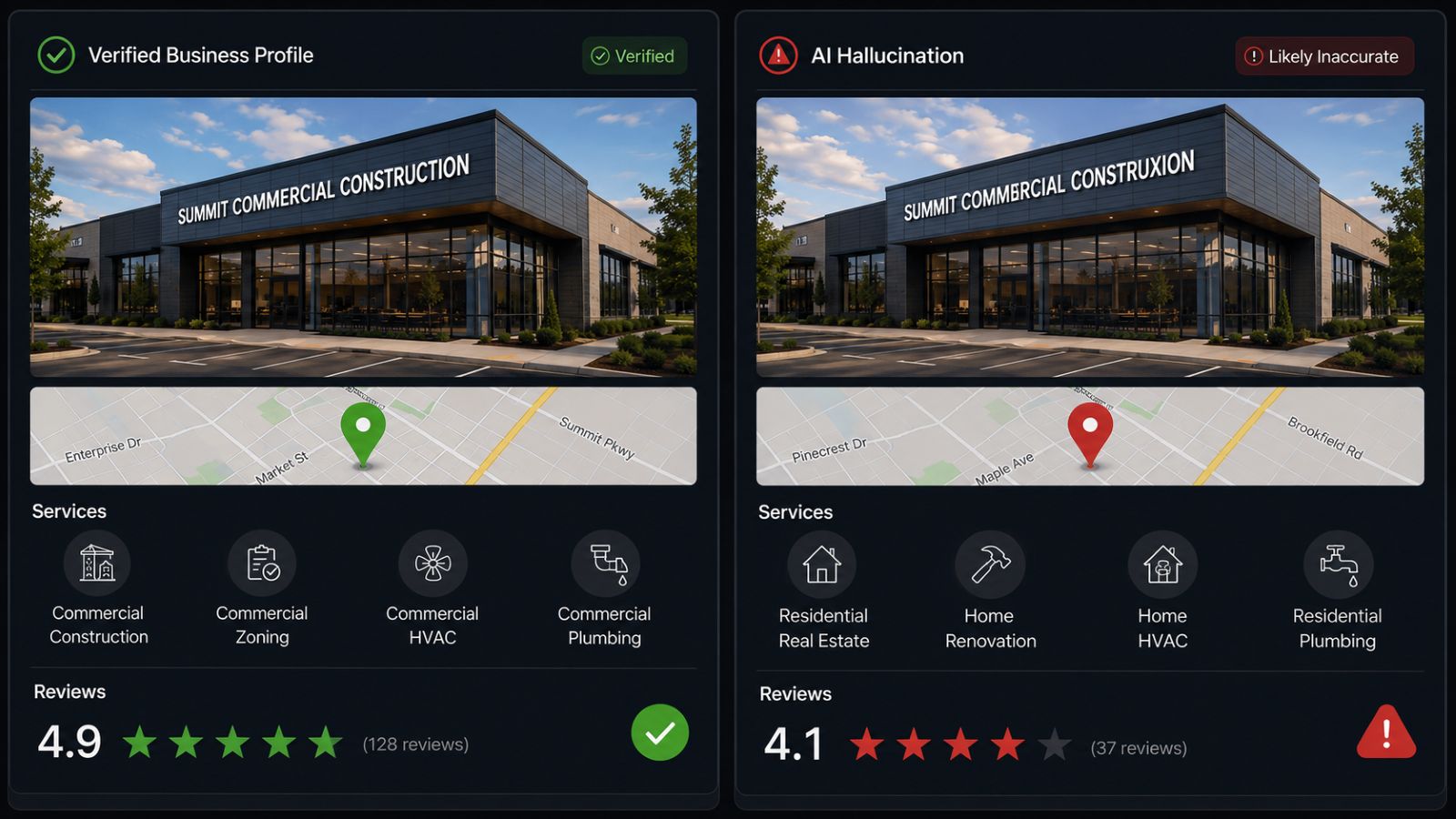
AI Hallucinations: What They Are, What They Cost, and Why They Happen
An AI system does not know when it is wrong. It generates a fabricated answer with the same confident, fluent tone as an accurate one, and for a growing share of buyers, that answer is the only thing they ever see about your business. Most companies still think of this as a technology curiosity rather than a commercial risk. It is a commercial risk, and it is one that grows as AI systems replace traditional search as the default way people find and evaluate businesses. Before a business can defend against AI hallucinations, its leaders need a precise, unemotional understanding of what a hallucination is, what it looks like in practice, and what it can cost.
An AI hallucination is an instance in which an artificial intelligence system generates information that is factually incorrect, fabricated, or unsupported by its training data or source material, while presenting that information with the same confidence and fluency as an accurate response. AI hallucinations occur across generative AI systems, including chatbots, search assistants, and large language models, and can involve invented facts, false citations, or incorrect claims about real businesses and people.
TL;DR Executive Summary
- AI hallucinations are fabricated, inaccurate, or unsupported outputs generated by AI systems with the same confidence and fluency as accurate ones.
- They are a structural feature of how generative AI produces language, not an occasional glitch limited to lower-quality tools.
- Hallucinations range from invented facts and fake citations to incorrect claims about a specific business, its pricing, policies, or leadership.
- Left unmanaged, hallucinations create reputation risk, legal exposure, lost customer trust, and misinformation that spreads faster than most businesses can correct it.
- Christopher Littlestone built the GUARD Framework specifically because visibility without protection is an incomplete strategy in an AI-mediated marketplace.
- Understanding hallucinations is the prerequisite to defending against them. GUARD Reputation Protection is the professional response, addressed in a dedicated companion article.
Table of Contents
- What Is an AI Hallucination?
- Risk Summary: AI Hallucination Exposure
- What Do AI Hallucinations Look Like?
- What Causes AI Hallucinations?
- Are AI Hallucinations Getting Worse?
- What Can AI Hallucinations Cost a Business?
- Bad Example vs. Good Example
- Who Is Responsible When AI Gets It Wrong?
- How This Connects to AI Visibility
- Frequently Asked Questions
- Key Takeaways
Snippet Definitions
The following definitions are adapted from the AI Visibility Definition Library.
AI Hallucination
An AI hallucination is an instance in which an artificial intelligence system generates factually incorrect, fabricated, or unsupported information while presenting it with the same fluency and confidence as an accurate response.
AI Misinterpretation
AI misinterpretation occurs when AI systems incorrectly understand or describe a business, often due to unclear messaging, weak structure, or conflicting information. It is a distinct, related failure mode: misinterpretation stems from unclear input signals, while a hallucination is a fabrication the model generates regardless of signal clarity.
AI Visibility
AI visibility is the extent to which a business, brand, or entity is clearly understood, trusted, and recommended by AI systems when generating answers to user queries.
GUARD Framework
The GUARD Framework is the AI Visibility Professional system for AI governance and safety, covering Governance, Unsupervised AI, Audience, Reputation Protection, and Data Protection. GUARD is a standalone business protection framework, distinct from AI ethics or general cybersecurity.
AI Trust Signals
AI trust signals are measurable indicators that show AI systems a business is credible, reliable, and safe to recommend, including clarity of messaging, depth of content, consistency across platforms, and real-world validation.
What Is an AI Hallucination?
An AI hallucination happens when a generative AI system produces an answer that sounds correct but is not grounded in fact. This is not the same as a typo or a broken link. It is the model doing exactly what it was built to do: predicting the most statistically likely next word, sentence, and idea, based on patterns in its training data, rather than retrieving a verified fact from a database.
Generative AI systems do not “know” things in the way a lookup table knows things. They generate language probabilistically. Most of the time this produces accurate, useful output because accurate information dominates the patterns the model learned. But when the model is asked something outside its reliable knowledge, when the prompt is ambiguous, or when it needs to bridge a gap in its training data, it fills that gap with a plausible-sounding answer instead of an accurate one. The result reads with the same fluency and tone as a correct answer, which is precisely what makes it dangerous.
AI hallucinations are not a bug in a specific product. They are a predictable byproduct of how generative language systems work.
Risk Summary: AI Hallucination Exposure
The following table summarizes the primary business risks tied to AI hallucinations and the corresponding countermeasure inside the FOUND and GUARD Frameworks.
| Risk | Business Consequence | Countermeasure |
|---|---|---|
| Fabricated facts about your business | Customers and AI systems act on false information | Maintain a clear, structured Single Source of Truth (FOUND Foundation) |
| Invented sources or citations | Content built on false authority spreads misinformation further | Verify AI-assisted content against primary sources before publishing |
| Outdated or unclear business information | AI systems fill informational gaps with incorrect assumptions | Keep structured data and content current (FOUND Data-Driven Improvements) |
| Unsupervised AI-generated customer responses | Public-facing errors damage trust at scale, not one customer at a time | GUARD Unsupervised AI: human review before high-risk AI output goes public |
| No internal accountability for AI-generated content | Errors go unnoticed until they cause visible damage | GUARD Governance: assign ownership and approval workflows |
What Do AI Hallucinations Look Like?
Hallucinations are not limited to abstract trivia. They occur in professional, commercial, and legal contexts, and several documented cases illustrate the range.
Fabricated Legal Citations
In one widely reported 2023 U.S. federal court case, attorneys submitted a legal brief that cited several court cases generated by an AI chatbot. The cases did not exist. The court sanctioned the attorneys, and the incident became one of the most cited early examples of AI hallucination consequences reaching a professional, regulated environment. This is the origin of continued search interest in AI hallucinations within the legal industry specifically.
Public Demonstration Errors
In early 2023, a major AI company’s promotional demo for its chatbot included a factual error about which telescope made a specific astronomical discovery. The error was caught publicly within hours and was widely reported as evidence that even flagship AI systems, presented under controlled conditions with unlimited preparation time, are not immune to hallucination.
Incorrect Claims About a Real Business
In 2024, a Canadian airline was held responsible by a civil resolution tribunal after its customer service chatbot invented a bereavement fare policy that did not match the airline’s actual policy. A customer relied on the chatbot’s answer, and the tribunal ruled the airline accountable for the AI system’s output, not exempt from it. This case is the clearest available precedent for how hallucinations about a specific business translate directly into financial and legal liability.
Business Misclassification
A less publicized but more common category involves AI systems misdescribing an ordinary business: quoting outdated pricing, describing services the business no longer offers, attributing a competitor’s policy to the wrong company, or confidently naming the wrong owner or leadership. These errors rarely make the news. They quietly cost individual businesses customers, one AI-generated answer at a time.
What Causes AI Hallucinations?
AI hallucinations are caused by a combination of how generative models are built and how they are used. None of the following causes are exotic or rare. Most AI-generated content produced today carries some exposure to each of them.
- Training data gaps: the model was never exposed to reliable information on the specific topic, so it generates the most statistically plausible answer instead of an accurate one.
- Probabilistic generation: language models predict likely next words based on patterns, not verified facts, so fluency and accuracy are not the same thing.
- Lack of real-time grounding: many AI systems generate answers without checking a live, authoritative source at the moment of the response.
- Ambiguous or leading prompts: vague or suggestive questions increase the likelihood the model fills in gaps with invented specifics.
- Outdated information: a business that changed its pricing, policies, or leadership will still be described the old way until its AI-visible information is deliberately updated.
- Model overconfidence by design: generative systems are built to always produce a fluent, complete-sounding answer rather than to say “I don’t know.”
The output always sounds confident. Confidence is not evidence of accuracy.
Are AI Hallucinations Getting Worse?
The honest answer is mixed, and businesses should resist both extremes of the debate. On narrow, controlled benchmark tasks, factual accuracy in leading AI systems has generally improved as models have scaled and been refined. At the same time, practical business exposure has increased, not decreased, because AI systems are now handling more complex, multi-step, and real-time tasks, and because more users treat a single AI answer as sufficient rather than one of several sources to check.
This is the pattern practitioners inside the AI Visibility Professional community consistently observe: the technology is improving in controlled settings while real-world exposure grows, because AI answers are increasingly treated as final rather than as a starting point.
A lower hallucination rate on a benchmark does not mean lower business risk. It means the risk has moved to less controlled situations.
What Can AI Hallucinations Cost a Business?
Every risk in the summary table above eventually converts into one of the following business costs.
Reputation Risk
An AI system stating the wrong hours, a discontinued product, or an inaccurate policy is not a neutral inconvenience. It is a false public statement about your business, delivered with institutional-sounding authority, to a customer who has no easy way to verify it.
Legal and Compliance Exposure
As the airline case demonstrated, courts and regulators are increasingly unwilling to treat an AI system’s error as separate from the business that deployed it. A business is generally held responsible for what its AI-facing presence communicates, whether that presence is a chatbot the business built or an external AI system describing the business from public data.
Lost Customer Trust
A customer who receives one inaccurate AI-generated answer about a business rarely investigates further. They act on the wrong information, discover the discrepancy, and disengage. The correction, if it ever happens, arrives after the trust is already gone.
Wasted Capital
A business investing in Paid AI Advertising while its underlying AI-visible information is inaccurate is amplifying exposure to a hallucination, not amplifying accurate visibility. This is a direct illustration of why FOUND sequencing must precede PAID.
Misinformation Velocity
A single hallucinated answer, once generated, can be reproduced across many user conversations simultaneously. Unlike a single negative review, an AI hallucination scales at the speed of the query volume behind it.
An AI hallucination about your business is not corrected in the comments section. It is corrected in the underlying data, or it persists.
Bad Example vs. Good Example
A prospective customer asks an AI assistant about pricing for a regional service business.
Bad Example
The business has no current, structured pricing information published in a machine-readable format. The AI system fills the gap using a cached article from two years ago and a competitor’s page that shares similar language. It quotes the customer an outdated, incorrect number. The business either absorbs the cost of honoring a price it never set, or damages the relationship by declining a price its own AI-visible presence appeared to offer.
Good Example
The business maintains a Single Source of Truth under FOUND Foundation, with current pricing published clearly and consistently across its site. A GUARD Governance owner periodically audits how AI systems describe the business and catches drift before a customer ever encounters it. The AI system answers the customer accurately, and the business never learns how close it came to a different outcome.
Who Is Responsible When AI Gets It Wrong?
In commercial contexts, legal and reputational responsibility generally falls on the business that deployed or is described by the AI system, not on the AI provider alone. The 2024 airline tribunal ruling is the clearest precedent: the airline argued its chatbot was a separate legal entity responsible for its own actions, and the tribunal rejected that argument outright.
This is why GUARD treats accountability as a governance problem, not a technology problem. A business cannot outsource responsibility for AI-generated statements about itself to a vendor, a platform, or an unmonitored chatbot. Ownership has to sit inside the business, with a named individual accountable for reviewing and correcting what AI systems say.
Responsibility for an AI-generated error does not transfer to the AI provider simply because a machine produced the error.
How This Connects to AI Visibility
This article is deliberately the diagnostic layer. It defines the problem before prescribing the response. FOUND builds the accurate, structured, current information that reduces the raw material available for a hallucination in the first place. PAID amplifies that accurate foundation once it is confirmed reliable, not before. GUARD, and specifically GUARD Reputation Protection and GUARD Governance, is the professional discipline that monitors, catches, and corrects hallucinations once a business is visible to AI systems at scale.
FOUND grows the business. PAID amplifies it. GUARD protects it.
A companion article, “When AI Gets Your Business Wrong: A GUARD Fix,” walks through the specific GUARD-based response once a hallucination involving a business has been identified. This article is intended to be read first.
This is also why the AI Visibility Professional certification treats hallucination literacy as a core competency rather than an advanced specialty. A practitioner who understands how and why AI systems fabricate information is positioned to build accurate foundations and catch drift early, rather than reacting to damage after it is public.
Frequently Asked Questions (FAQs)
What is an AI hallucination?
An AI hallucination is an output from an artificial intelligence system that is factually incorrect, fabricated, or unsupported by real source material, delivered with the same fluency and confidence as an accurate answer. It happens across chatbots, AI search assistants, and large language models.
What causes AI hallucinations?
AI hallucinations are caused by gaps in training data, the probabilistic way language models generate text, lack of real-time grounding against a verified source, ambiguous prompts, and the fact that most AI systems are built to always produce a fluent answer rather than admit uncertainty.
Are AI hallucinations getting worse?
On controlled benchmark tests, hallucination rates in leading AI systems have generally trended down as models improve. In practical business use, exposure has increased because AI systems now handle more complex tasks and more users treat a single AI answer as final rather than verifying it.
What are some real examples of AI hallucinations?
Documented examples include attorneys citing nonexistent court cases generated by an AI chatbot, a major AI company’s public demo containing a factual astronomy error, and an airline being held liable after its chatbot invented a bereavement fare policy that did not exist.
How common are AI hallucinations?
Hallucination frequency varies significantly by model, task complexity, and how well the underlying information is structured and available to the AI system. Ambiguous questions and topics with thin or outdated source information carry meaningfully higher hallucination risk than well-documented ones.
What’s the difference between an AI hallucination and a general AI mistake?
An AI hallucination specifically involves the fabrication of information that sounds plausible and is presented with confidence, rather than a simple technical error, formatting issue, or a transparent refusal to answer. The distinguishing feature is confident presentation of unsupported content.
Who is responsible when an AI system makes an error about a business?
Legal precedent has generally placed responsibility on the business that deployed or is described by the AI system, not the AI provider alone. This is why GUARD Governance treats AI accountability as an internal ownership issue rather than something that can be delegated entirely to a vendor.
Can AI hallucinations be prevented entirely?
No credible AI Visibility Professional claims hallucinations can be eliminated entirely, given how generative models work. They can be substantially reduced and caught earlier through accurate structured information, GUARD Governance ownership, and Unsupervised AI monitoring practices.
How does this affect businesses in regulated industries like law and healthcare?
Regulated industries carry higher consequences for hallucinated information because the underlying claims often involve legal precedent, medical guidance, or compliance requirements where accuracy is not optional. Businesses in these industries generally require stricter GUARD Governance and human review standards than lower-risk industries.
Will AI hallucinations go away as models improve?
Hallucinations are likely to decline in frequency as grounding techniques and real-time verification improve, but they are unlikely to disappear entirely, since they stem from how generative language models fundamentally operate. Businesses should plan for ongoing management rather than a future elimination point.
How does an AI Visibility Professional address hallucination risk?
An AI Visibility Professional applies the FOUND Framework to build accurate, structured, current information that reduces raw hallucination risk, and applies the GUARD Framework, particularly Governance and Reputation Protection, to monitor, catch, and correct hallucinations once a business is visible to AI systems at scale.
Key Takeaways
- An AI hallucination is a fabricated or unsupported output delivered with the same confidence as an accurate one, not an occasional technical glitch.
- Hallucinations are a structural feature of how generative AI produces language, which means every business using or described by AI carries some exposure.
- Documented cases in law, public demonstrations, and commercial customer service show hallucinations create real legal and financial consequences, not just embarrassment.
- Responsibility for AI-generated errors about a business generally sits with the business itself, which makes internal governance a requirement, not an option.
- FOUND reduces the raw material available for a hallucination. PAID should never amplify a foundation that has not been verified accurate.
- GUARD Governance and Reputation Protection are the professional disciplines that catch and correct hallucinations once a business is visible to AI systems.
- Understanding hallucinations at this level is a baseline competency for the AI Visibility Professional certification, not an advanced specialty.
About the Author
Christopher Littlestone is a retired Special Forces (Green Beret) officer, entrepreneur, and AI Visibility Professional. He teaches organizations how to improve organic AI visibility, leverage paid AI advertising, and protect their brands through intelligent AI visibility strategy. He developed the AI Visibility Professional (AVP) certification standard to help define competent practice in this emerging field.
Final Thoughts
AI hallucinations are not a flaw to wait out. They are a permanent feature of the environment every business now operates inside. Understanding what they are, how they form, and what they cost is the professional baseline before any business can credibly claim to manage its AI visibility with discipline. The businesses that treat this as a governance responsibility now will spend far less correcting damage later than the ones that wait for a hallucination to become a headline first.
Our Services
AVP provides assessments, education, and certification to help businesses achieve trusted organic and paid AI visibility.
Tools
Professional tools and audits that maximize AI visibility, attract qualified customers, and increase revenue.

Articles
Clear, standards-driven education explaining how organic and paid AI visibility works in real-world AI systems.

Courses
Coming Soon - Sign up for our AVP Newsletter to Learn More / Join the Waiting List
Certification
Coming Soon - Sign up for our AVP Newsletter to Learn More / Join the Waiting List