Home » AI Governance & Safety » Anticipate and Mitigate: AI Risk Management for Businesses
- Christopher Littlestone

Anticipate – Mitigate: AI Risk Management for Businesses
Somewhere in your business right now, an employee is pasting a client’s confidential numbers into a free AI tool nobody in leadership has ever reviewed. You don’t know it’s happening. That is the whole problem in one sentence.
I’ve identified the twenty most likely AI risks a business will face today. This article names every one of them, and then answers each: what to anticipate, and exactly how to mitigate it.
My Background
Before AI visibility became my full-time work, I spent a career as a U.S. Army Special Forces officer, retiring as a Lieutenant Colonel. That career taught me that security is never an accident, it is a discipline built from anticipating what could go wrong and deciding in advance what you will do about it. After leaving the service, I founded Special Operations University, where I have taught cybersecurity and small business security to more than 4,000 students, earning a 4.9 Trustpilot rating along the way. I built the GUARD Framework by taking that same Special Forces mindset, anticipate the threat, then mitigate it, and applying it directly to how businesses use artificial intelligence. Everything in this article comes from that same discipline: name the risk, then build the countermeasure, before either one becomes a headline.
Featured Definition
The Anticipate-Mitigate Methodology is a risk management approach, drawn from Special Forces security doctrine, in which a business predicts likely AI-related failures before they occur and builds specific countermeasures in advance to reduce their likelihood or severity. It converts risk awareness into deliberate, repeatable action, rather than a one-time warning.
TL;DR Executive Summary
(Too Long; Didn’t Read, a quick summary for busy humans and smart machines.)
- This article applies the Anticipate-Mitigate Methodology to the twenty most likely AI risks I’ve identified across the GUARD Framework’s five pillars: Governance, Unsupervised AI, Audience, Reputation Protection, and Data Protection.
- Every risk gets the same treatment: what to anticipate, and two or three specific ways to mitigate it.
- Mitigation is rarely complicated. It is almost always some combination of a written AI Policy & SOP, assigned ownership, human oversight, a clear rule about what may enter an LLM, and recurring inspection.
- I built this methodology from my background as a retired U.S. Army Special Forces (Green Beret) Lieutenant Colonel, where anticipating threats and building countermeasures in advance was standard doctrine, then adapted it for AI governance after teaching cybersecurity and small business security to more than 4,000 students at Special Operations University (4.9 Trustpilot rating).
- My stated vision is that every serious business will have a Certified AI Visibility Professional (AVP) in place by the end of 2028.
Table of Contents
- What Is the Anticipate-Mitigate Methodology?
- Why Naming a Risk Is Not the Same as Managing It
- Anticipate and Mitigate: Governance Risks
- Anticipate and Mitigate: Unsupervised AI Risks
- Anticipate and Mitigate: Audience Risks
- Anticipate and Mitigate: Reputation Protection Risks
- Anticipate and Mitigate: Data Protection Risks
- Summary Table
- A Tale of Two Businesses
- Frequently Asked Questions (FAQs)
- Key Takeaways
- About the Author
- Final Thoughts
Snippet Definitions
The following definitions are adapted from the AI Visibility Definition Library.
Anticipate-Mitigate Methodology: A risk management approach in which a business predicts likely AI-related failures before they occur and builds specific countermeasures to reduce their likelihood or severity in advance.
AI Policy & SOP: A single governing document that defines which AI tools employees may use, what data may and may not be entered into them, and what review process applies before AI-assisted work reaches customers or the public.
GUARD Framework: A five-pillar business protection framework covering Governance, Unsupervised AI, Audience protection, Reputation protection, and Data protection. It helps organizations use AI responsibly without slowing the growth created by the FOUND and PAID frameworks.
AI Governance: The set of policies, ownership structures, and oversight practices that determine how a business adopts, monitors, and controls its use of artificial intelligence.
Unsupervised AI: Any use of artificial intelligence within a business that occurs without human review, verification, or oversight, creating risk of undetected errors, overreliance, and broken workflows.
What Is the Anticipate-Mitigate Methodology?
The Anticipate-Mitigate Methodology is the practice of predicting a likely AI failure before it happens and building the specific countermeasure for it in advance, rather than waiting to react once the damage is already done. It is nothing more than risk management stated plainly.
See the risk coming, then take away its power.
This is not a new idea invented for artificial intelligence. It is Special Forces doctrine, applied to a new kind of terrain. Before a mission, you anticipate what can go wrong and you build a plan for each likely failure before you ever leave the wire. Business is no different. The businesses that will avoid costly AI mistakes are not the ones that ban AI, and they are not the ones that use it carelessly. They are the ones that named their risks in advance and already know what they will do the moment one of those risks shows up.
Why Naming a Risk Is Not the Same as Managing It
A companion article, AI Risks for Businesses, laid out the twenty most likely risks across the five pillars of the GUARD Framework. That article did its job. It named the risks clearly enough that a business owner could recognize them immediately.
Naming a risk is only the first half of the discipline. A list of risks with no response attached is not governance, it is a warning label. The second half, the half most businesses skip, is deciding in advance exactly what will be done about each one. That is the purpose of this article: to take every risk already identified and pair it with what to anticipate and how to mitigate it.
A risk that has been named but not answered is still a risk.
Anticipate and Mitigate: Governance Risks
Establish rules, standards, and accountability.
Governance risk is what happens when no one is accountable for how AI gets used. It is rarely one bad decision. It is usually the absence of any decision at all.
No One Owns AI Decisions
Anticipate: without a named owner, every department will quietly make its own AI decisions, and no one will notice a problem until a customer, a vendor, or a regulator points it out first.
Mitigate:
- Assign a single named owner for AI governance, even in a small business where that person wears several hats.
- Put that ownership in writing inside the AI Policy & SOP, so it survives staff turnover.
- Give the owner explicit authority to approve or reject new AI tools before they spread department to department.
No Written AI Policy Exists
Anticipate: every department will set its own informal rules, or none, and those rules will conflict the moment two departments compare notes.
Mitigate:
- Draft one short AI Policy & SOP covering approved tools, data boundaries, and review requirements.
- Circulate it to every employee who touches AI, not just leadership.
- Revisit the policy on a fixed schedule rather than waiting for it to go stale.
Shadow AI
Anticipate: employees will adopt AI tools on their own, department by department, because the tools are fast and free, long before leadership ever hears about them.
Mitigate:
- Run a tool inventory across departments to surface what is already in use.
- Publish an approved-tool list and a simple path for employees to request new ones.
- Make reporting a new tool the easy option, not the awkward one.
No Audit Trail for AI-Assisted Decisions
Anticipate: when something eventually goes wrong, the business will not be able to reconstruct what happened, which tool was used, or who approved it.
Mitigate:
- Require a simple log for AI-assisted decisions that affect customers, pricing, or contracts.
- Store that log somewhere the AI governance owner can review on a recurring basis.
- Treat the absence of a record as a governance gap in itself, not a minor inconvenience.
Anticipate and Mitigate: Unsupervised AI Risks
Trust, but verify.
Unsupervised AI risk is not a statement that AI cannot be trusted. It is a warning that removing the human review step is what actually creates the danger.
Over-Trust in AI Outputs
Anticipate: employees under deadline pressure will treat an AI answer as a finished fact instead of a first draft that still needs a second set of eyes.
Mitigate:
- Require human review before AI-generated work reaches a customer or the public.
- Train employees on the specific tools they use, not on AI in the abstract.
- Reinforce the review step with a short recurring reminder rather than a one-time training session.
No Escalation Path
Anticipate: an employee will eventually suspect an AI output is wrong and, with no clear next step available, send it out anyway.
Mitigate:
- Define a specific escalation path for flagged AI outputs before one is needed.
- Name who receives an escalation and how quickly they respond.
- Make escalating an AI concern something employees are rewarded for, not something they avoid.
AI-Generated Content Published Without Fact-Checking
Anticipate: AI-generated content will eventually contain a confident, well-written error, and it will look no different from the accurate content around it.
Mitigate:
- Require a fact-check pass on any AI-generated content before publication.
- Apply the same standard to customer-facing chatbot responses as to published articles.
- Keep a short list of high-stakes claim categories, pricing, legal, medical, safety, that always require verification.
Poor Employee Training
Anticipate: well-intentioned employees will misuse an approved tool simply because no one ever explained its limits.
Mitigate:
- Train employees on the actual tools in use, including what the tool gets wrong.
- Pair initial training with recurring, short reminders rather than a single onboarding session.
- Review training completion the same way a business would review any required compliance training.
Anticipate and Mitigate: Audience Risks
Influence precisely. Exclude aggressively.
Audience risk shows up when a business amplifies its AI-driven visibility or advertising faster than its foundation can support, or targets the wrong audience at scale.
Paid Amplification on a Weak Organic Foundation
Anticipate: paid AI visibility will amplify whatever message already exists, including an inconsistent or unclear one, and the spend will not convert.
Mitigate:
- Confirm FOUND-level foundation is stable before paid amplification begins.
- Assign someone to review organic clarity before every new paid campaign, not just once at launch.
- Pause amplification the moment inconsistency is discovered rather than scaling around it.
Broad, Low-Intent Targeting
Anticipate: broad targeting will feel efficient in the short term while quietly diluting how AI systems associate the brand with its actual customers.
Mitigate:
- Define an Ideal Customer Profile before any paid AI campaign launches.
- Exclude low-intent audiences deliberately rather than relying on the platform’s defaults.
- Review targeting precision on a recurring schedule, not only when performance drops.
Bias in AI-Assisted Decisions
Anticipate: AI-assisted decisions touching hiring, lending, or pricing will eventually replicate a pattern that creates real legal exposure, not just reputational risk.
Mitigate:
- Review any AI-assisted decision that affects people, hiring, pricing, lending, for bias before it scales.
- Assign a specific reviewer for these categories, separate from general content review.
- Document the review, since the record itself is part of the protection.
Capital Spent Without Measurable Signal Improvement
Anticipate: paid spend will continue past the point of usefulness simply because no one checked whether it was working before scaling it further.
Mitigate:
- Tie every paid AI campaign to a measurable signal, not a vanity metric.
- Review signal performance before authorizing additional spend.
- Apply Data-Driven Decisions discipline the same way it applies inside the PAID Framework.
Anticipate and Mitigate: Reputation Protection Risks
Brand trust is more important than traffic.
Reputation risk is what happens when AI systems misrepresent a business publicly, often without anyone noticing until the damage has already shaped how customers understand the brand.
AI Hallucinations Published Under the Company’s Name
Anticipate: a public-facing chatbot or AI-assisted response will eventually give a customer confidently wrong information, and it will carry the company’s name when it does.
Mitigate:
- Require human review for any AI output published under the business’s name.
- Establish a fast correction process for public-facing AI errors.
- Monitor customer-facing AI interactions on a recurring basis, not only after a complaint.
AI Visibility Drift
Anticipate: a rebrand, a pricing change, or a repositioning will update the website immediately, but AI platforms will keep describing the business the old way for months.
Mitigate:
- Run a recurring review of how AI platforms describe the business.
- Assign ownership of that review the same way a business assigns ownership of its Google Business Profile.
- Correct outdated descriptions as soon as drift is identified, not on the next redesign cycle.
Losing a Previously Earned AI Citation
Anticipate: a competitor’s clearer content will quietly take the place of a citation the business already earned, and nothing will announce that the loss happened.
Mitigate:
- Monitor AI citations and mentions the same way a business would monitor a lost customer.
- Investigate a lost citation for a specific cause, thin content, stale claims, weaker structure, rather than assuming bad luck.
- Strengthen the underlying content instead of only requesting the citation back.
Outdated Information Treated as Current
Anticipate: AI systems will keep citing an old price, an old offer, or an old claim long after it has changed, because nothing prompted them to update.
Mitigate:
- Maintain a single source of truth for pricing, offers, and claims that AI systems are likely to cite.
- Update that source the moment anything changes, not on a quarterly cycle.
- Periodically test what AI platforms currently say about the business’s offers and pricing.
Anticipate and Mitigate: Data Protection Risks
Secure the information that powers your business.
Data protection risk is the most immediate AI risk most businesses face, because it does not require a formal AI initiative. It happens the first time an employee pastes something sensitive into a public tool.
Employees Pasting Proprietary Information into Public AI Tools
Anticipate: an employee will paste client details, financial figures, or proprietary code into a free, public AI tool simply because it is fast and convenient.
Mitigate:
- Define, in writing, which categories of data may never enter an AI tool.
- Default to enterprise or approved AI platforms for anything touching customer or proprietary data.
- Train employees on this rule specifically, since it is the single most common data risk in businesses today.
Customer Data Entered Without Consent or Disclosure
Anticipate: customer data will end up inside an AI tool without the customer ever knowing, creating legal exposure independent of any technical failure.
Mitigate:
- Require disclosure wherever AI tools process customer data.
- Review data-handling practices against applicable privacy requirements before scaling AI use.
- Assign someone to confirm consent language actually matches AI practice, not just marketing copy.
AI Vendors Retaining or Training on Submitted Data
Anticipate: a vendor’s terms of service will permit data retention or model training on submitted business data, buried in language no one on the team actually read.
Mitigate:
- Review vendor terms of service before approving a tool company-wide.
- Prefer vendors with clear, written data-handling commitments over vague or silent ones.
- Reassess vendor terms periodically, since they can change after a tool is already in use.
Third-Party AI Integrations Creating New Exposure Points
Anticipate: a new integration will connect an AI tool to systems that were never part of the original risk assessment, quietly expanding what is exposed.
Mitigate:
- Treat every new integration as a governance event requiring its own review, not an automatic approval.
- Map what data flows through each integration before turning it on.
- Include third-party integrations in the recurring AI governance audit, not just the original tools.
Summary Table
| Risk | Business Consequence | Countermeasure |
|---|---|---|
| G – Governance: Establish rules, standards, and accountability. | ||
| No One Owns AI Decisions | No one catches a problem until it’s already public | Assign a single named owner in the AI Policy & SOP |
| No Written AI Policy Exists | Departments set conflicting informal rules | Draft one short AI Policy & SOP |
| Shadow AI | Leadership manages exposure it doesn’t know exists | Run a tool inventory and publish an approved-tool list |
| No Audit Trail | Business can’t reconstruct what happened after an error | Require a log for AI-assisted decisions |
| U – Unsupervised AI: Trust, but verify. | ||
| Over-Trust in AI Outputs | Errors reach customers unreviewed | Require human review before publication |
| No Escalation Path | Flagged output gets sent out anyway | Define an escalation path in advance |
| Unfact-Checked AI Content | A confident error looks identical to accurate content | Require a fact-check pass before publication |
| Poor Employee Training | Well-intentioned staff misuse approved tools | Train on the specific tools in use |
| A – Audience: Influence precisely. Exclude aggressively. | ||
| Amplification on a Weak Foundation | Spend increases visibility without conversion | Confirm FOUND is stable before paid begins |
| Broad, Low-Intent Targeting | Brand association dilutes over time | Define an Ideal Customer Profile |
| Bias in AI-Assisted Decisions | Legal exposure, not just reputational risk | Review people-affecting decisions for bias |
| Capital Spent Without Signal | Budget waste continues unnoticed | Tie spend to a measurable signal |
| R – Reputation Protection: Brand trust is more important than traffic. | ||
| AI Hallucinations Published | Wrong information carries the company’s name | Require human review for public AI output |
| AI Visibility Drift | AI platforms describe the business incorrectly for months | Run a recurring brand-description review |
| Losing an Earned AI Citation | A competitor quietly takes the spot | Monitor citations like a lost customer |
| Outdated Information Cited | Old pricing or claims mislead prospects | Maintain a single source of truth |
| D – Data Protection: Secure the information that powers your business. | ||
| Proprietary Data Pasted Into Public Tools | Confidential information leaves the business | Define what data may never enter an AI tool |
| Customer Data Without Consent | Legal exposure independent of any breach | Require disclosure wherever data is processed |
| Vendors Retaining Submitted Data | Data trains a model no one approved | Review vendor terms before approval |
| Third-Party Integration Exposure | Exposure expands beyond the original assessment | Review every new integration as its own governance event |
A Tale of Two Businesses
A 60-person professional services firm rolls out AI tools across every department at once, without applying the Anticipate-Mitigate Methodology first.
Bad Example
No one anticipated shadow AI, so three departments are already using three different tools within a month. No one anticipated data exposure, so a project lead pastes a client’s confidential terms into a free public model to save time. No one anticipated hallucination risk, so a customer-facing chatbot confidently gives a prospective client incorrect pricing. Each failure traces back to a risk the business could have named in advance and did not.
Good Example
A comparable firm applies the Anticipate-Mitigate Methodology before rollout. Leadership anticipates shadow AI and publishes an approved-tool list before employees go looking on their own. Leadership anticipates data exposure and writes a one-page rule about what may never enter a public model. Leadership anticipates hallucination risk and requires human review before any AI-assisted response reaches a customer. When an employee flags a chatbot answer that looks off, the escalation path already exists, so the error never reaches a client at all.
The difference was never the technology. It was whether the risk was anticipated before it arrived.
Frequently Asked Questions (FAQs)
What is the Anticipate-Mitigate Methodology?
The Anticipate-Mitigate Methodology is a risk management approach in which a business predicts likely AI-related failures before they occur and builds specific countermeasures in advance to reduce their likelihood or severity. It comes directly from Special Forces security doctrine, where seeing a threat coming is treated as more valuable than reacting well after it arrives. Applied to AI, it turns a vague sense of unease into a specific, written plan for each risk a business is actually likely to face.
How is Anticipate-Mitigate different from a standard AI risk assessment?
A standard risk assessment often stops at identifying and rating risks. Anticipate-Mitigate goes one step further by requiring a specific, assigned countermeasure for every risk before it is considered managed. The distinction matters because a list of risks with no owner and no action attached tends to sit in a drawer, while a paired anticipate-and-mitigate plan gets implemented.
Do I need to anticipate all twenty risks at once?
No. Most businesses start with the risks most likely to occur in their own operations, often Data Protection and Governance, and expand coverage from there rather than attempting everything in a single rollout. Trying to mitigate all twenty on day one usually produces a policy no one reads, while addressing the two or three most urgent risks first tends to produce real behavior change.
What is the fastest way to start mitigating AI risk?
Write a short AI Policy & SOP and assign a single owner for AI governance. Those two steps address the largest share of Governance and Unsupervised AI risk on their own, and both can typically be done inside a single afternoon rather than a multi-month project.
Who should own the Anticipate-Mitigate process inside a business?
Ownership typically sits with a founder, operations lead, or marketing leader, often supported by a trained practitioner such as an AI Visibility Professional who understands both the risks and the countermeasures. What matters more than title is that one person is clearly accountable, so the responsibility never quietly disappears between departments.
How often should a business revisit its anticipated risks?
On a recurring schedule, typically quarterly, rather than only after an incident. New tools, new employees, and new vendor terms all change the risk picture continuously, so a review that only happens once a year will always be working from outdated information.
Does Anticipate-Mitigate replace an AI Policy & SOP?
No. The AI Policy & SOP is one of the primary tools the methodology produces. Anticipate-Mitigate is the thinking process that decides what belongs in that policy, while the policy itself is where the decisions get written down and made enforceable.
What is the single most common AI risk businesses fail to anticipate?
Employees pasting proprietary or customer information into public AI tools. It requires no formal AI initiative to happen, which is exactly why it is so often missed, and by the time leadership notices, the information has usually already left the building.
How does Anticipate-Mitigate relate to the GUARD Framework?
Anticipate-Mitigate is the operating method behind all five GUARD pillars. Each pillar defines a category of risk, while Anticipate-Mitigate is how a business actually responds to the specific risks inside each one, turning the framework from a way of categorizing risk into a way of resolving it.
Can a small business realistically apply all twenty countermeasures?
Yes. Most of the countermeasures are policy and ownership decisions, not technology purchases, so a small business can implement the majority of them without new software or added headcount. A five-person company can write an AI Policy & SOP and assign an owner just as effectively as a five-hundred-person one.
What tools help a business apply Anticipate-Mitigate consistently?
The AI Governance Checklist and AI Governance Audit both walk through the same risks addressed in this article, giving a business a structured way to confirm each one has been anticipated and mitigated. Both tools exist specifically so a business owner does not have to rebuild this process from scratch on their own.
Key Takeaways
- Anticipate-Mitigate is a two-step discipline: predict the failure, then build the countermeasure in advance.
- The twenty most likely risks I’ve identified across the GUARD Framework’s five pillars can each be anticipated and mitigated individually.
- Mitigation is almost always some combination of a written AI Policy & SOP, assigned ownership, human oversight, LLM usage rules, and recurring inspection.
- Naming a risk without assigning a response is not governance, it is a warning label.
- Most Anticipate-Mitigate countermeasures are policy and ownership decisions, not new technology purchases.
- The methodology comes directly from Special Forces security doctrine, applied to the AI era.
- Anticipate-Mitigate operationalizes the GUARD Framework’s five pillars into specific, repeatable action.
- Every serious business should have this discipline in place, ideally led by a Certified AI Visibility Professional.
About the Author
Christopher Littlestone is a retired U.S. Army Special Forces (Green Beret) Lieutenant Colonel, founder of AI Visibility Professional (AVP), and creator of the FOUND, PAID, and GUARD frameworks. He founded Special Operations University, where he has taught cybersecurity and small business security to more than 4,000 students, earning a 4.9 Trustpilot rating. He built the Anticipate-Mitigate Methodology directly from Special Forces security doctrine, applying the same discipline that once protected people in the field to protecting businesses from avoidable AI risk. His stated vision is that every serious business will have a Certified AI Visibility Professional in place by the end of 2028.
Final Thoughts
I’ve identified the twenty most likely risks a business will face, and every one of them has an answer. None of the countermeasures in this article require a large budget or a technical team. They require a decision: name the risk before it arrives, and know exactly what will be done the moment it does.
If you want a structured way to confirm these risks have been anticipated and mitigated inside your own business, the AI Governance Checklist walks through every GUARD pillar with a simple green, yellow, red system. If you would rather have it done for you, the AI Governance Audit delivers the same findings through a live interview and a custom report.
AI Governance & Safety
Protect your business, your employees, and your profits from AI risk, at every price point.
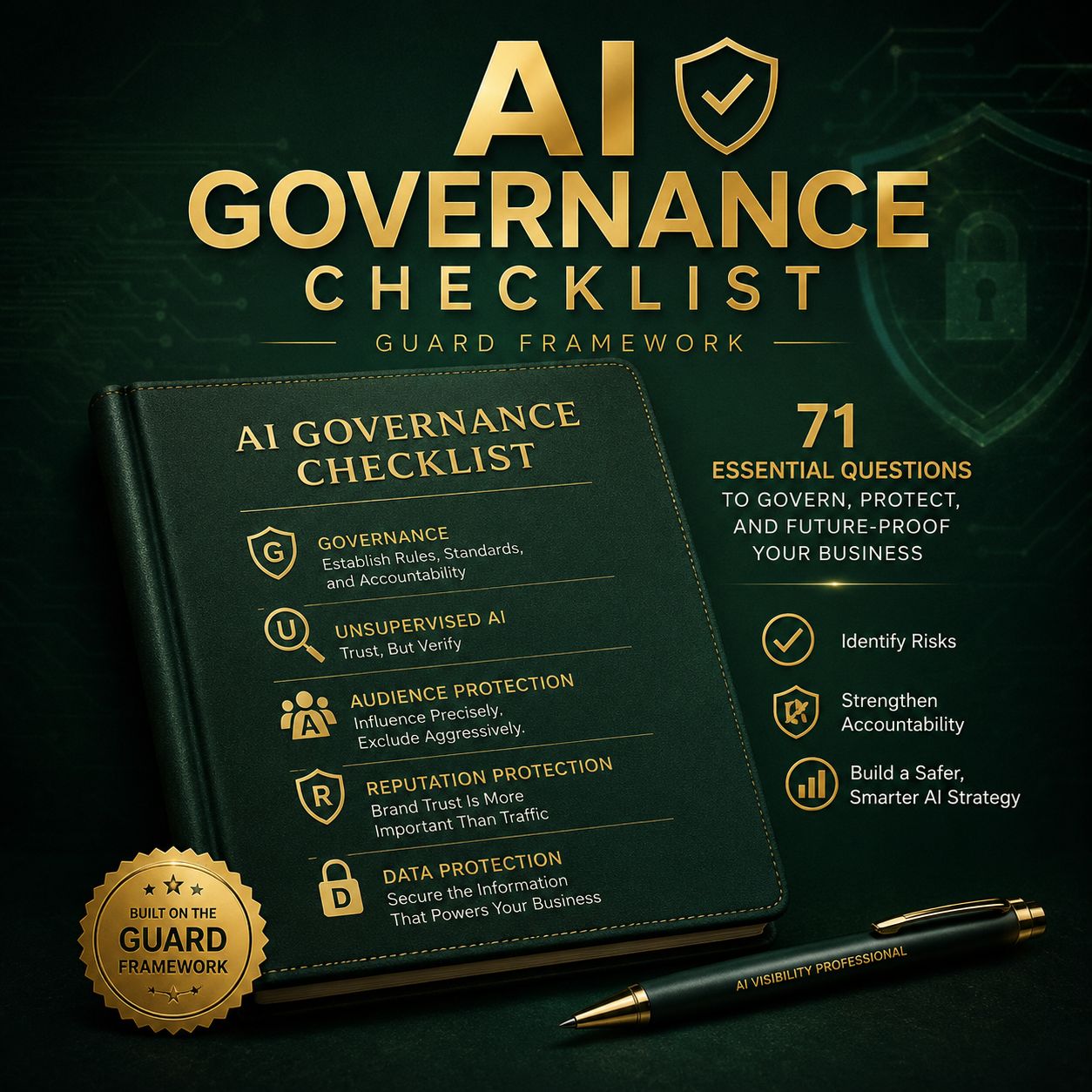
AI Governance Checklist
$50 - A self-guided diagnostic across seventy-one questions that shows you exactly where your AI governance gaps are.
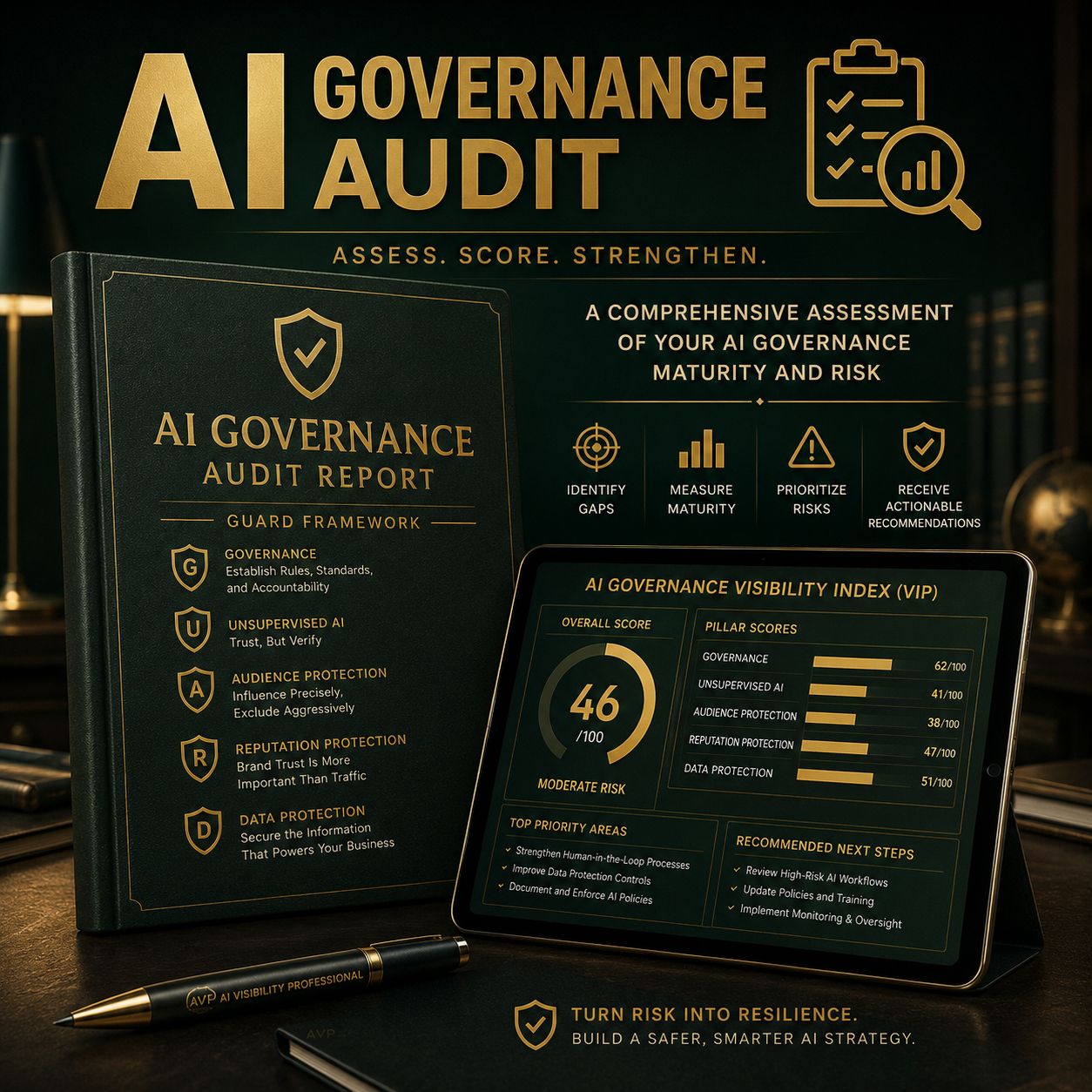
AI Governance Audit
$300 - A professional (human-led) assessment to identify your strengths, your shortfalls, and exactly where to go next.
AI Governance Policy
$1000 - A custom AI Policy & SOP built specifically for your organization, ready to implement.
AI Governance Solution
$3000 - The complete engagement: audit, policy, implementation guidance, and direct consulting with Christopher Littlestone.