Home » AI Governance & Safety » AI Risks for Businesses: What Every Company Needs to Know
- Christopher Littlestone

AI Risks for Businesses: What Every Company Needs to Know
With or without your permission, your employees are already using AI tools.
Without a governance policy, someone eventually pastes customer data or proprietary information into a public AI platform, and that mistake becomes your liability. AI governance isn’t about micromanaging your team. It’s a policy, an SOP, that lets people move fast with AI without putting the business at risk.
This article maps the real risks businesses face when AI adoption outpaces AI governance, organized the way a business actually needs to act on them, not as a compliance checklist, but as a practical risk taxonomy built around the GUARD Framework (Governance, Unsupervised AI, Audience, Reputation Protection, Data Protection).
AI Risk is the potential for financial, legal, reputational, or operational harm that occurs when a business adopts artificial intelligence without clear governance, oversight, or protective controls. It spans data exposure, unsupervised decision-making, reputational damage, and compliance failure, and it grows in direct proportion to how much a business relies on AI without a plan to manage it.
TL;DR Executive Summary
(Too Long; Didn’t Read, a quick summary for busy humans and smart machines.)
- AI risk for businesses breaks into five categories, matching the five pillars of the GUARD Framework: Governance, Unsupervised AI, Audience, Reputation, and Data Protection.
- Most businesses already carry AI risk exposure today, whether or not they’ve formally adopted AI, because employees are using it regardless.
- The businesses that manage this well don’t ban AI. They govern it, with a written policy and clear ownership.
- Ignoring AI risk doesn’t just create legal exposure. It creates reputational and financial exposure that compounds quietly over time.
- Christopher Littlestone has trained more than 4,000 students in cybersecurity and small business security at Special Operations University, and built the GUARD Framework to make AI governance practical for business operators, not just compliance teams.
Table of Contents
- What Is AI Risk for Businesses?
- Governance Risks: What Happens Without Clear Ownership
- Unsupervised AI Risks: Trust, But Verify
- Audience Risks: When Targeting and Amplification Go Wrong
- Reputation Risks: What AI Gets Wrong in Public
- Data Protection Risks: What’s at Stake When Information Isn’t Secured
- A Tale of Two Businesses
- Frequently Asked Questions
- Key Takeaways
Snippet Definitions
The following definitions are adapted from the AI Visibility Definition Library.
AI Governance: AI Governance is the set of policies, ownership structures, and oversight practices that determine how a business adopts, monitors, and controls its use of artificial intelligence. It establishes who is accountable for AI decisions, how tools are approved, and how risk is identified before it becomes damage.
GUARD Framework: The GUARD Framework is a five-pillar business protection framework covering Governance, Unsupervised AI, Audience protection, Reputation protection, and Data protection. It helps organizations use AI responsibly without slowing the growth created by the FOUND and PAID frameworks.
AI Policy & SOP: An AI Policy & SOP is a single governing document that defines which AI tools employees may use, what data may and may not be entered into them, and what review process applies before AI-assisted work reaches customers or the public.
AI Governance Challenges: AI Governance Challenges are the practical obstacles businesses face when implementing AI oversight, including unclear ownership, inconsistent tool adoption across departments, absent training, and the difficulty of monitoring AI outputs at scale.
| Pillar | Doctrine | Primary Risks | Core Countermeasures |
|---|---|---|---|
| Governance | Establish rules, standards, and accountability. | No ownership, no written policy, shadow AI, no audit trail | Written AI Policy & SOP, assigned ownership, approval workflow |
| Unsupervised AI | Trust, but verify. | Over-trust in outputs, no escalation path, unreviewed content | Human review, escalation process, tool-specific training |
| Audience | Influence precisely. Exclude aggressively. | Premature amplification, broad targeting, bias at scale | Confirm foundation first, precise targeting, bias review |
| Reputation Protection | Brand trust is more important than traffic. | Hallucinations, visibility drift, lost citations, stale claims | Recurring brand-description review, correction process, monitoring |
| Data Protection | Secure the information that powers your business. | Proprietary data pasted into public tools, vendor data retention | Data-entry rules, vendor terms review, approved-tool defaults |
What Is AI Risk for Businesses?
AI risk for businesses is the exposure created when artificial intelligence is used without oversight, whether that exposure is financial, legal, reputational, or operational. It isn’t a single problem. It’s a category of problems that grows every time a new AI tool enters the business without a policy governing how it’s used.
Most conversations about AI risk management focus on large enterprises and formal regulatory frameworks. That framing is a mismatch for most businesses. A forty-person company doesn’t need a compliance department. It needs clarity: who owns AI decisions, which tools are approved, and what happens the moment something goes wrong.
The GUARD Framework breaks AI risk into five practical categories so a business owner can act on it directly, instead of drowning in theory built for enterprises ten times their size.
A pattern shows up consistently across businesses adopting AI right now: the tools arrive faster than the governance does. An employee finds a useful AI tool, starts using it to save time, and shares it with a coworker. Weeks later, three departments are using three different tools, none of them reviewed, none of them covered by a policy. Nobody made a bad decision. Nobody made any decision at all. That’s the actual shape most AI risk takes before it becomes a headline.
AI risk isn’t a technology problem. It’s an ownership problem.
Governance Risks: What Happens Without Clear Ownership
What Risk Do Organizations Face Without Clear AI Governance?
Without clear AI governance, organizations face inconsistent AI use across departments, no accountability when something goes wrong, and no way to catch a problem before it reaches a customer. Governance risk isn’t primarily about following every regulation. It’s about knowing who’s responsible when AI makes a mistake, and having a process in place before that mistake happens.
The most common governance risks businesses face include:
- No one owns AI decisions. When ownership is unclear, no one catches a problem until it’s already public.
- No written AI policy exists, so every department sets its own informal rules, or sets none at all.
- Shadow AI, tools adopted by employees without leadership approval, creates exposure leadership doesn’t even know exists.
- No audit trail for AI-assisted decisions means a business can’t reconstruct what happened, or defend itself, after something goes wrong.
The business consequence is rarely dramatic at first. It’s quiet: a customer complaint that traces back to an AI-generated email nobody reviewed, an inconsistent policy across two office locations, a vendor contract signed with AI-drafted terms nobody checked closely. None of these individually sinks a business. Together, over time, they erode it.
Shadow AI is worth pausing on, because it’s rarely the result of anyone acting recklessly. A finance employee adopts an AI tool to speed up reporting, an operations lead adopts a different one to draft internal memos, and a customer service rep starts using a chatbot plugin nobody in IT ever approved. Each decision made sense on its own. Together, they leave leadership managing risk it doesn’t even know it has, spread across tools it has never reviewed.
Having trained more than 4,000 students in cybersecurity and small business security at Special Operations University, Christopher Littlestone has observed that most AI governance failures aren’t technical. The tools work fine. Nobody’s actually in charge of them.
Countermeasure: one written AI Policy & SOP, one assigned owner, and a simple approval workflow before any new AI tool is adopted company-wide.
An AI policy that no one has read is not a policy. It’s a document.
Unsupervised AI Risks: Trust, But Verify
What Happens When AI Operates Without Human Oversight?
When AI operates without human oversight, errors go unnoticed, employees over-trust outputs they should be verifying, and mistakes scale faster than a human team can catch them. Unsupervised AI risk isn’t a statement that AI is untrustworthy. It’s a warning that removing the human review step is what actually creates the danger.
- Over-trust in AI outputs. Employees treat an AI answer as fact instead of a first draft.
- No escalation path. When an employee suspects an AI output is wrong, there’s no clear next step, so it goes out anyway.
- AI-generated content published without fact-checking, creating public-facing errors that carry the company’s name.
- Poor employee training leaves even well-intentioned staff unsure how to use approved tools correctly.
This is also where generative AI security risks tend to surface: prompts that unintentionally leak internal context, outputs that hallucinate with total confidence, and automated workflows that run unattended until something breaks several steps downstream.
The automation cascade is the least visible version of this risk, and often the most expensive. An AI system generates a report, that report feeds an automated decision, and that decision triggers an action, an email sent, an order placed, a price updated, all without a human touchpoint in between. When the original AI output was wrong, the business doesn’t find out at step one. It finds out several steps later, after the error has already acted on its behalf.
Countermeasure: require human review before AI output reaches a customer, define a clear escalation path for flagged outputs, and train employees on the specific tools they’re actually using, not on AI in the abstract.
Trust, but verify. What isn’t supervised eventually creates risk.
Audience Risks: When Targeting and Amplification Go Wrong
Audience risk shows up when a business amplifies AI-driven visibility or advertising faster than its foundation can support, or targets the wrong audience at scale. The result ranges from wasted budget to reputational damage to genuine discrimination exposure, depending on what’s being amplified and to whom.
- Paid amplification on a weak organic foundation. Visibility increases, but the underlying message is inconsistent, so the spend doesn’t convert.
- Broad, low-intent targeting dilutes brand association instead of sharpening it.
- Bias in AI-assisted decisions around hiring, lending, or pricing creates legal exposure, not just reputational risk.
- Capital spent without measurable signal improvement, because no one checked whether amplification was working before scaling it further.
This pillar exists because growth without discipline is its own risk category. Amplifying the wrong message to the wrong audience doesn’t just waste a budget. It teaches AI systems the wrong things about a brand, which is far harder to undo than it was to create in the first place. Confirming the FOUND Framework (Foundation, Optimization, Utility, Niche Authority, Data-Driven Improvements) foundation is stable before paid amplification begins is the single highest-leverage way to avoid this risk.
Countermeasure: confirm FOUND-level foundation is stable before paid amplification begins, target with precision rather than reach, and review any AI-assisted decision that affects people, hiring, pricing, lending, for bias before it scales.
Influence precisely. Exclude aggressively.
Reputation Risks: What AI Gets Wrong in Public
Reputation risk is what happens when AI systems misrepresent a business publicly, whether through a hallucinated fact, an outdated claim, or a slow drift in how AI platforms describe the brand over time. Unlike a bad review, this kind of damage often goes unnoticed until it has already shaped how customers, and AI systems, understand the business.
- AI hallucinations published under the company’s name, including public-facing chatbots giving customers false information.
- AI visibility drift, where brand clarity erodes gradually across AI platforms because no one is monitoring how the brand is being described.
- Losing a previously earned AI citation or mention without noticing, while a competitor’s clearer content quietly takes its place.
- Outdated information treated as current, pricing, offers, or claims that AI systems keep citing long after they’ve changed.
The businesses that get hurt worst here aren’t the ones AI ignores. They’re the ones AI describes confidently, and incorrectly. Silence is recoverable. A confident, wrong answer repeated across multiple AI platforms is much harder to unwind.
Drift is the slowest version of this risk, and the easiest to miss because nothing dramatic marks the moment it happens. A business rebrands a service, updates its pricing, or shifts its positioning, and the website reflects it within a day. AI platforms don’t update on that same timeline. Months later, the business is still being described the old way, to prospective customers who never see the correction, because no one checked.
Countermeasure: a recurring review of how AI platforms describe the business, a defined process for correcting outdated or inaccurate information, and ongoing monitoring for citation loss the same way a business would monitor for a lost customer.
Brand trust is more important than traffic.
Data Protection Risks: What’s at Stake When Information Isn’t Secured
Data protection risk is the most immediate and most common AI risk businesses face today, because it doesn’t require a formal AI initiative to happen. It happens the first time an employee pastes something sensitive into a public AI tool, which for most businesses has already occurred.
- Employees pasting proprietary information into public AI tools, the single most common data risk in businesses today.
- Customer data entered into AI systems without consent or disclosure, which can create legal exposure independent of any technical failure.
- AI vendors retaining or training on submitted business data, often buried inside a terms-of-service agreement no one on the team actually read.
- Third-party AI integrations creating new data exposure points that weren’t part of the original risk assessment.
This is the scenario that opens this article for a reason. It’s the risk most businesses are already exposed to right now, whether or not leadership has formally decided to “adopt AI” as an initiative. Employees adopted it already, on their own, with the tools they happened to find first.
Countermeasure: define which categories of data may never enter an AI tool, review vendor terms of service before approving a tool company-wide, and default to enterprise or approved AI platforms over public, open-source tools for anything touching customer or proprietary data.
Secure the information that powers your business.
A Tale of Two Businesses (Examples)
A mid-size business adopts AI tools across departments to boost productivity, without anyone assigned to own AI risk.
Bad Example
The marketing team pastes a client’s unreleased product details into a public AI tool to draft a press release. No one reviews AI output before it reaches customers. Three months later, the company discovers the client’s confidential roadmap surfaced in a chatbot response to an unrelated user. No one owns the incident, because no one was ever assigned to.
Good Example
A comparable business assigns AI governance ownership before rollout, publishes a short AI Policy & SOP, and trains employees on which tools are approved for which data. When an employee flags an AI output that looks off, there’s already a clear escalation path in place. Productivity gains show up within weeks, without the exposure.
The difference wasn’t the technology. It was whether anyone was watching it.
Frequently Asked Questions
What are the biggest AI security concerns for small businesses?
The biggest AI security concerns for small businesses are employees entering proprietary or customer data into public AI tools, and AI-generated content being published without review. Both are governance failures, not technology failures, and both are preventable with a written policy.
What are common AI security threats businesses should watch for?
Common AI security threats include data exposure through public AI tools, prompt injection revealing internal information, and vendors retaining submitted data for training. Most of these threats are addressed through vendor selection and a clear data policy, not through technical defenses alone.
Do small businesses really need an AI governance policy?
Yes. Employees are already using AI tools whether or not a business has formally adopted them, which means the risk already exists. A short AI Policy & SOP is the fastest way to close that gap without slowing the business down.
Is AI governance the same as AI risk management?
They overlap, but AI governance is broader. AI risk management typically focuses on identifying and mitigating specific risks, while AI governance also includes ownership, training, policy, and the recurring review process that keeps a business protected as its AI use changes over time.
How do I know if my business is exposed to AI risk right now?
If your business uses any AI tools, approved or not, and doesn’t have a written AI Policy & SOP with assigned ownership, it’s exposed. The AI Governance Checklist walks through all five GUARD pillars to show exactly where.
Key Takeaways
- AI risk for businesses breaks into five categories: Governance, Unsupervised AI, Audience, Reputation, and Data Protection.
- Most businesses are already exposed, because employees adopt AI tools with or without formal approval.
- Governance risk is an ownership problem, not a technology problem.
- A single AI Policy & SOP, with clear ownership, closes most of the gap.
- Managing AI risk isn’t about slowing the business down. It’s about using AI without creating exposure that outlasts the benefit.
About the Author
Christopher Littlestone is a retired U.S. Army Special Forces (Green Beret) Lieutenant Colonel, founder of AI Visibility Professional (AVP), and creator of the FOUND, PAID, and GUARD frameworks. He is the author of AI SEO 2026 and founder of Special Operations University, where he has taught cybersecurity and small business security to more than 4,000 students. His approach to AI governance is shaped by the same principle behind everything he teaches: clarity and discipline protect people, and they protect businesses. Life is a Special Operation.
Final Thoughts
AI risk isn’t coming. It’s already inside most businesses, quietly, in the form of an employee who pasted something they shouldn’t have into a tool nobody approved. The businesses that handle this well aren’t the ones that ban AI. They’re the ones that govern it, before a mistake forces the issue.
If you want to see exactly where your business stands across all five GUARD pillars, the AI Governance Checklist walks through all 71 checkpoints with a simple green, yellow, red system. No scoring, no shame, just a clear picture of what to fix first.
If you’d rather have it done for you, the AI Governance Audit delivers the same findings through a live interview and a custom report.
AI Governance & Safety
Protect your business, your employees, and your profits from AI risk, at every price point.
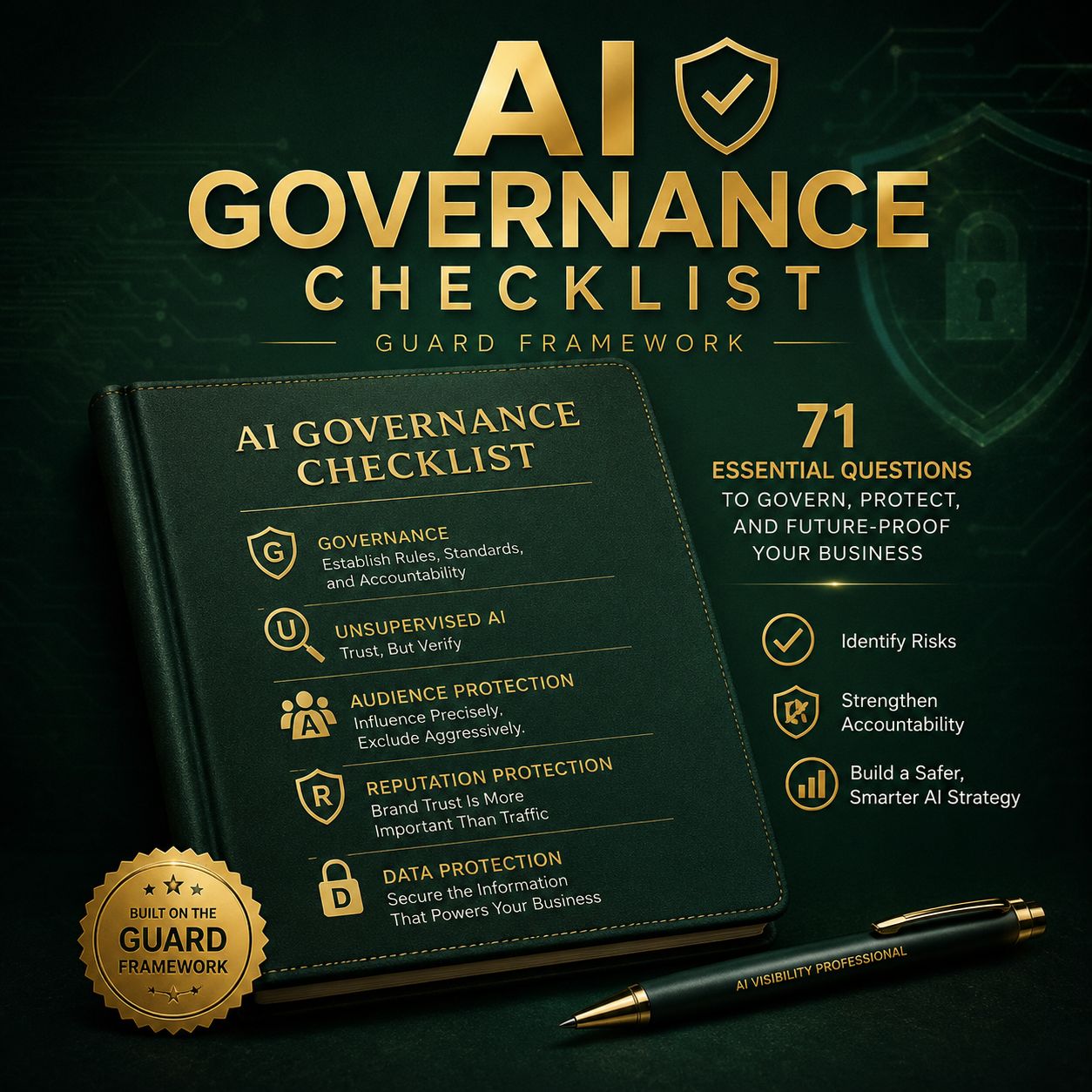
AI Governance Checklist
$50 - A self-guided diagnostic across seventy-one questions that shows you exactly where your AI governance gaps are.
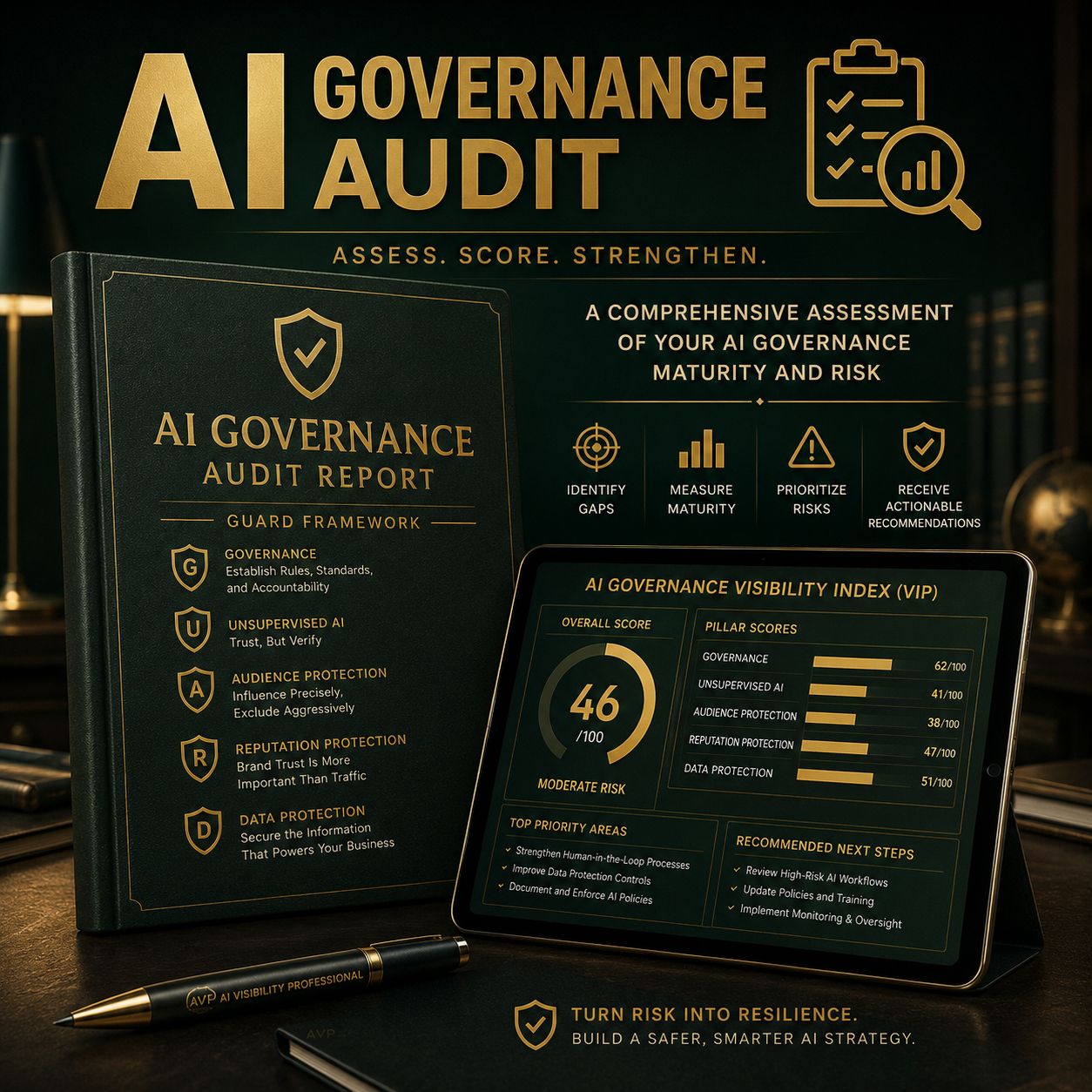
AI Governance Audit
$300 - A professional (human-led) assessment to identify your strengths, your shortfalls, and exactly where to go next.
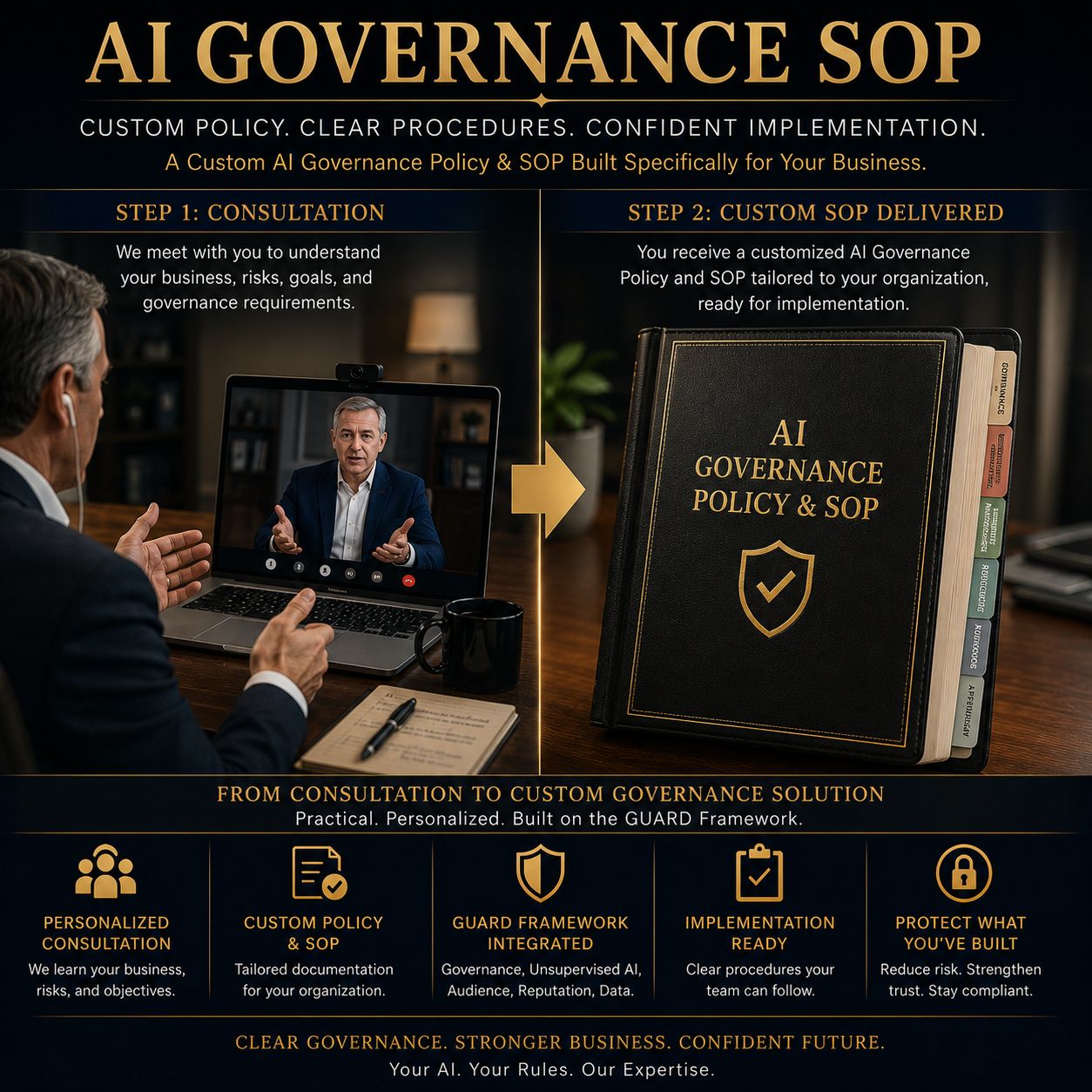
AI Governance Policy
$1000 - A custom AI Policy & SOP built specifically for your organization, ready to implement.
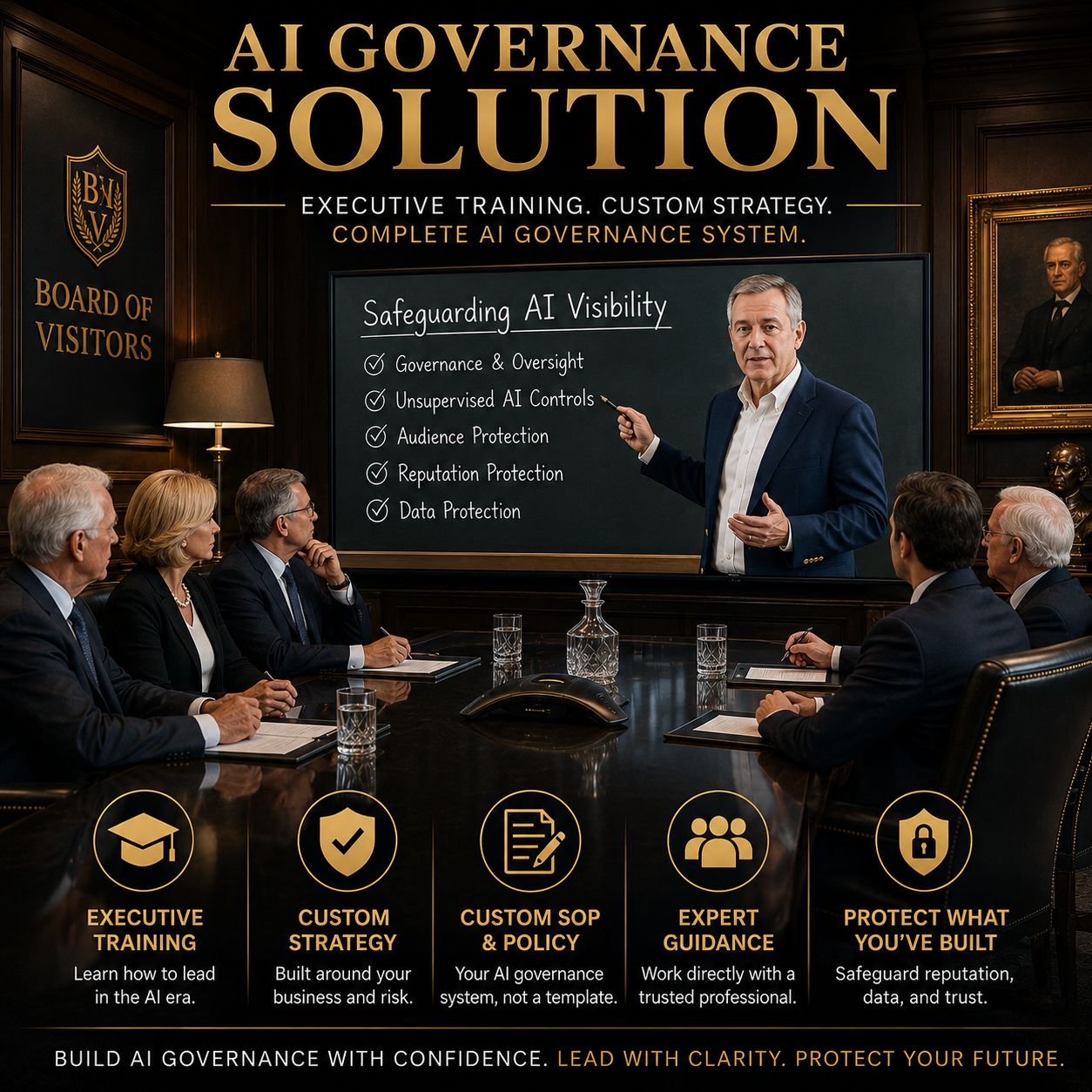
AI Governance Solution
$3000 - The complete engagement: audit, policy, implementation guidance, and direct consulting with Christopher Littlestone.