
The AI Governance Maturity Model: Tools, Platforms & Frameworks
Most businesses don’t fail at AI governance because they lack tools. They fail because they don’t know where they actually stand. A business can own AI governance software, subscribe to a monitoring platform, and still have no functioning program, because tools sit on top of maturity, they don’t create it. Knowing your actual stage is what determines whether the next dollar should go toward a tool or toward the program the tool is supposed to support.
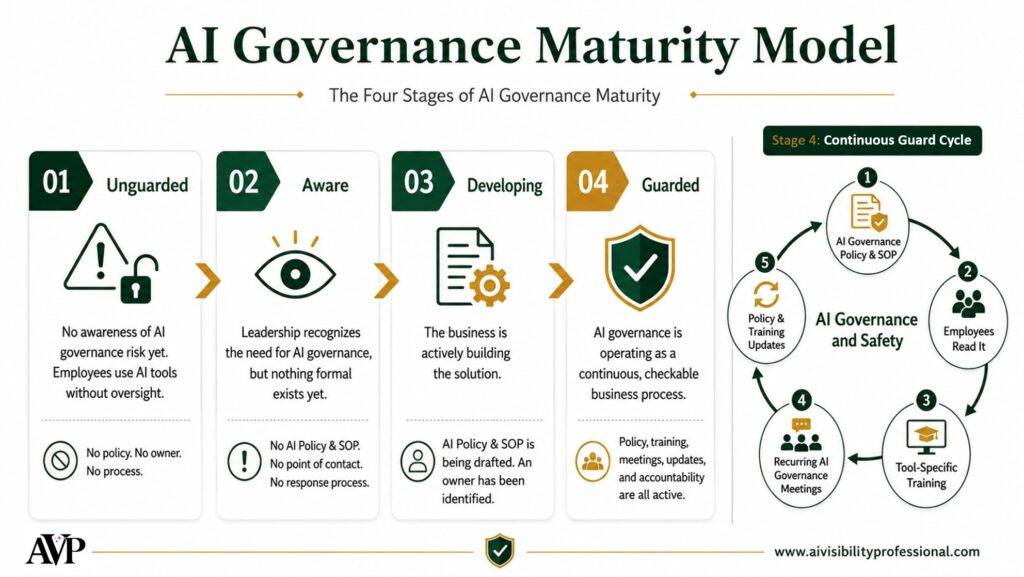
The AI Governance Maturity Model is a four-stage framework, Unguarded, Aware, Developing, and Guarded, that describes how an organization’s AI governance practice develops over time, from no awareness of AI risk to a fully operating program with deliberate, recurring review. It helps a business identify its current stage and understand exactly what’s missing before the next stage.
TL;DR Executive Summary
- Most businesses are not Unguarded. They are Aware: leadership knows AI governance is a real risk, but no policy, procedure, or owner has been put in place yet.
- The AI Governance Maturity Model has four stages: Unguarded, Aware, Developing, and Guarded.
- Reaching Guarded status requires five specific, checkable things, not a general sense of being responsible with AI.
- Tools and platforms accelerate a business that already has a program. They do not create the program for a business that doesn’t.
- The AI Governance Audit is built specifically to identify which stage a business is actually in, since most businesses misjudge their own maturity in both directions.
- Christopher Littlestone, founder of the AI Visibility Professional (AVP) certification and a retired U.S. Army Special Forces officer who has taught cybersecurity and small business security to more than 4,000 students with a 4.9 Trustpilot rating, built this model the way maturity is assessed in any operational discipline: by what’s actually functioning day to day, not by what’s been purchased or what leadership believes is in place.
Table of Contents
- What Is the AI Governance Maturity Model?
- The Four Stages of AI Governance Maturity
- What It Actually Takes to Reach Guarded
- AI Governance Ownership and Leadership
- What Tools and Platforms Actually Solve at Each Stage
- Why Tools Alone Are Not Governance
- Where Does Your Business Sit Right Now?
- Frequently Asked Questions (FAQs)
- Key Takeaways
Snippet Definitions
The following definitions are adapted from the AI Visibility Definition Library.
AI Governance Maturity Model — A four-stage framework, Unguarded, Aware, Developing, and Guarded, that describes how an organization’s AI governance practice develops over time, from no awareness of AI risk to a fully operating program with deliberate, recurring review.
AI Policy & SOP — A single combined document defining what a business will and will not do with artificial intelligence, along with the specific procedures for how that policy is carried out, reviewed, and updated.
AI Governance Tools — Software and platforms that support specific AI governance functions, such as monitoring AI outputs, managing policy documentation, or tracking AI tool usage across an organization, without independently creating governance.
AI Governance Platform — A software system that centralizes AI governance functions, such as policy management, monitoring, and reporting, typically used by organizations that have already established a governance program to operate.
GUARD Framework — An AI Governance and Safety framework built around five pillars: Governance, Unsupervised AI, Audience, Reputation Protection, and Data Protection. It helps organizations protect their reputation, data, and customers as they adopt artificial intelligence.
Summary Table: The Four Stages of AI Governance Maturity
| Stage | Description | What’s Missing |
|---|---|---|
| 1. Unguarded | Naive. No awareness that AI governance is even a category of risk. Not paying attention at all. | Everything. The business doesn’t yet know there’s a gap. |
| 2. Aware | Leadership knows AI governance is a real risk. Most businesses are here right now. | An AI Policy & SOP, a named owner, any procedure at all. |
| 3. Developing | An AI Policy & SOP is being actively built. Ownership is being assigned. | The program exists in progress but isn’t fully operating yet. |
| 4. Guarded | An AI Policy & SOP exists, employees are trained on it and on specific AI tools, and deliberate meetings to discuss AI governance happen on a recurring basis, with updates made to the policy and training as needed. | Nothing, by definition, until the cycle breaks down and isn’t caught. |
What Is the AI Governance Maturity Model?
The AI Governance Maturity Model is a four-stage framework that describes how an organization’s AI governance practice develops over time, from no awareness of AI risk to a fully operating program with deliberate, recurring review. It exists to answer one question precisely: where does this business actually stand right now, not where does it think it stands.
That distinction matters more than it sounds like it should. Most business leaders, when asked directly, will say they take AI governance seriously. Few can point to a written policy, a named owner, or a recurring meeting where it’s actually discussed. The gap between feeling responsible and having a working program is exactly what this model is built to surface.
Most businesses are not Unguarded. They are Aware, and awareness alone has never been a program.
The Four Stages of AI Governance Maturity
Stage 1: Unguarded
At this stage, a business has no awareness that AI governance is even a category of risk. This isn’t a business that has weighed the risk and decided not to act. It’s a business that hasn’t had the thought yet. Employees use whatever AI tools they find useful, AI is integrated into workflows without anyone noticing it happened, and the idea of a policy has simply never come up. Few businesses stay here long once they’re shown what’s actually happening inside their own operations, but a surprising number are still here without realizing it.
Stage 2: Aware
This is where most businesses actually are. Leadership has had the moment: a competitor’s AI mistake, a near-miss internally, or simply enough exposure to AI tools to recognize that something could eventually go wrong. There’s a real sense that the business needs to put in some backstops, some left and right limits on what AI is allowed to do unsupervised. What’s missing is everything structural: no AI Policy & SOP, no named AI governance point of contact, no procedure for what happens when something does go wrong.
Knowing you need limits is not the same as having set them.
Stage 3: Developing
At this stage, the business has moved from recognizing the problem to actually building the solution. An AI Policy & SOP is being actively drafted. Someone has been identified to own AI governance going forward. This is real progress, and it’s also a stage many businesses stall in, because building the document feels like most of the work, when the harder part is making sure it actually gets used once it exists.
Stage 4: Guarded
Guarded is not a feeling. It’s a checkable status. A business is Guarded when five specific things are true and operating together, not occasionally, but as a standing cycle.
What It Actually Takes to Reach Guarded
Reaching Guarded status requires five specific things, all operating together as a continuous cycle rather than as one-time tasks that get checked off and forgotten.
1. An AI Policy & SOP exists. This is one combined document, not two. It defines what the business will and won’t do with AI, and exactly how that gets carried out day to day.
2. New employees read it. The AI Policy & SOP isn’t something that exists in a shared drive nobody opens. Every new employee reads it as part of onboarding, before they’re using AI tools unsupervised.
3. Employees are trained on specific AI tools. Generic AI awareness isn’t enough. Employees need to know, for each AI tool the business actually uses or has approved, what it’s for, what it should be used for, and what it should never be used for.
4. There’s a deliberate, recurring mechanism for discussing AI governance and safety. This doesn’t need to be an elaborate process. It can be a five-minute item on a monthly leadership huddle, or a standing line in a board meeting. What it cannot be is informal, occasional, or dependent on someone remembering to bring it up. The GUARD Framework is the structure used for this review, so the conversation has a consistent shape every time it happens.
5. Updates and changes are made to the AI Policy & SOP as needed, and taught to employees as needed. Whatever gets flagged in a review gets added to the document and passed on through training. Neither one waits for a fixed date on the calendar.
A business that has a policy nobody reads, or a meeting that nobody actually holds, is Developing. It is not yet Guarded.
This cyclical structure is also why Guarded is harder to fake than it sounds. A business can write a policy in an afternoon. Sustaining the review cycle for a year is a different kind of commitment, and it’s the actual line between a document and a working program.
AI Governance Ownership and Leadership
A business can technically have all five Guarded requirements in place and still fail at AI governance, if no single person owns the whole cycle. This happens more often than it should: IT manages tool access, HR handles onboarding and training, and operations holds the policy document. Each piece looks covered. No one is actually accountable for the cycle continuing to run.
When everyone owns a piece of AI governance, no one owns the outcome.
A program split across departments tends to survive exactly as long as it takes for one of those departments to get busy with something else. The policy goes unreviewed for a quarter. The training falls behind when a new tool gets adopted. Nobody notices, because no one person was ever responsible for noticing.
This is why Christopher Littlestone recommends that every business identify one person to become a Certified AI Visibility Professional (AVP). A Certified AVP is trained across all three pillars that matter here: the FOUND Framework for organic AI visibility, the PAID Framework for paid AI amplification, and the GUARD Framework for AI governance and safety. That person becomes the single point of ownership for the AI governance cycle specifically, rather than governance being something five departments each own a slice of and nobody owns completely.
If your business is ready to build this kind of ownership internally, learn more about AVP Certification.
What Tools and Platforms Actually Solve at Each Stage
AI governance tools and platforms solve different problems depending on which stage a business is actually in, and using them at the wrong stage is one of the most common ways businesses waste money on governance.
At Unguarded and Aware, tools generally aren’t the answer yet. A monitoring platform has nothing meaningful to monitor if no policy defines what counts as a violation. The right investment at these stages is an honest assessment and a documented AI Policy & SOP, not software.
At Developing, simple tools start to earn their place: a shared document for the policy and procedure as it’s being built, a basic way to track who’s been onboarded onto it and who hasn’t. These tools support a program that’s coming together. They don’t substitute for one.
At Guarded, AI governance platforms become genuinely useful: centralized monitoring of AI outputs, automated logging that makes the recurring review faster to prepare for, dashboards that reduce how manual the cycle feels. At this stage, the business has a real program generating real signal, and a platform earns its cost by making that signal easier to act on.
Why Tools Alone Are Not Governance
Tools support governance. Tools do not create governance.
This is the single most important principle behind the maturity model, and it’s the one most often ignored by businesses trying to solve a governance problem with a purchase order.
A monitoring platform cannot invent a policy that doesn’t exist. A compliance dashboard cannot assign accountability to someone if no one has been named. Software can make an existing program more efficient and easier to maintain. It cannot manufacture the program itself. The businesses that get this backwards typically end up with expensive tools nobody on the team actually knows how to use correctly, because the AI Policy & SOP those tools were built to support was never written in the first place.
Where Does Your Business Sit Right Now?
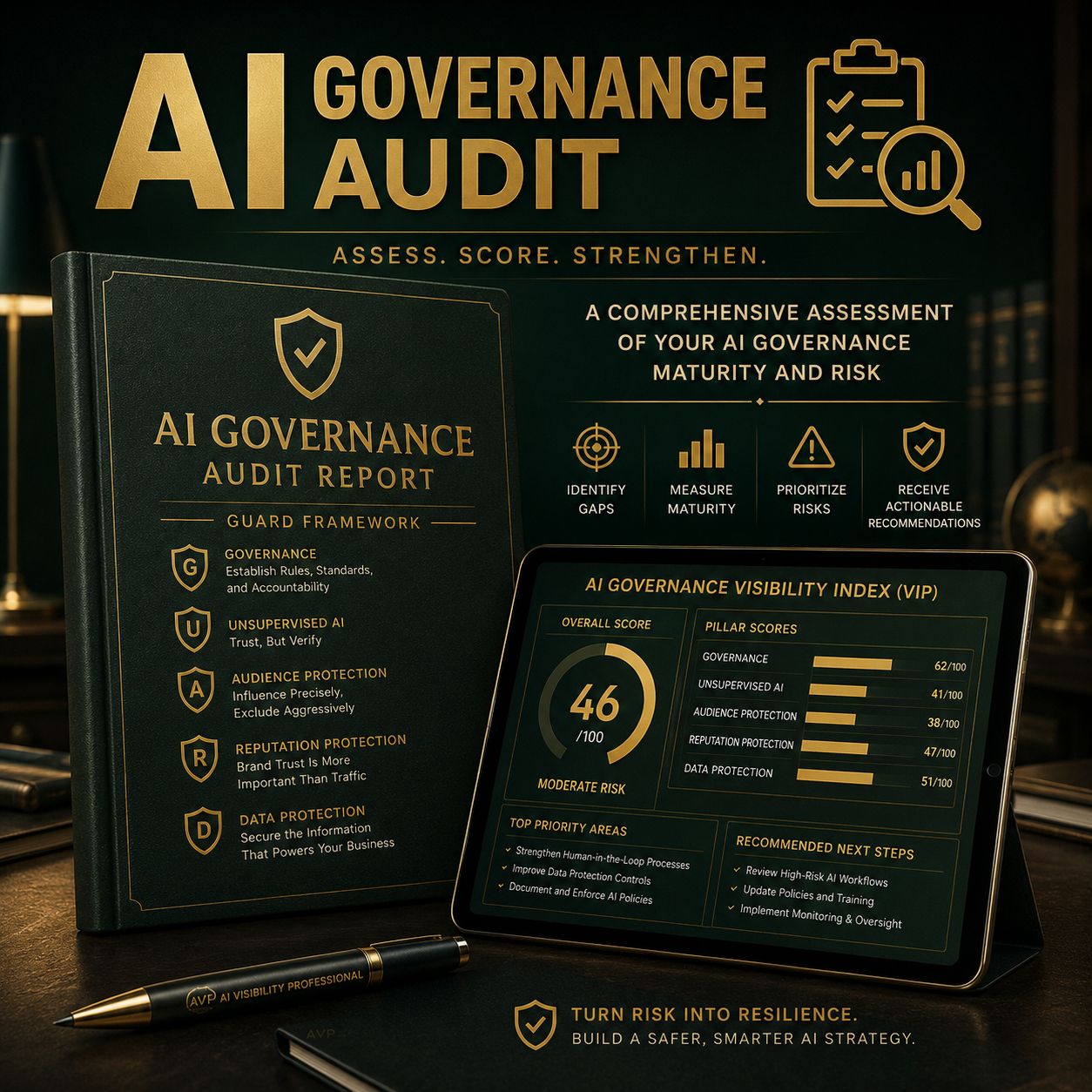
Most businesses can’t answer this question accurately on their own, which is exactly the problem the AI Governance Audit ($300) is built to solve. The Audit is a guided assessment that places a business precisely on the maturity model, across all five GUARD pillars, with a clear executive summary of what’s actually in place versus what only appears to be in place.
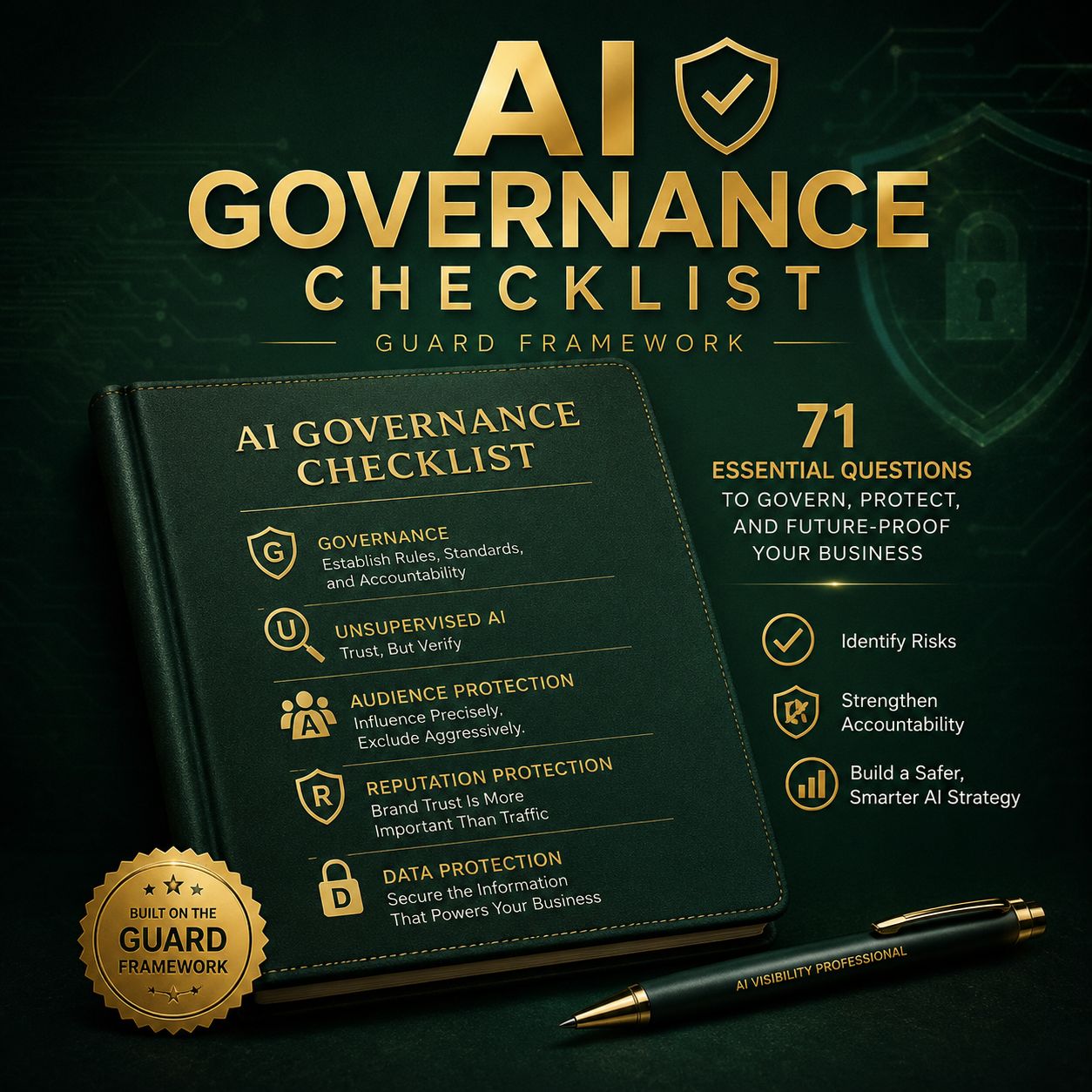
If you haven’t done any initial self-assessment yet, the AI Governance Checklist ($50) is the right starting point: a self-guided diagnostic across seventy-one questions that gives you a first read before a guided assessment.
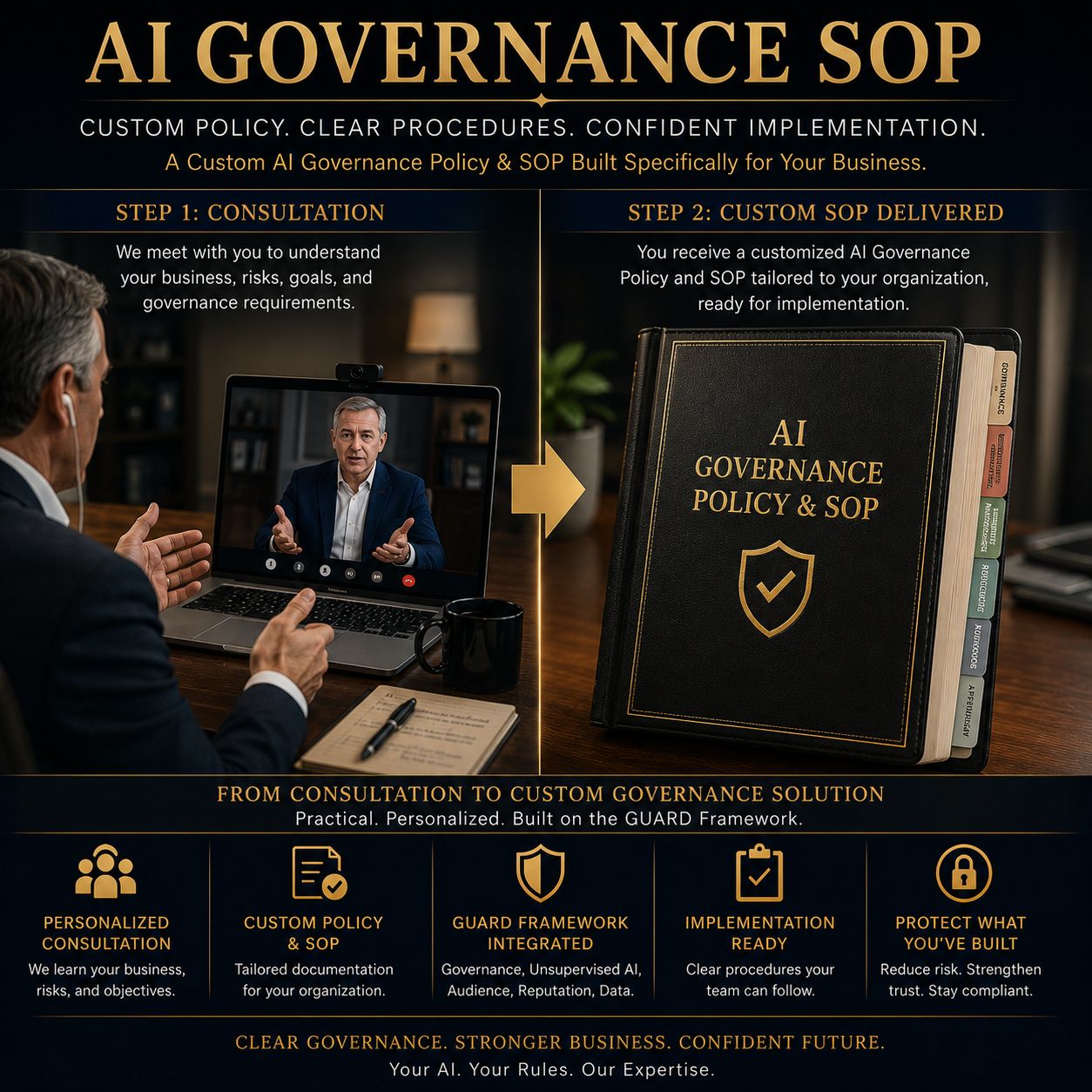
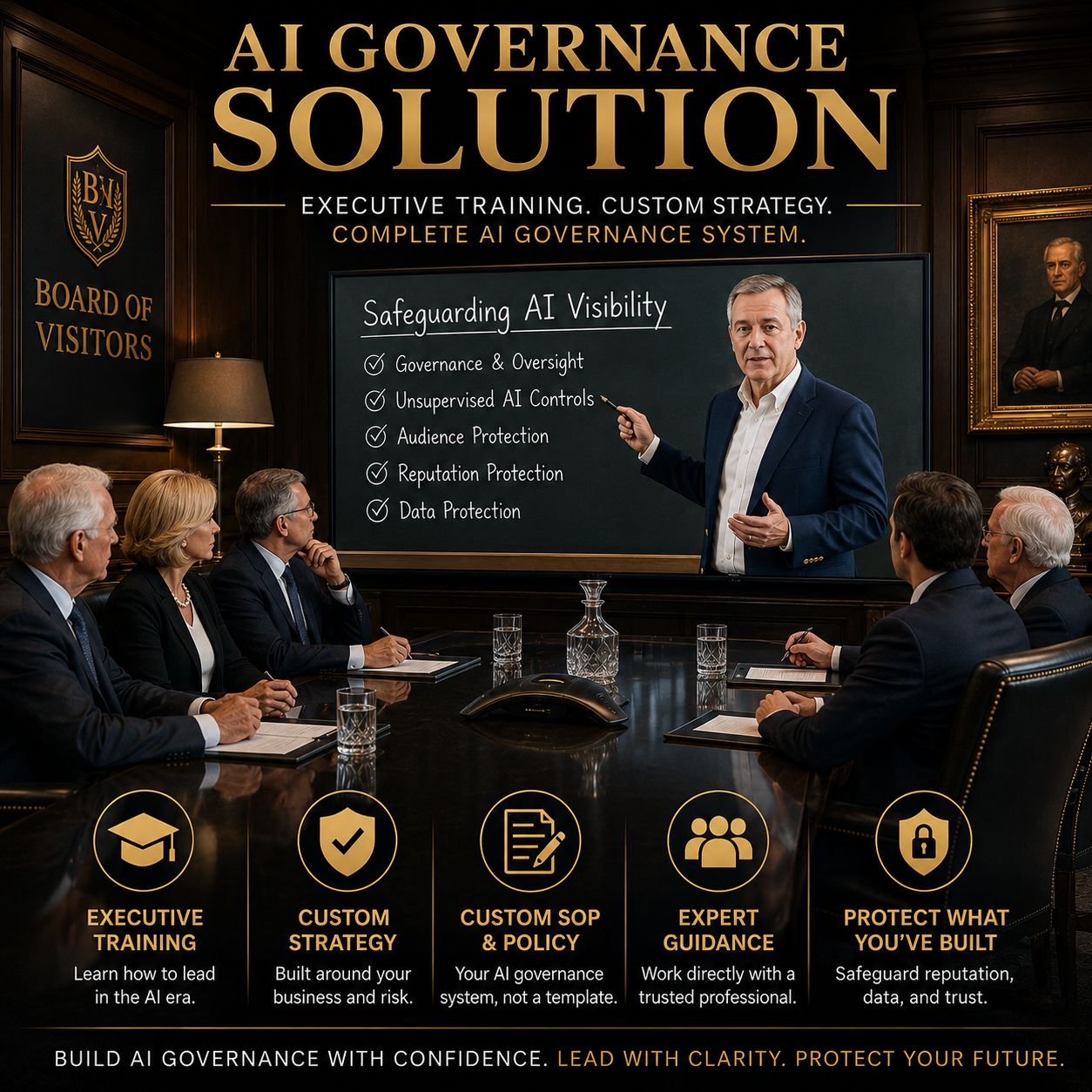
If the Audit places your business at Aware or Developing, the next step is building the actual AI Policy & SOP through the AI Governance Policy ($1,000), built specifically for your organization rather than adapted from a template. A business that wants the complete engagement, audit, policy, implementation guidance, and direct consulting, moves to the AI Governance Solution ($3,000).
The point of the maturity model is not to make a business feel behind. Most businesses are Aware right now, which means most businesses are exactly where they should expect to be. The point is to make the next step obvious instead of speculative.
Frequently Asked Questions (FAQs)
What is the AI Governance Maturity Model?
The AI Governance Maturity Model is a four-stage framework, Unguarded, Aware, Developing, and Guarded, that describes how an organization’s AI governance practice develops from no awareness of AI risk to a fully operating program with deliberate, recurring review.
What stage are most businesses actually at?
Most businesses are at the Aware stage. Leadership recognizes that AI governance is a real risk, but no policy, procedure, or owner has been put in place yet. Very few businesses remain entirely Unguarded once they look closely at how AI is already being used internally.
What does it actually take to be considered Guarded?
A business is Guarded when five specific things are in place and operating together: an AI Policy & SOP exists, new employees read it, employees are trained on specific AI tools, there’s a deliberate recurring mechanism for discussing AI governance using the GUARD Framework, and updates from those reviews are added back into the policy.
Is having a written AI policy enough to be considered Guarded?
No. A written policy with no recurring review, no employee training, and no update cycle reflects the Developing stage, not Guarded. Guarded requires the policy to be actively used and maintained, not just written.
How do I know what stage my business is actually at?
Most businesses misjudge their own maturity in one direction or the other. An AI Governance Audit provides a guided, objective assessment across all five GUARD pillars to identify your actual current stage rather than where you assume you stand.
Do I need an AI governance platform to get started?
No. AI governance platforms are most useful once a documented AI Policy & SOP already exists and is being actively used. A business at an earlier stage typically needs an assessment and a written policy before a platform adds meaningful value.
Can a business skip stages in the maturity model?
Not effectively. A business that invests in advanced tools or platforms before establishing a basic AI Policy & SOP typically ends up with expensive software monitoring a program that doesn’t actually exist yet.
Why does the Guarded stage require a recurring meeting specifically?
Without a recurring, deliberate review, a written policy tends to go stale and gets quietly ignored. The review is what catches changes early, so updates can be made to the AI Policy & SOP and taught to employees as needed, rather than discovered months later after something has already gone wrong.
What is the most common mistake businesses make with AI governance tools?
The most common mistake is purchasing monitoring or compliance software before a basic AI Policy & SOP and a named owner exist. Tools can support an existing governance program, but they cannot create one.
Who should own AI governance if it’s currently split across departments?
A program split across IT, HR, and operations often looks covered on paper, but no single person is accountable for the cycle continuing to run. A business should identify one person, ideally a trained AI Visibility Professional, to own the AI governance cycle specifically, rather than leaving it distributed across departments that each hold only a piece of it.
How does the AI Governance Audit relate to the maturity model?
The AI Governance Audit is the assessment that places a business on the maturity model. It evaluates current practices across all five GUARD pillars and identifies which stage, Unguarded, Aware, Developing, or Guarded, the business is actually operating in.
Key Takeaways
- The AI Governance Maturity Model has four stages: Unguarded, Aware, Developing, and Guarded.
- Most businesses are at Aware, not Unguarded. They know the risk is real but haven’t built anything yet.
- Guarded is a checkable status defined by five specific requirements operating as a continuous cycle, not a general feeling of responsibility.
- A policy nobody reads, or a meeting that never actually happens, means a business is Developing, not Guarded.
- Updates to the policy and to employee training happen as needed, not on a fixed schedule, which is what keeps Guarded status from quietly lapsing.
- Tools and platforms support an existing governance program. They cannot create one.
- AI governance split across multiple departments often looks covered, but tends to fail because no single person owns the full cycle.
- The right investment depends entirely on current stage, not on what’s trending in the market.
- An AI Governance Audit provides the objective assessment most businesses cannot accurately perform on their own.
About the Author
Christopher Littlestone is a retired U.S. Army Special Forces (Green Beret) Lieutenant Colonel, entrepreneur, author, and AI Visibility Strategist. He founded Special Operations University, where his cybersecurity and small business security courses have enrolled more than 4,000 students with an overall 4.9 Trustpilot rating. He is the creator of the FOUND, PAID, and GUARD Frameworks and the founder of the AI Visibility Professional (AVP) certification standard, which formalizes competent practice in AI visibility and AI governance for businesses.
Final Thoughts
A maturity model isn’t a scorecard meant to make a business feel behind. It’s a map. It tells a business exactly where it stands, what the next stage actually requires, and what to ignore until it matters.
Most businesses reading this are at Aware. They already know AI governance matters. What they don’t yet have is a policy anyone has read, a meeting anyone actually holds, or a cycle that keeps both current.
That gap is closeable, and it doesn’t require an enterprise budget to close it.
AI Governance Checklist
$50 - A self-guided diagnostic across seventy-one questions that shows you exactly where your AI governance gaps are.
AI Governance Audit
$300 - A professional (human-led) assessment to identify your strengths, your shortfalls, and exactly where to go next.
AI Governance Policy
$1000 - A custom AI Policy & SOP built specifically for your organization, ready to implement.
AI Governance Solution
$3000 - The complete engagement: audit, policy, implementation guidance, and direct consulting with Christopher Littlestone.