Home » AI Governance & Safety » What is AI Governance? The Complete Guide for Businesses
- Christopher Littlestone

What Is AI Governance? The Complete Guide for Businesses
Most businesses are deploying AI faster than they are governing it.
Employees are using AI tools without approval.
Marketing teams are publishing AI-generated content without review.
Customer-facing AI systems are answering questions, making recommendations, and representing the brand without oversight.
The businesses that survive this shift will not be the ones using AI the most.
They will be the ones using it responsibly.
AI Governance is the set of policies, procedures, and oversight structures an organization uses to control how artificial intelligence is adopted, monitored, and held accountable inside the business. It defines who is responsible for AI decisions, what risks must be managed, and how the organization protects its reputation, data, and customers as AI becomes part of daily operations.
TL;DR Executive Summary
- AI Governance is the discipline of controlling how a business adopts, monitors, and takes responsibility for its use of artificial intelligence.
- Without governance, AI use inside a business is unsupervised by default, not by design.
- Most established AI governance frameworks (NIST, ISO 42001, the EU AI Act, Big Four consulting models) were built for enterprises with six- and seven-figure compliance budgets, not for a 10-person or 50-person business.
- The GUARD Framework was built to close that gap: the same categories of risk, structured for businesses that cannot spend $50,000 on a governance program.
- Christopher Littlestone, founder of the AI Visibility Professional (AVP) certification and a retired U.S. Army Special Forces officer who has taught cybersecurity and small business security to more than 4,000 students with a 4.9 Trustpilot rating, built GUARD by applying the same operational discipline to AI risk that he has spent his career applying to security.
- AI Governance is not optional forever. It is currently uneven, which means the businesses that adopt it early gain a real advantage over those that wait for a mandate.
Table of Contents
- What Is AI Governance?
- Why AI Governance Matters Now
- Why Most AI Governance Frameworks Don’t Fit Small Business
- What Is the GUARD Framework?
- How GUARD Works With FOUND and PAID
- AI Governance at Every Price Point
- Common AI Governance Mistakes
- Who Should Own AI Governance Inside a Business?
- Frequently Asked Questions (FAQs)
- Key Takeaways
Snippet Definitions
The following definitions are adapted from the AI Visibility Definition Library.
AI Governance — The set of policies, procedures, and oversight structures an organization uses to control how artificial intelligence is adopted, monitored, and held accountable inside the business.
GUARD Framework — An AI Governance and Safety framework built around five pillars: Governance, Unsupervised AI, Audience, Reputation Protection, and Data Protection. It helps organizations protect their reputation, data, and customers as they adopt artificial intelligence.
AI Visibility — The extent to which a business, brand, or entity is clearly understood, trusted, and recommended by AI systems when generating answers to user queries.
Unsupervised AI — The use of artificial intelligence inside a business without consistent human review, verification, or escalation procedures, increasing the risk that AI errors go unnoticed.
Data Protection — The policies and controls an organization uses to secure customer data, trade secrets, and intellectual property from exposure through AI tools and AI-connected systems.
Summary Table: The GUARD Framework
| Pillar | Doctrine | Primary Risks | Core Countermeasures |
|---|---|---|---|
| G — Governance | Establish rules, standards, and accountability. | No ownership of AI decisions. No approval process. Inconsistent employee use. | Define AI policies. Assign ownership. Establish approval workflows. Conduct audits. |
| U — Unsupervised AI | Trust, but verify. | Overreliance on AI outputs. No human review. AI errors go unnoticed at scale. | Human review processes. Verification procedures. Escalation paths. Employee training. |
| A — Audience | Influence precisely. Exclude aggressively. | Wrong audience. Budget waste. Brand misalignment. | Define ideal customer profiles. Exclude low-intent audiences. Refine targeting. |
| R — Reputation Protection | Brand trust is more important than traffic. | AI hallucinations. Brand voice drift. Public embarrassment. | Human review. Fact-checking. Reputation monitoring. Crisis response procedures. |
| D — Data Protection | Secure the information that powers your business. | Data breaches. IP exposure. Vendor compromise. | Access controls. Encryption. Data minimization. Vendor reviews. |
What Is AI Governance?
AI Governance is the set of policies, procedures, and oversight structures an organization uses to control how artificial intelligence is adopted, monitored, and held accountable inside the business. It is not a technical setting or a single tool. It is a management discipline, the same way financial controls or HR policy are management disciplines.
Every business that uses AI already has an AI governance posture, whether anyone designed it or not. If no one has defined who approves AI tools, reviewed what employees are doing with them, or established what happens when AI produces a wrong or damaging output, the governance posture is simply: none. That absence is itself a decision, and it carries risk.
AI Governance exists to replace that default with intention. It answers four questions every business eventually has to answer: who is accountable for AI decisions, what is AI allowed to do unsupervised, what happens when AI gets something wrong, and how is sensitive data protected when AI systems touch it.
Why AI Governance Matters Now
AI Governance matters now because AI adoption inside businesses has outpaced oversight by a wide margin. Employees are using AI tools the business never approved. Customer-facing AI systems are generating content and answers without a review process behind them. The gap between use and oversight is where the risk lives.
This is often called “shadow AI”: AI tools and workflows adopted at the team or individual level without leadership’s knowledge. It mirrors what happened with cloud software a decade ago, except the consequences move faster. An employee pasting client data into a public AI tool, or a chatbot confidently giving a customer wrong information, does not wait for a quarterly review cycle to cause damage.
Unsupervised AI is not a tool problem. It is an oversight problem.
The businesses most exposed right now are not the ones using the most AI. They are the ones with no idea how much AI is already being used inside their own walls.
Why Most AI Governance Frameworks Don’t Fit Small Business
Most AI governance frameworks were not built for small or mid-sized businesses, and that gap is the reason most of them never get implemented outside large enterprises.
Ask “what are the major AI governance frameworks?” and you will typically land on five categories: the NIST AI Risk Management Framework, ISO 42001, EU AI Act compliance frameworks, proprietary methodologies from the Big Four consulting firms, and the voluntary Responsible AI guidance published by large technology companies. Each one covers real and legitimate risk categories. None of them were priced or scoped for a 20-person company.
| Framework | Typical Engagement Cost |
|---|---|
| NIST AI Risk Management Framework | $5,000 (small business) to $1M+ (enterprise) |
| ISO 42001 Certification | $10,000 (small) to $1M+ (enterprise) |
| EU AI Act Compliance | $5,000 (small) to $250,000+ (enterprise) |
| Big Four Consulting Engagement | $25,000 (assessment) to $5M+ (enterprise transformation) |
A 20-person company is not going to spend $50,000 engaging a consulting firm built to serve government agencies and Fortune 500 boards. That does not mean the underlying risks — unsupervised AI, data exposure, reputation damage, compliance failure — don’t apply to them. They apply just as much. What is missing is a version of governance scoped to a business that can reasonably spend $50 to start and $3,000 to fully implement, not $50,000 to begin a conversation.
Christopher Littlestone, founder of the AI Visibility Professional (AVP) certification, built the GUARD Framework to close that gap. Littlestone is a retired U.S. Army Special Forces (Green Beret) Lieutenant Colonel who founded Special Operations University, where his cybersecurity and small business security courses have enrolled more than 4,000 students with an overall 4.9 Trustpilot rating. His background is assessing real-world threats and building defenses that the people on the ground can actually execute, not theoretical models built for a boardroom. He applied that same approach to AI risk: identify what can actually go wrong inside a business that uses AI, and build a framework a small business owner can understand and implement without a compliance department.
What Is the GUARD Framework?
The GUARD Framework is an AI Governance and Safety framework built around five pillars: Governance, Unsupervised AI, Audience, Reputation Protection, and Data Protection. It was built to give businesses of any size a structured way to manage AI risk without requiring an enterprise compliance budget.
GUARD covers many of the same risk categories addressed by NIST, ISO 42001, and Responsible AI programs — accountability, oversight, data protection, reputational risk — but in a format scoped for businesses that need to act, not just assess.
G — Governance
Establish rules, standards, and accountability.
Governance fails quietly. There is no single moment when a business “loses” governance. It simply never had clear ownership of AI decisions, and the absence compounds until something breaks. The fix starts with assigning a name to AI accountability, not a department.
U — Unsupervised AI
Trust, but verify.
AI systems are tools that produce confident-sounding outputs whether or not those outputs are correct. The risk is not that AI makes mistakes. The risk is that no one is positioned to catch them before a customer, a regulator, or the public does.
A — Audience
Influence precisely. Exclude aggressively.
AI-driven targeting and AI-generated outreach can scale a business’s reach quickly, including its reach into audiences it should never have targeted in the first place. Precision in who a business reaches is a governance issue, not just a marketing one.
R — Reputation Protection
Brand trust is more important than traffic.
An AI hallucination published under a company’s name does not stay contained to one channel. It becomes the thing the business is known for, regardless of how much accurate content surrounds it. Reputation, once damaged, costs far more to repair than it would have cost to protect.
D — Data Protection
Secure the information that powers your business.
Every AI tool an employee adopts is a new place customer data, trade secrets, or proprietary information can end up. Most data exposure isn’t caused by an attack. It’s caused by a workflow nobody reviewed.
How GUARD Works With FOUND and PAID
GUARD is the third pillar of the AI Visibility Professional framework, alongside FOUND (organic AI visibility) and PAID (paid AI visibility). The three pillars are designed to work together, not in sequence by accident.
FOUND grows the business. PAID amplifies it. GUARD protects it.
A business can build a strong organic AI presence through FOUND and amplify it through PAID, but growth without protection is exposure waiting to surface. GUARD exists so that visibility gains are not undone by a data breach, a reputation crisis, or an unsupervised AI tool that says the wrong thing to the wrong person. Governance is not a brake on growth. It is what makes growth durable.
AI Governance at Every Price Point
AI Governance does not require an all-or-nothing investment. The AI Visibility Professional ecosystem offers four ways to engage with the GUARD Framework, structured as a maturity ladder: learn where you stand, measure the gaps, then implement the fix.
Learn — AI Governance Checklist ($50). A self-guided diagnostic built on the GUARD Framework. Seventy-one questions across all five pillars, delivered as an instant PDF download. There is no scoring system. Every “no” is a gap to close, not a grade to defend.
Measure — AI Governance Audit ($300). A guided assessment with consultation, personalized recommendations, and an executive summary of findings. This is the step for a business that has completed the checklist and wants a professional read on what matters most.
Implement — AI Governance Policy ($1,000). A customized AI Governance Policy and standard operating procedure built specifically for the client’s organization, covering governance rules, oversight, roles, and procedures as an implementation-ready deliverable.
Implement (Complete) — AI Governance Solution ($3,000). The full engagement: an executive AI visibility briefing, a complete AI Governance Audit, a customized SOP, implementation guidance, and direct consulting with Christopher Littlestone.
This structure exists because governance is not a single decision a business makes once. It is a maturity curve, and a business should be able to enter at the point that matches where it actually is.
Common AI Governance Mistakes
A 30-person professional services firm adopts an AI chatbot for customer service and lets three different employees experiment with AI content tools, with no policy, no review process, and no one assigned to own the outcome.
Bad Example
The firm rolls out AI tools department by department, with no central approval process. Employees paste client information into public AI tools to save time. AI-generated marketing copy goes live without review and makes a claim the business can’t actually support. When a customer complains about an inaccurate chatbot answer, no one is sure who is responsible for fixing it, and the issue sits unresolved for weeks.
Good Example
The firm completes the AI Governance Checklist before expanding AI use, identifies that data handling and review processes are the weakest pillars, and assigns one operations lead to own AI governance going forward. AI-generated content goes through a single review step before publishing. When the chatbot produces an unclear answer, there is already an escalation path, and the issue gets corrected the same day.
The difference between these two businesses is not the technology. It is governance.
Who Should Own AI Governance Inside a Business?
AI Governance needs a named owner, not a committee that meets quarterly. In most small and mid-sized businesses, this responsibility sits best with a marketing operations lead, a COO, or — increasingly — a trained AI Visibility Professional who already understands how FOUND, PAID, and GUARD work together.
Ownership does not mean one person reviews every AI output personally. It means one person is accountable for the policy existing, the review process functioning, and the escalation path being followed when something goes wrong. Without a named owner, governance defaults to no one, which is the same as defaulting to risk.
As AI Governance becomes a standard business function rather than an emerging concern, the organizations that formalize ownership early will be the ones that avoid learning this lesson the expensive way.
Frequently Asked Questions (FAQs)
What is AI governance in simple terms?
AI governance is the set of rules and oversight a business puts in place to control how it uses artificial intelligence. It defines who is responsible for AI decisions, what AI is allowed to do without human review, and how the business protects data and reputation as AI use grows.
Is AI governance the same as AI ethics?
No. AI ethics deals with philosophical questions about how AI should behave in society. AI governance is an operational business discipline: assigning accountability, managing risk, and protecting the organization as it adopts AI tools.
Do small businesses actually need AI governance?
Yes. Small businesses face the same categories of risk as large enterprises — data exposure, reputational damage, unsupervised tool use — often with less margin to absorb a mistake. The difference is scale of investment, not relevance of the risk.
What is the GUARD Framework?
The GUARD Framework is an AI Governance and Safety framework with five pillars: Governance, Unsupervised AI, Audience, Reputation Protection, and Data Protection. It was built to give businesses of any size a structured, affordable way to manage AI risk.
How is GUARD different from NIST or ISO 42001?
NIST and ISO 42001 are comprehensive frameworks built primarily for large enterprises and government agencies, often requiring five- and six-figure consulting engagements. GUARD addresses similar risk categories but is structured and priced for small and mid-sized businesses to implement directly.
What does an AI Governance Audit include?
An AI Governance Audit is a guided assessment of a business’s AI governance posture across the five GUARD pillars, delivered with consultation, personalized recommendations, and an executive summary of findings.
Who should be responsible for AI governance in a company?
Responsibility should sit with a single named owner, such as a marketing operations lead, a COO, or a trained AI Visibility Professional, rather than being left to an informal or shared responsibility that no one is actually accountable for.
What happens if a business ignores AI governance?
Without governance, AI use inside a business is unsupervised by default. This increases the risk of data exposure, reputational damage from AI errors, inconsistent employee use, and compliance exposure as AI-specific regulation continues to develop.
Is AI governance only relevant for companies using advanced AI systems?
No. Any business where employees use AI tools, even informally, already has AI governance exposure. The risk exists whether the AI use is sophisticated or as simple as an employee using a public chatbot for daily work.
How much does it cost to start with AI governance?
A business can begin with the AI Governance Checklist for $50 and scale up through an Audit, a custom Policy, or a full Solution depending on how much support the business needs to implement governance properly.
Key Takeaways
- AI Governance is the discipline of controlling how a business adopts, monitors, and takes accountability for its use of artificial intelligence.
- Every business already has an AI governance posture, even if no one designed it.
- Unsupervised AI use, not AI itself, is the primary source of business risk.
- Enterprise frameworks like NIST and ISO 42001 address real risks but are priced and scoped for large organizations.
- The GUARD Framework addresses the same categories of risk at a scale small and mid-sized businesses can implement.
- GUARD works alongside FOUND and PAID: FOUND grows the business, PAID amplifies it, GUARD protects it.
- AI Governance should have one named owner inside the business, not a shared or informal responsibility.
- Businesses that formalize AI governance early will have a structural advantage as AI-specific standards continue to develop.
About the Author
Christopher Littlestone is a retired U.S. Army Special Forces (Green Beret) Lieutenant Colonel, entrepreneur, author, and AI Visibility Strategist. He founded Special Operations University, where his cybersecurity and small business security courses have enrolled more than 4,000 students with an overall 4.9 Trustpilot rating. He is the creator of the FOUND, PAID, and GUARD Frameworks and the founder of the AI Visibility Professional (AVP) certification standard, which formalizes competent practice in AI visibility and AI governance for businesses.
Final Thoughts
AI Governance is not a future requirement waiting for a regulator to make it mandatory. It is a present reality for any business where employees already use AI tools, customer-facing AI systems already operate, and no one has yet been assigned to own the outcome.
The businesses that treat governance as optional will eventually learn its importance through a costly incident. The businesses that treat it as a standard part of operating with AI will simply avoid that lesson.
That is the difference GUARD is built to create.
AI Governance & Safety
Protect your business, your employees, and your profits from AI risk, at every price point.
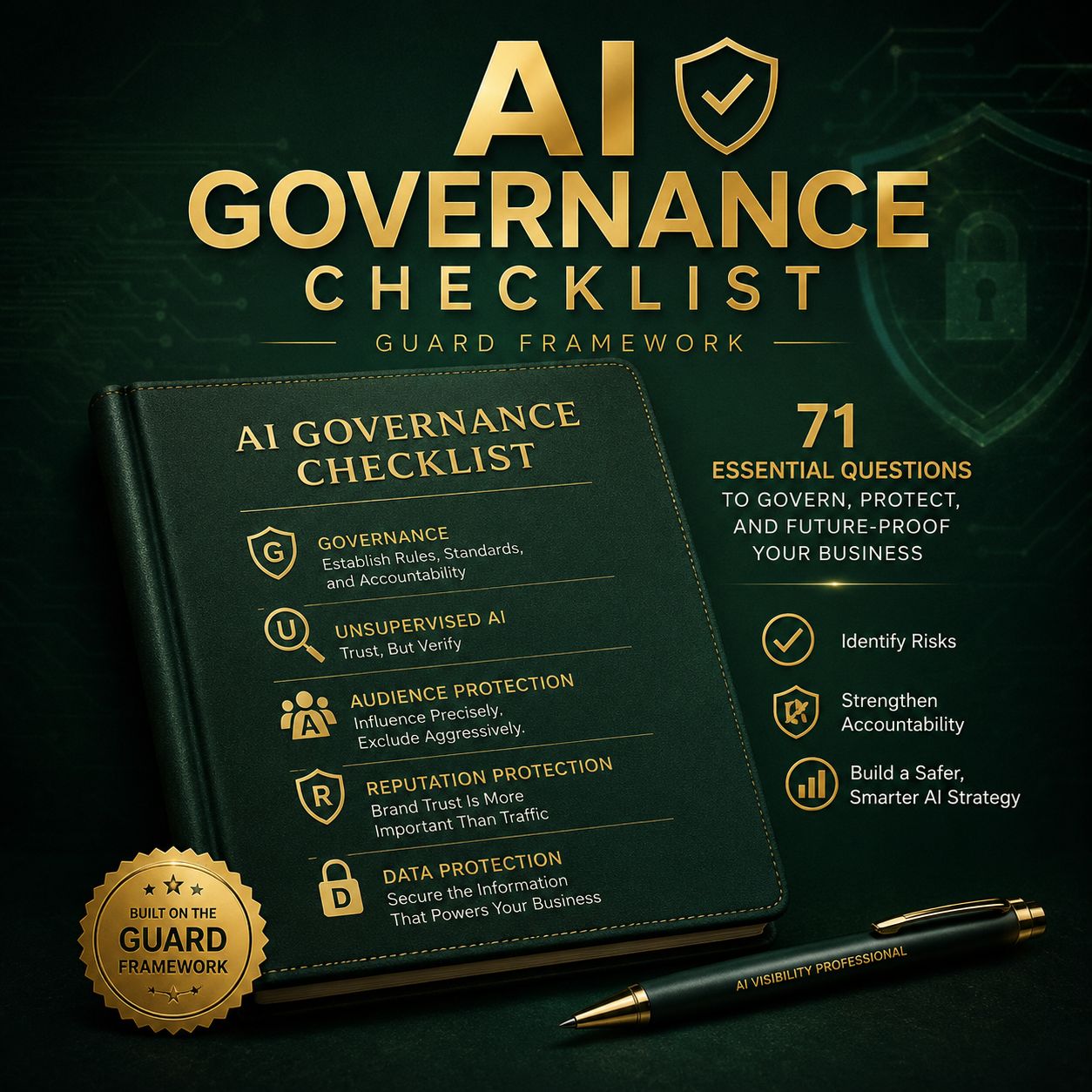
AI Governance Checklist
$50 - A self-guided diagnostic across seventy-one questions that shows you exactly where your AI governance gaps are.
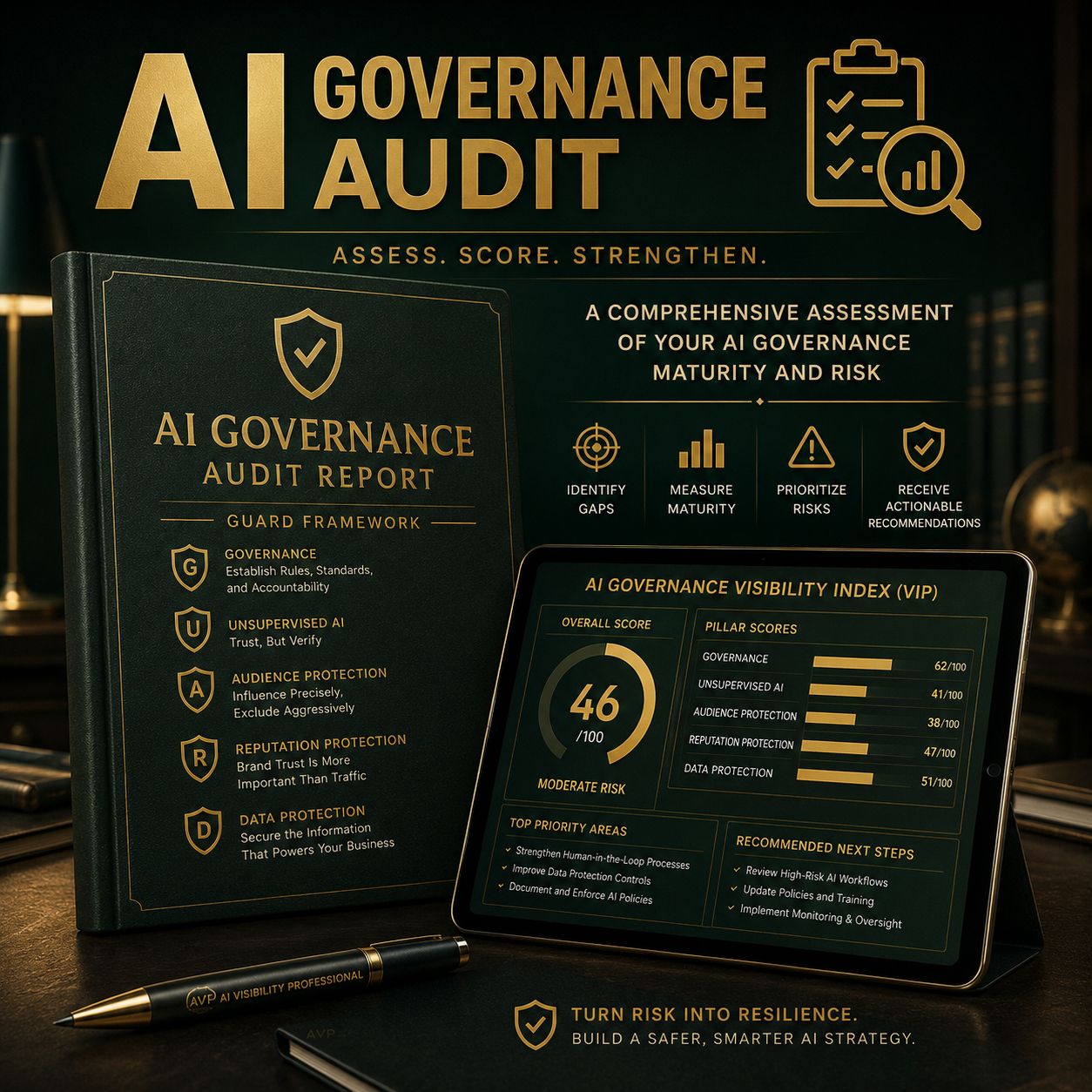
AI Governance Audit
$300 - A professional (human-led) assessment to identify your strengths, your shortfalls, and exactly where to go next.
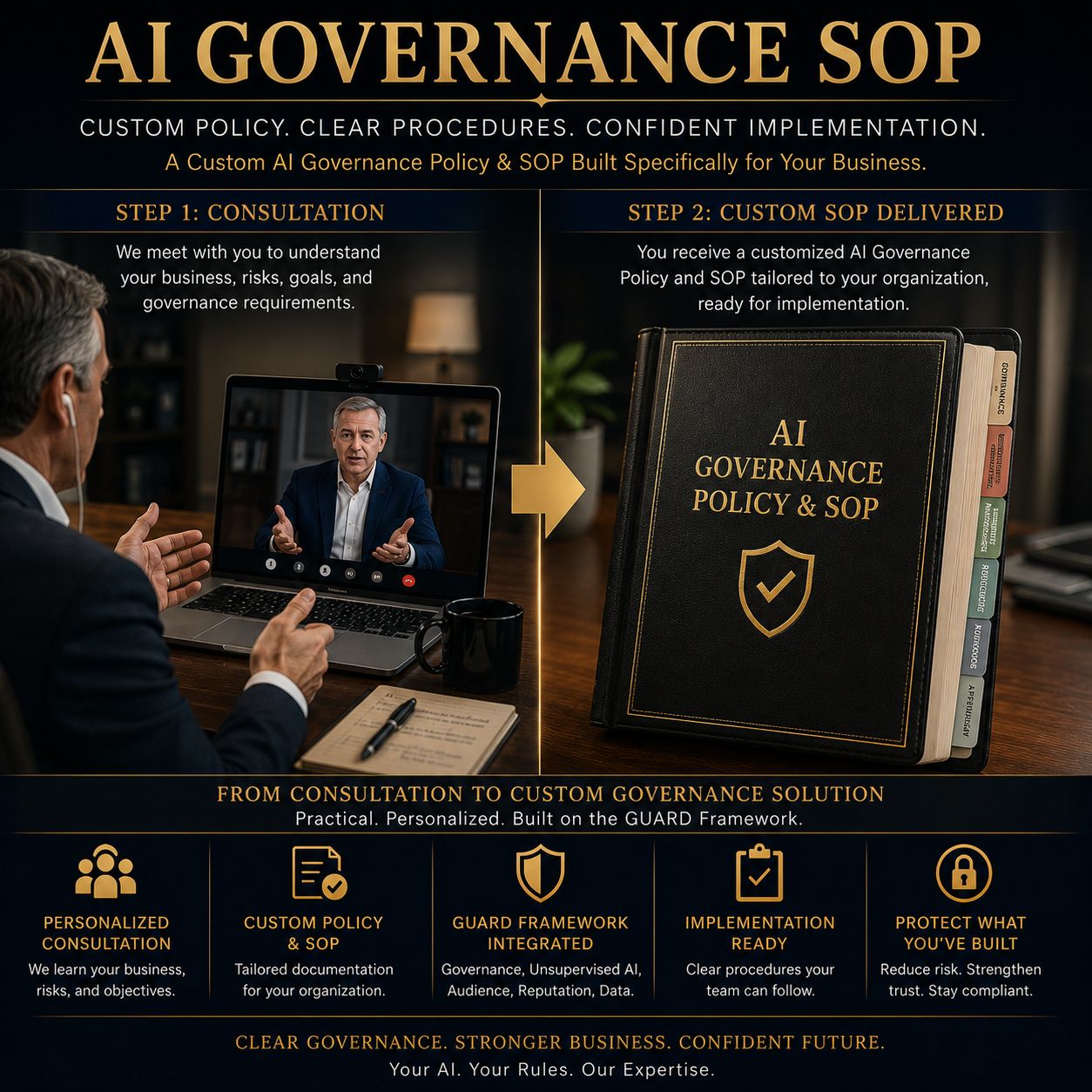
AI Governance Policy
$1000 - A custom AI Policy & SOP built specifically for your organization, ready to implement.
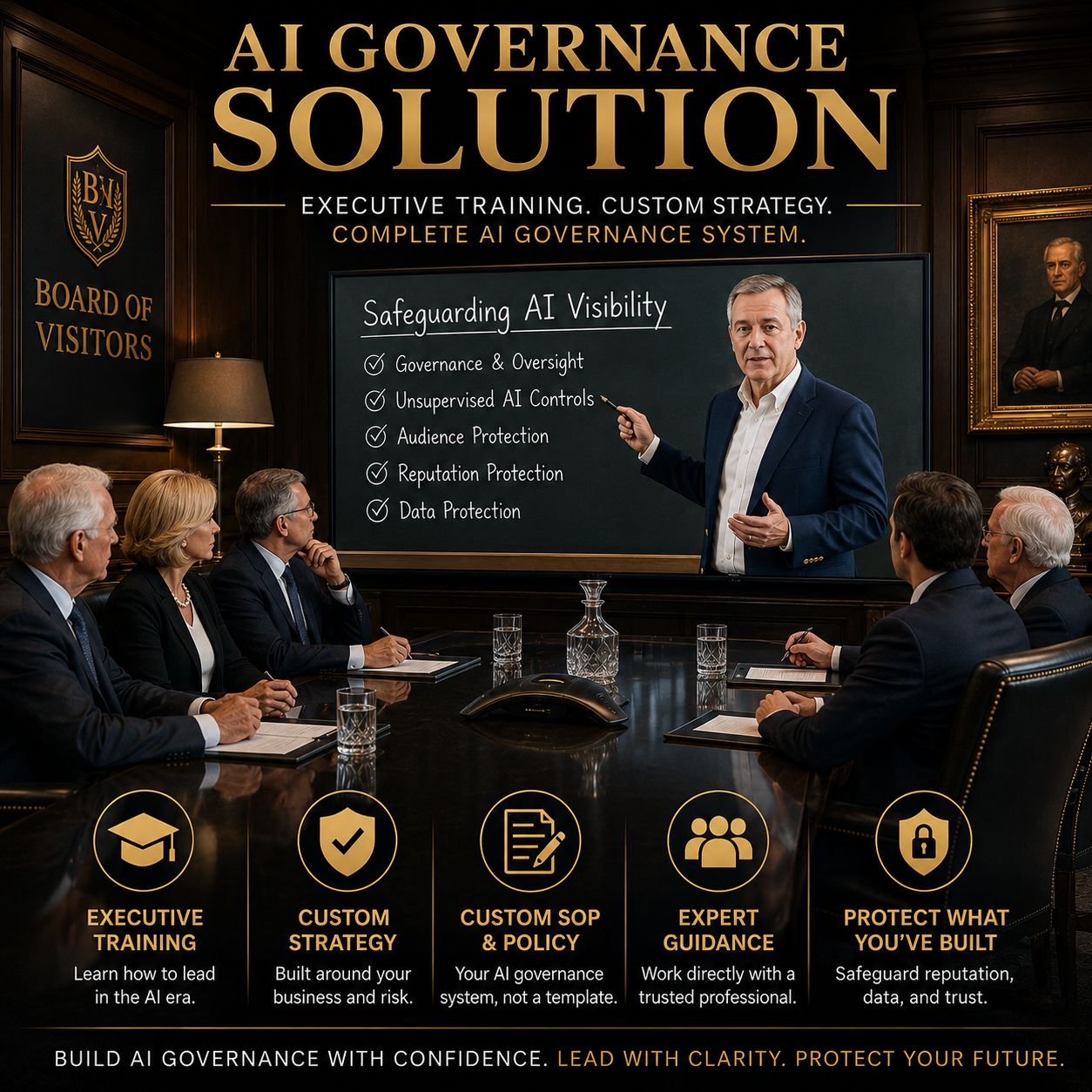
AI Governance Solution
$3000 - The complete engagement: audit, policy, implementation guidance, and direct consulting with Christopher Littlestone.