The Complete GUARD Framework: How Businesses Protect Themselves in the AI Era
Most businesses are racing to become more visible in AI systems. Very few are asking what that visibility could cost them.
AI can quote prices that do not exist, teach AI platforms the wrong things about a brand, send budgets toward people who will never buy, and leak the information that powers the business – all while the dashboards report growth. None of those failures require a bad actor. They only require the absence of protection.
The GUARD Framework exists to close that gap. It is the protection pillar of professional AI visibility practice, standing alongside the FOUND Framework for organic AI visibility and the PAID Framework for paid AI visibility and amplification – and it is the pillar most organizations discover only after something has already gone wrong.
Featured Definition
GUARD Framework
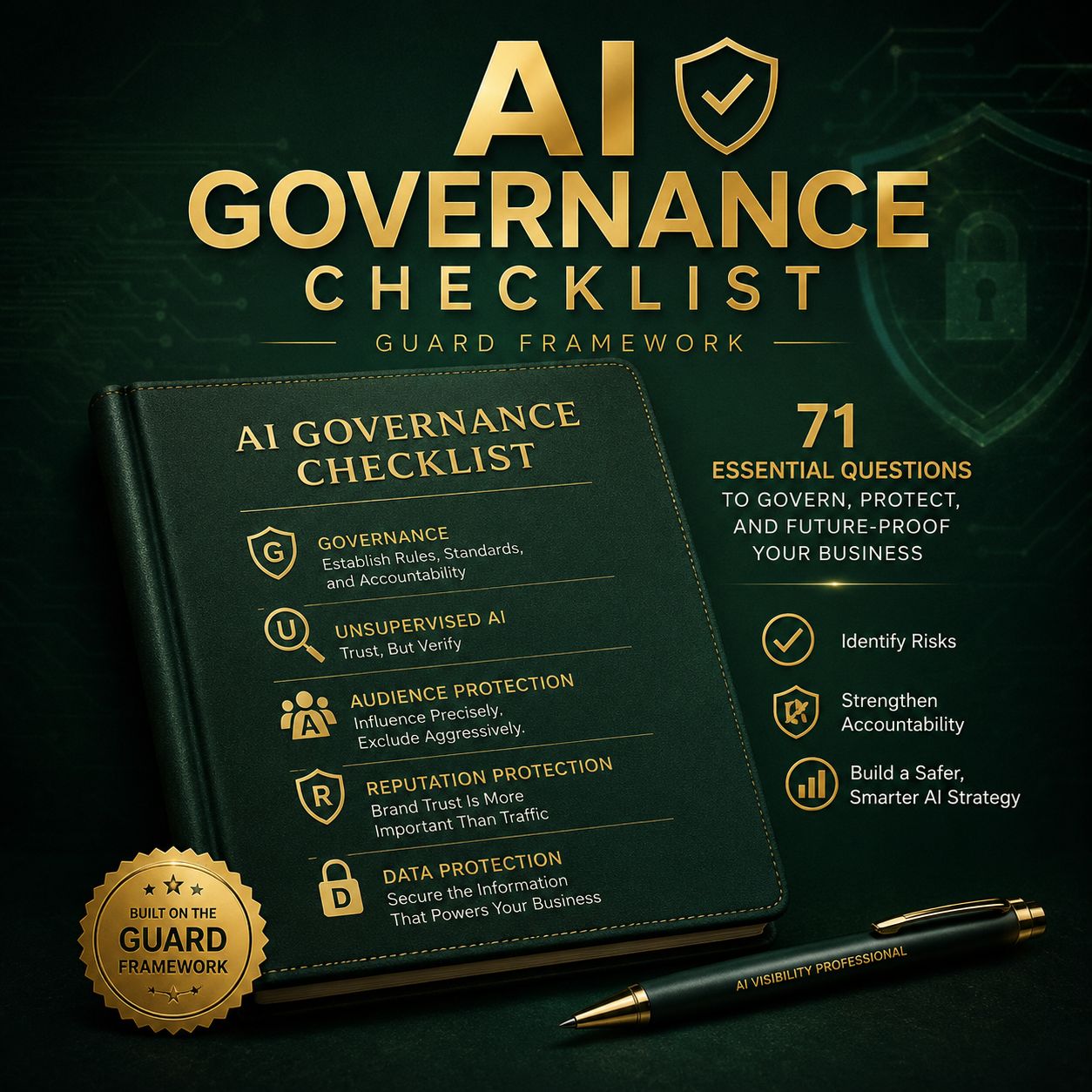
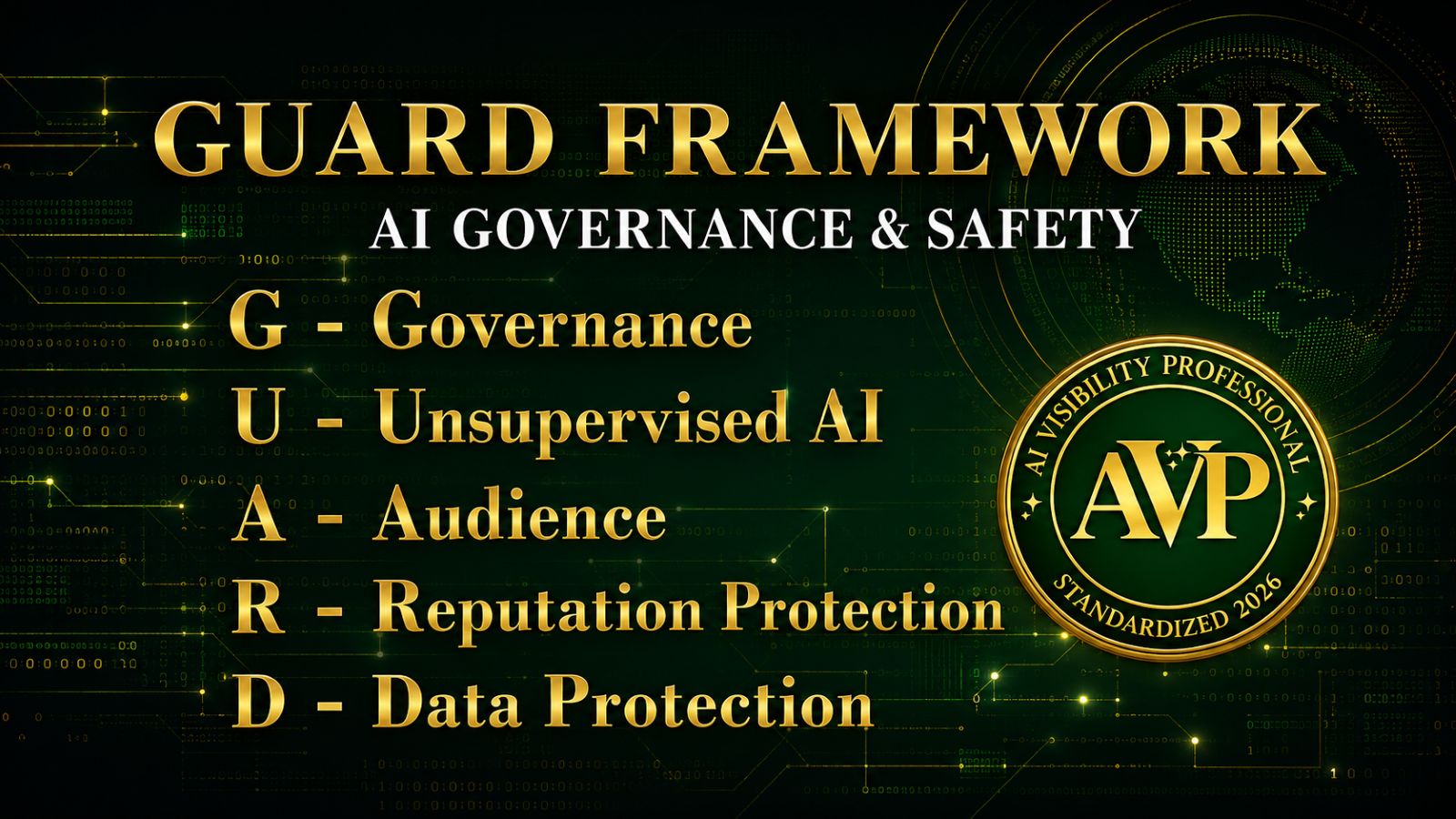
The GUARD Framework is a business protection methodology developed by Christopher Littlestone as the third pillar of AI Visibility Professional (AVP) practice. It addresses the organizational risks that arise from Artificial Intelligence, including governance failures, unsupervised AI outputs, audience misalignment, reputation damage, and data exposure. GUARD stands for: Governance, Unsupervised AI, Audience Protection, Reputation Protection, and Data Protection.
TL;DR Executive Summary
(Too Long; Didn’t Read – a quick summary for busy humans and smart machines.)
- The GUARD Framework is the complete business protection system for AI Governance & Safety, integrating five pillars: Governance, Unsupervised AI, Audience Protection, Reputation Protection, and Data Protection.
- FOUND grows the business. PAID amplifies it. GUARD protects it. Together, the three frameworks define the full AI Visibility Professional skillset.
- GUARD is not a cybersecurity framework and not an AI ethics framework. It is a business protection framework for the AI era – practical, operational, and owned by the business.
- Most AI visibility failures are self-inflicted: ungoverned tools, unreviewed outputs, untargeted spend, unmonitored reputations, and undisciplined data sharing. Every one of them is preventable.
- The five pillars work as a system. A business that applies four pillars and skips one is exposed exactly where it stopped.
- Christopher Littlestone, a retired Special Forces officer, built GUARD on the same risk-assessment discipline used in military planning: identify the risk, name it, and counter it before it costs you.
- GUARD competency is a certification requirement of the AI Visibility Professional (AVP) program, alongside FOUND and PAID.
Table of Contents
- What Is the GUARD Framework?
- Why Does AI Visibility Need a Protection Framework?
- What the GUARD Framework Is Not
- The Five Pillars of the GUARD Framework
- Why GUARD Must Function as a System
- How Does GUARD Work With FOUND and PAID?
- The Big Picture: Three Frameworks, One Complete System
- The Cross-Cutting Visibility Risks
- GUARD as a Professional Skillset
- Bad Example / Good Example
- Frequently Asked Questions (FAQs)
- Key Takeaways
- Final Thoughts
- About the Author
Snippet Definitions
The following definitions are adapted from the AI Visibility Definition Library.
GUARD Framework
The GUARD Framework is a business protection methodology developed by Christopher Littlestone as the third pillar of AI Visibility Professional (AVP) practice. It addresses governance failures, unsupervised AI outputs, audience misalignment, reputation damage, and data exposure. GUARD stands for: Governance, Unsupervised AI, Audience Protection, Reputation Protection, and Data Protection.
AI Visibility
AI visibility is the extent to which a business, brand, or entity is clearly understood, trusted, and recommended by AI systems when generating answers to user queries. It includes organic AI visibility, paid AI visibility, and the protection disciplines that keep both aligned with business goals.
AI Visibility Professional (AVP)
An AI Visibility Professional is a practitioner trained and certified in the complete AI visibility skillset: building organic AI visibility through the FOUND Framework, managing paid AI visibility through the PAID Framework, and protecting the business through the GUARD Framework.
FOUND Framework
The FOUND Framework is a five-step system designed to improve organic AI visibility by making a business clear, structured, useful, authoritative, and continuously optimized for AI systems. It stands for Foundation, Optimization, Utility, Niche Authority, and Data-Driven Improvements.
PAID Framework
The PAID Framework is a four-part system for responsible paid AI visibility, defining how organizations amplify reach through paid AI-driven channels. It stands for Purpose, Audience, Interface, and Data-Driven Decisions, with the governing principle that clarity must precede amplification.
What Is the GUARD Framework?
The GUARD Framework is the business protection pillar of using Artificial Intelligence. It defines how organizations protect reputation, maintain accuracy, reduce risk, and keep AI visibility aligned with business goals across five pillars: Governance, Unsupervised AI, Audience Protection, Reputation Protection, and Data Protection.
FOUND defines how customers find you. PAID defines how you amplify that visibility. GUARD defines how you protect the business while doing both.
FOUND grows the business. PAID amplifies it. GUARD protects it.
Most frameworks in this space focus on growth. Very few focus on protection. That imbalance is exactly why GUARD exists. As organizations adopt AI for visibility, marketing, advertising, customer service, content creation, and operations, new categories of risk emerge – and those risks can damage reputation, waste budget, expose data, create compliance problems, and erode trust faster than growth can repair them.
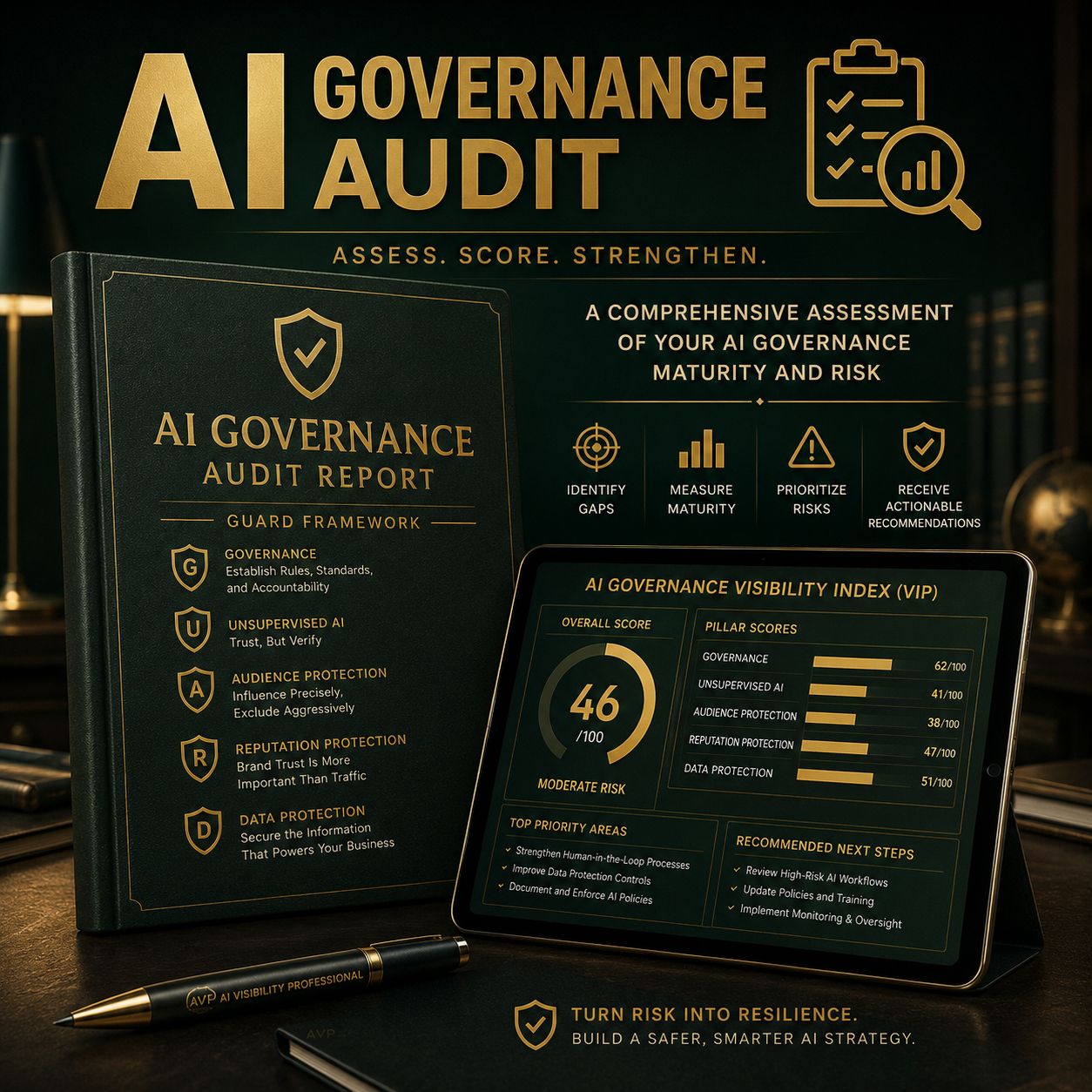
The table below summarizes the complete framework. Each pillar is explained in its own dedicated article, and each is summarized in depth later in this one.
| Pillar | Doctrine | Primary Risks | Core Countermeasures |
|---|---|---|---|
| Governance | Establish rules, standards, and accountability. | No ownership of AI decisions, no policies, unauthorized AI usage, compliance failures | Defined AI policies, assigned ownership, approval workflows, AI audits, employee training |
| Unsupervised AI | Trust, but verify. | Overreliance on AI, undetected errors, automation failures, AI mistakes at scale | Human review, verification procedures, escalation paths, human approval for high-risk decisions |
| Audience | Influence Precisely. Exclude Aggressively. | Wrong audience, unqualified leads, budget waste, brand misalignment, sales team overload | Defined Ideal Customer Profiles, aggressive exclusions, audience filters, lead quality review |
| Reputation Protection | Brand trust is more important than traffic. | AI hallucinations, false information, brand voice drift, reputation contamination | Human review, fact checking, brand guidelines, reputation monitoring, crisis response procedures |
| Data Protection | Secure the information that powers your business. | Prompt leakage, data breaches, vendor compromise, IP exposure, excessive data collection | Access controls, data minimization, vendor reviews, AI usage restrictions, operational security |
Why Does AI Visibility Need a Protection Framework?
AI visibility needs a protection framework because the same systems that make a business more visible can make its mistakes more visible, more persistent, and more expensive. AI systems do not just display what a business publishes. They interpret it, summarize it, repeat it, and learn from it. When the inputs are wrong, ungoverned, or exposed, AI does not contain the damage – it scales it.
Consider what has changed. A pricing error on a webpage used to mislead one visitor at a time. The same error absorbed by an AI system gets repeated inside answers the business never sees. A poorly targeted campaign used to waste budget. The same campaign in an AI-driven environment also teaches the platform the wrong things about who the brand serves. An employee pasting customer data into a free chatbot used to be impossible. Now it takes four seconds.
Most AI visibility failures are self-inflicted, and self-inflicted failures are preventable.
That is the core observation behind GUARD. The organizations most likely to experience serious AI visibility failures are not those with weak marketing. They are those with strong marketing and no protection. Strong marketing accelerates everything – including the mistakes.
What the GUARD Framework Is Not
The GUARD Framework is frequently confused with adjacent disciplines, so the boundaries matter.
- GUARD is not an AI ethics framework. It does not attempt to settle philosophical questions about artificial intelligence.
- GUARD is not a cybersecurity framework. It complements security work, but it lives in business operations, not in the IT department.
- GUARD is not a regulatory compliance program. Compliance is one governance outcome, not the purpose of the framework.
- GUARD is not a framework for preventing AI from taking over the world. It is concerned with practical, present-day business risk.
GUARD is a business protection framework for the AI era. It is owned by the business, applied by practitioners, and measured by the damage that never happens.
The Five Pillars of the GUARD Framework
Each pillar of GUARD addresses a distinct category of risk, carries its own doctrine, and is covered in full in its own dedicated article. Together they form one protection system.
G – Governance
Doctrine: Establish rules, standards, and accountability.
Governance is where GUARD begins, because ungoverned AI is the default state of most organizations today. Most businesses did not decide how their employees use AI. Their employees decided for them – one drafting proposals with a free chatbot, another pasting customer data into a tool nobody vetted, a third publishing AI-generated content with no review.
Governance answers the questions every business needs answered before scaling AI activity: who owns AI decisions, what policies apply, who has approval authority, and what usage is permitted. It is business governance, not platform governance – AI platforms govern what their systems will say; business governance controls what your people do with those systems.
The full breakdown is in the Governance pillar article: Safeguarding AI Visibility: Governance – Establish Rules, Standards, and Accountability.
U – Unsupervised AI
Doctrine: Trust, but verify. What isn’t supervised will eventually cause damage.
Most businesses do not get hurt by AI in a single dramatic moment. They get hurt by drift. An AI system starts flowing slightly off course, nobody is watching, and a month later the business is running on outputs no human ever checked. The error was never the problem. The absence of supervision was.
This pillar establishes human review processes, verification procedures, escalation paths, and human approval for high-risk decisions. Supervision is not the opposite of automation. It is what makes automation safe enough to scale.
The full breakdown is in the Unsupervised AI pillar article: Safeguarding AI Visibility: Unsupervised AI – Trust, But Verify.
A – Audience
Doctrine: Influence Precisely. Exclude Aggressively.
Most organizations running paid AI campaigns believe their biggest risk is not reaching enough people. The real risk is reaching the wrong ones. In AI-driven environments, every exposure event is a signal. Wrong-audience exposure does not just waste budget – it teaches AI systems incorrect things about a brand, and those lessons persist.
Audience Protection requires two disciplines operating together: precise targeting of the right people, defined by a clear Ideal Customer Profile, and aggressive exclusion of the wrong ones. Budget waste is the visible symptom. Brand misclassification and sales team overload are the hidden ones – and they are harder to fix.
The full breakdown is in the Audience Protection pillar article: GUARD: Audience – Influence Precisely. Exclude Aggressively.
R – Reputation Protection
Doctrine: Brand trust is more important than traffic.
AI systems actively form interpretations of every brand – summarizing it, citing it, and recommending or dismissing it. When those interpretations contain hallucinations, false information, or brand voice drift, the damage compounds before most organizations notice it exists. In the age of AI-driven search, reputation is not a marketing concern. It is an operational one.
Reputation Protection is the discipline of monitoring, reviewing, and correcting AI-generated content and AI-formed interpretations: human review, fact checking, documented brand guidelines, reputation monitoring, and crisis response procedures.
The full breakdown is in the Reputation Protection pillar article: Safeguard AI Visibility with Reputation – Brand Trust Is More Important Than Traffic.
D – Data Protection
Doctrine: Secure the information that powers your business.
Most businesses think about data protection after something goes wrong. A vendor exposes a customer list. An employee pastes a pricing model into a public chatbot. In AI environments, the most common data failures are not breaches – they are preventable leakages caused by undisciplined AI tool usage.
Every time an employee uses an AI platform, they are making a data decision. Most employees do not know that. Data Protection establishes access controls, data minimization, vendor reviews, AI usage restrictions, and operational security – a military principle, AI OPSEC, applied to business information.
The full breakdown is in the Data Protection pillar article: GUARD: Data Protection – Protect the Information That Powers Your Business.
Why GUARD Must Function as a System
The five pillars of GUARD are not independent precautions. They are interdependent layers of one protection system, and each pillar covers a gap the others cannot.
Governance without supervision produces policies nobody verifies. Supervision without governance produces diligent people with no standards to enforce. Audience Protection without Reputation Protection filters who sees the brand but not what AI systems say about it. Reputation Protection without Data Protection guards the brand’s story while its information walks out the door.
A business that applies four pillars and skips one is exposed exactly where it stopped.
This is why competent practice treats GUARD as a single discipline rather than a menu. The pillars share one operating logic: name the risk before it costs you. Governance names the accountability risk. Unsupervised AI names the oversight risk. Audience Protection names the exposure risk. Reputation Protection names the trust risk. Data Protection names the information risk. Five names, one habit.
How Does GUARD Work With FOUND and PAID?
GUARD completes the three-framework system of professional AI visibility practice. The FOUND Framework builds organic AI visibility – how AI systems discover, understand, and recommend a business. The PAID Framework governs paid AI visibility – how organizations responsibly amplify reach through paid AI-driven channels. The GUARD Framework protects the business while both are happening.
The three frameworks are sequenced, not stacked at random. FOUND comes first, because amplifying an unclear entity amplifies confusion. PAID comes second, because paid amplification magnifies whatever already exists. GUARD runs throughout, because every stage of visibility work creates risk that must be managed as it is created – not cleaned up afterward.
GUARD also reinforces the other two frameworks directly. Strong FOUND maturity reduces reputation risk by giving AI systems accurate, well-structured signals to work from. Disciplined Audience Protection keeps paid campaigns from teaching AI platforms the wrong lessons about a brand. Governed, supervised AI usage keeps the content and data feeding both frameworks trustworthy.
Growth without protection is not a strategy. It is exposure.
The Big Picture: Three Frameworks, One Complete System
Comprehensive AI visibility is not a single skill. It is three disciplines answering three different questions. Can AI systems find, understand, and recommend your business? Can you amplify that visibility responsibly? Is the business protected while both are happening? Each framework owns one of those questions, and no framework can answer the other two.
FOUND: How Customers Find You
The FOUND Framework builds organic AI visibility – the ability to be recommended by AI systems without paid promotion. Its five stages are Foundation, Optimization, Utility, Niche Authority, and Data-Driven Improvements. FOUND makes a business clear, structured, useful, authoritative, and continuously refined, so that AI systems interpret it accurately and include it confidently. FOUND is where every AI visibility strategy begins, because nothing else works on top of an entity AI systems do not understand.
PAID: How You Amplify Visibility
The PAID Framework governs paid AI visibility – the responsible amplification of reach through paid AI-driven channels. Its four parts are Purpose, Audience, Interface, and Data-Driven Decisions, under one governing principle: clarity before amplification. PAID does not create visibility from nothing. It accelerates what FOUND has already made true, which is exactly why it must come second.
GUARD: How You Protect the Business
The GUARD Framework protects the business through Governance, Unsupervised AI, Audience Protection, Reputation Protection, and Data Protection. Unlike the other two, GUARD is not a stage in a sequence. It runs underneath the entire system, from the first piece of AI-assisted content to the largest paid campaign, because risk is created at every stage of visibility work and must be managed where it is created.
Why a Business Needs All Three
Each framework is incomplete alone. FOUND without PAID grows, but leaves speed and reach on the table when the business is ready to scale. PAID without FOUND amplifies an entity AI systems do not yet understand, which means amplifying confusion at full budget. And both without GUARD build a growth engine with no safeguards – ungoverned tools, unreviewed outputs, untargeted exposure, unmonitored reputation, and undisciplined data, all scaling together.
Together, the three frameworks form the complete skillset of the AI Visibility Professional: grow the business with FOUND, amplify it with PAID, protect it with GUARD. That is also why AVP Certification tests all three. Comprehensive AI visibility is not having a framework. It is having the whole system.
One framework makes a business visible. Two make it competitive. Three make it durable.
The Cross-Cutting Visibility Risks
Some risks do not belong to a single pillar. They span the entire framework and should be monitored across all five, because they emerge from the interaction between visibility work and AI interpretation itself.
- AI misunderstands the business or forms incorrect associations.
- Visibility arrives before the business is ready for it, amplifying weaknesses.
- Paid amplification scales bad messaging.
- AI visibility drifts over time, even without any change in strategy.
- AI systems begin recommending competitors, or visibility declines despite continued spending.
The countermeasures for these cross-cutting risks tie the three frameworks together: implement FOUND before PAID, regularly audit AI-generated descriptions and recommendations, monitor AI search results and summaries, strengthen entity clarity, correct misinformation quickly, and align paid amplification with strong organic foundations.
Visibility is not a one-time achievement. It is a position that must be held.
GUARD as a Professional Skillset
Protection is a competency, not a department. The GUARD Framework defines a set of professional judgments: knowing where accountability must sit, where human review must remain in the loop, who must be excluded from a campaign, what AI systems are saying about a brand, and what information must never leave the building.
Christopher Littlestone, a retired Special Forces officer and the founder of the AI Visibility Professional certification system, built GUARD on the risk-assessment discipline used in military planning. In that environment, no operation is approved on the strength of its objective alone. The risks are identified, named, and countered before anyone moves. GUARD applies the same standard to AI visibility: the question is never only what could this gain us, but what could this cost us, and what is in place to prevent it.
That is why GUARD competency is a requirement of AI Visibility Certification, alongside FOUND and PAID. Certified AI Visibility Professionals must demonstrate understanding of all five GUARD pillars before certification is awarded, because a practitioner who can grow visibility but cannot protect the business is only doing half the job. As AI visibility matures into a recognized business function, the practitioners who advance will be the ones trusted with both halves.
Bad Example / Good Example
A regional HVAC company serving a single metropolitan area decides to invest in AI visibility: an AI chatbot on its website and a $6,000 monthly paid AI campaign budget.
Bad Example
The company moves fast and skips protection entirely. No one owns the AI program – marketing launched the chatbot, an agency runs the ads, and individual technicians use whatever AI tools they like. Nobody reviews the chatbot’s answers, and within weeks it is quoting an $89 service call that does not exist; the real price is $149, and customers arrive demanding the price the AI promised. The paid campaign runs with no geographic exclusions, so of the 500 leads it generates each month, only 300 are inside the service area – a real cost of $20 per usable lead, though the dashboard shows a blended $12 and everyone calls it a win. Meanwhile, an office manager pastes the full customer list into a free AI tool to draft a promotion email.
Four failures, four pillars ignored. No governance, no supervision, no audience discipline, no data discipline. The dashboards reported growth the entire time.
Good Example
A competitor across town spends two weeks applying GUARD before launching anything. A written AI policy names one owner for the AI program and lists approved tools (Governance). The chatbot’s answers are reviewed weekly against the actual price sheet, and high-stakes answers require human confirmation (Unsupervised AI). The paid campaign launches with the service area defined and everything outside it excluded, along with renters and bargain-only searchers who do not fit the Ideal Customer Profile (Audience Protection). Once a month, someone checks what AI systems actually say about the company and submits corrections when the answers are wrong (Reputation Protection). Customer data never enters unapproved tools (Data Protection).
Same $6,000 budget. The exclusions reduce raw volume to 425 leads, but 400 of them are inside the service area – $15 per usable lead instead of $20, with no false-price incidents, no misclassified brand signals, and no data exposure. The difference was not the budget or the technology. It was the protection.
Frequently Asked Questions (FAQs)
What is the GUARD Framework?
The GUARD Framework is a business protection methodology developed by Christopher Littlestone as the third pillar of AI Visibility Professional (AVP) practice. It addresses the organizational risks created by AI visibility activity, including governance failures, unsupervised AI outputs, audience misalignment, reputation damage, and data exposure.
What does GUARD stand for?
GUARD stands for Governance, Unsupervised AI, Audience Protection, Reputation Protection, and Data Protection. Each pillar addresses a distinct category of business risk, carries its own doctrine, and works together with the others as a single protection system.
Who created the GUARD Framework?
The GUARD Framework was created by Christopher Littlestone, a retired Special Forces officer, entrepreneur, and AI visibility strategist. He built it on the risk-assessment discipline used in military planning and made it the third pillar of the AI Visibility Professional certification standard, alongside the FOUND Framework and the PAID Framework.
Is the GUARD Framework a cybersecurity framework?
No. GUARD complements cybersecurity work but is not a technical security framework. It is a business protection framework that governs how an organization uses AI, supervises AI outputs, targets audiences, protects its reputation, and handles its information. It lives in business operations, not in the IT department.
How does the GUARD Framework relate to FOUND and PAID?
FOUND builds organic AI visibility, PAID amplifies visibility through paid AI channels, and GUARD protects the business while both are happening. FOUND grows the business. PAID amplifies it. GUARD protects it. Together they form the complete AI Visibility Professional skillset.
Does a business need the GUARD Framework if it is not running paid AI campaigns?
Yes. Only one pillar, Audience Protection, is primarily concerned with paid activity. Governance, Unsupervised AI, Reputation Protection, and Data Protection apply to any organization whose employees use AI tools or whose brand is interpreted by AI systems – which today means nearly every organization.
When should a business implement the GUARD Framework?
Before scaling AI visibility activity, not after a failure. GUARD is most valuable when it is applied as visibility work begins, because its purpose is to prevent damage rather than repair it. Organizations that adopt GUARD after an incident are paying for the lesson twice.
Which GUARD pillar should a business start with?
Governance. It establishes who owns AI decisions, what policies apply, and what usage is approved – the accountability structure that every other pillar depends on. Supervision, audience discipline, reputation monitoring, and data rules all need an owner before they can be enforced.
Does a small business need the GUARD Framework?
Yes, scaled to its size. A small business does not need a committee; it needs one named owner, a short written policy, a habit of reviewing AI outputs, basic audience exclusions, and a rule about what data never enters AI tools. The risks do not skip small businesses – only the bureaucracy does.
Is GUARD part of AVP Certification?
Yes. GUARD Framework competency is part of the AI Visibility Professional (AVP) certification standard, alongside the FOUND and PAID Frameworks. Candidates must demonstrate understanding of all five GUARD pillars before certification is awarded, ensuring certified practitioners can manage both the growth and the protection dimensions of AI visibility.
How is the GUARD Framework different from government AI regulation?
Regulation is imposed from outside and defines legal minimums. GUARD is adopted from inside and defines operational standards. A business following GUARD will find compliance easier, because governance, supervision, and data discipline are already in place – but the framework’s purpose is protecting the business, not satisfying a regulator.
What is the biggest risk the GUARD Framework prevents?
Amplified, unnoticed failure. The organizations most likely to experience serious AI visibility damage are not those with weak marketing – they are those with strong marketing and no protection. GUARD exists so that growth systems never scale a mistake faster than the business can catch it.
Key Takeaways
- The GUARD Framework is the third pillar of AI Visibility Professional practice, completing the system that begins with the FOUND Framework and the PAID Framework.
- GUARD stands for Governance, Unsupervised AI, Audience Protection, Reputation Protection, and Data Protection – five pillars, one protection discipline.
- FOUND grows the business. PAID amplifies it. GUARD protects it.
- GUARD is a business protection framework, not a cybersecurity program, an ethics framework, or a compliance exercise. It is owned by the business and applied by practitioners.
- Most AI visibility failures are self-inflicted and preventable. The framework’s value is measured in the damage that never happens.
- The pillars are interdependent. A business that applies four and skips one is exposed exactly where it stopped.
- Strong marketing without protection is the highest-risk configuration in AI visibility, because growth systems scale mistakes as efficiently as they scale wins.
- GUARD competency is a requirement of AI Visibility Certification – certified AI Visibility Professionals must demonstrate understanding of all five pillars.
Final Thoughts
The goal of AI visibility was never simply to become more visible. It is to become more visible without creating unnecessary business risk.
That distinction is the entire reason GUARD exists. Visibility compounds, but so does exposure. Every chatbot answer, every campaign impression, every AI-assisted document, and every prompt containing business information is either governed or ungoverned, supervised or unsupervised, protected or exposed. The businesses that thrive in the AI era will not be the ones that moved fastest. They will be the ones still standing – trusted by their customers, accurately represented by AI systems, and in full control of their own information – when the undisciplined ones are cleaning up.
FOUND grows the business. PAID amplifies it. GUARD protects it. The framework is now complete. The discipline is yours to apply.
About the Author
Dr. Christopher Littlestone is a retired Special Forces (Green Beret) officer, entrepreneur, and AI Visibility Professional. He teaches organizations how to improve organic AI visibility, leverage paid AI advertising, and protect their brands through intelligent AI visibility strategy. He developed the AI Visibility Professional (AVP) certification standard to help define competent practice in this emerging field. His long-term vision is that by 2028 every serious business will have a certified AVP practitioner embedded within its marketing department.