Home » AI Governance & Safety » Unsupervised AI » AI Governance & Safety: “Unsupervised AI” – Trust but Verify
- Christopher Littlestone

AI Governance & Safety: “Unsupervised AI” – Trust but Verify
Most businesses do not get hurt by AI in a single dramatic moment. They get hurt by drift.
An AI system starts flowing slightly left when it should have been flowing right, nobody is watching, and a month later the business is running ads it never wanted, publishing claims it never approved, and answering customers in a voice it does not recognize.
The error was never the problem. The absence of supervision was.
This article explains Unsupervised AI – the U pillar of the GUARD Framework – and why “trust, but verify” is the professional standard that separates intelligent AI adoption from unmanaged risk.
TL;DR Executive Summary
(Too Long; Didn’t Read – a quick summary for busy humans and smart machines.)
- Unsupervised AI is the U pillar of the GUARD Framework: the use of AI systems without adequate human review, verification, or oversight.
- The doctrine of this pillar is: Trust, but verify. What isn’t supervised will eventually cause damage.
- AI failures rarely announce themselves. They compound quietly – small errors drift into large ones because no human is positioned to catch them.
- The primary risks are overreliance, undetected errors, automation failures, and AI mistakes operating at scale before anyone notices.
- The countermeasures are human review processes, verification procedures, escalation paths, employee AI training, and human approval for high-risk decisions.
- Supervision is not the opposite of automation. It is what makes automation safe enough to scale.
- Christopher Littlestone, a retired Special Forces officer and founder of the AI Visibility Professional (AVP) certification system, built this pillar on a principle every military navigator knows: a one-degree error feels invisible at the start and becomes a mission failure at distance.
- Competent AI visibility practice – the standard validated by AVP Certification – requires knowing where human judgment must remain in the loop.
Table of Contents
- What Is Unsupervised AI?
- Featured Definition
- Snippet Definitions
- The Drift Problem: How Small AI Errors Become Big Business Damage
- Why Unsupervised AI Is the Most Underestimated Risk in AI Visibility
- The Risks of Unsupervised AI
- The Countermeasures: Trust, But Verify
- Supervision Is Not Anti-Automation
- Bad Example / Good Example
- Where Unsupervised AI Fits in the GUARD Framework
- How FOUND and PAID Depend on Supervised AI
- The Professional Standard
- Frequently Asked Questions (FAQs)
- Key Takeaways
- Final Thoughts
- About the Author
What Is Unsupervised AI?
Unsupervised AI does not mean AI that is broken. It means AI that is unobserved.
A business can deploy excellent AI tools – content generators, ad optimization systems, chatbots, automated workflows – and still create serious risk if no human is reviewing what those systems produce, verifying that outputs are accurate, or watching for the moment when behavior begins to deviate from intent.
The defining characteristic of unsupervised AI is not the technology. It is the absence of human accountability around the technology.
AI systems produce confident outputs regardless of accuracy. They do not flag their own mistakes. They do not escalate their own failures. They do not pause to ask whether the campaign they are optimizing still matches the business strategy that launched it. Those functions belong to humans – and when no human performs them, the business absorbs every consequence.
Featured Definition
Unsupervised AI (GUARD): Unsupervised AI is the U pillar of the GUARD Framework. It refers to the use of AI systems without adequate human review, verification, or oversight, creating risk of undetected errors, automation failures, and harmful outputs at scale. The doctrine of this pillar is: Trust, but verify. What isn’t supervised will eventually cause damage.
Snippet Definitions
The following definitions are adapted from the AI Visibility Definition Library.
GUARD Framework: The GUARD Framework is a five-pillar business protection system for organizations pursuing AI visibility. It addresses governance, oversight, audience, reputation, and data protection risks that arise when AI tools are used for marketing, advertising, content creation, and business operations. The five pillars are Governance, Unsupervised AI, Audience, Reputation Protection, and Data Protection.
Human-in-the-Loop: Human-in-the-loop is a process design that requires human review, approval, or intervention at critical stages of an AI-driven workflow, ensuring that errors are identified and corrected before they cause damage. It is a core countermeasure in the Unsupervised AI pillar of the GUARD Framework. AI does not self-correct. Humans do.
AI Overreliance: AI overreliance is the condition where employees or users trust AI outputs without sufficient verification, increasing the risk of errors, misinformation, and poor decisions going undetected. AI systems produce confident outputs regardless of accuracy. Overreliance removes the human check that catches mistakes before they become public.
AI Output Verification: AI output verification is the practice of reviewing and confirming AI-generated content or decisions against known facts, brand standards, or human judgment before publication or action. It is the operational expression of the human-in-the-loop principle and a required countermeasure in the Unsupervised AI pillar of the GUARD Framework.
The Drift Problem: How Small AI Errors Become Big Business Damage
Here is the failure pattern we see most often, and it almost never starts with a catastrophe.
A business adopts an AI system for a legitimate purpose – generating ad variations, optimizing campaign targeting, drafting content, responding to customer inquiries. The early outputs look good. Trust builds. Review gets lighter. Eventually, review stops entirely, because the system “has been fine.”
Then the system starts flowing left when it should have been flowing right.
Not dramatically. A slightly off-brand phrase here. A targeting adjustment that quietly expands into the wrong audience there. An optimization decision that favors engagement over accuracy. Each individual deviation is small enough that it would survive a casual glance – if anyone were glancing.
A month later, the business is running ads it never wanted in the first place. The messaging has drifted from the strategy. The claims have drifted from the facts. The spend has drifted from the plan. And because the drift was gradual, there was never a single moment that triggered an alarm.
Christopher Littlestone, who developed the GUARD Framework after a career as a Special Forces officer, frames this with a land navigation principle every military leader learns early: a one-degree azimuth error is invisible at the starting point and a mission failure at distance. You do not correct course by trusting the compass once and walking blind. You verify continuously, because small deviations compound with every step. AI systems behave exactly the same way. The error is rarely the disaster. The unverified accumulation of errors is.
This is why the doctrine of this pillar is not “distrust AI.” It is trust, but verify. The trust is earned through verification – and it expires the moment verification stops.
Why Unsupervised AI Is the Most Underestimated Risk in AI Visibility
Of the five GUARD pillars, Unsupervised AI is the one businesses most consistently underestimate, for three reasons.
First, AI failures are quiet. A data breach announces itself. A reputation crisis trends. But an AI system drifting off-course produces no alert, no error message, no notification. The outputs keep arriving on schedule. They simply stop being right.
Second, trust accumulates faster than competence justifies. Humans extend trust to systems that perform well early. After a few weeks of acceptable outputs, employees stop reading carefully. Leaders stop asking questions. The review process that existed on day one quietly dissolves by day sixty – precisely when the system has accumulated enough autonomy to do real damage.
Third, errors scale at machine speed. A human employee making a mistake produces one bad email, one bad post, one bad decision. An AI system making the same mistake produces it across every output, every campaign, every customer interaction, simultaneously. Unsupervised AI does not just create errors. It industrializes them.
This combination – silent failure, eroding review, and machine-speed scale – is what makes unsupervised AI a distinct business risk rather than a technical inconvenience. It is also why competent oversight is a professional skill, not an administrative afterthought.
The Risks of Unsupervised AI
The GUARD Framework identifies the specific risks that emerge when AI operates without adequate human oversight. They fall into three groups.
Trust Failures
- Employees and users trust AI too much, accepting outputs without verification.
- Employees misunderstand AI limitations, assuming the system “knows” things it is merely predicting.
- Excessive trust in AI outputs removes the human check that catches errors before they become public.
- Poor AI literacy across the organization means nobody recognizes the warning signs of drift.
Oversight Failures
- No human review of AI-generated content, decisions, or campaign behavior.
- No escalation path when something looks wrong – so concerns die where they are noticed.
- Lack of transparency about when and where AI is involved in business outputs.
- AI mistakes go unnoticed because no one is assigned to notice them.
Operational Failures
- Overreliance on AI for decisions that require human judgment.
- Automation failures and broken workflows that continue running because nothing stops them.
- AI errors at scale – one flawed instruction replicated across thousands of outputs.
- Poor implementation and poor employee training, which guarantee that supervision gaps form from day one.
Notice what these risks have in common: none of them is caused by bad AI. Every one of them is caused by the absence of a human function – review, verification, escalation, training, accountability. The technology is rarely the failure point. The missing supervision is.
The Countermeasures: Trust, But Verify
The GUARD Framework prescribes a set of countermeasures for the Unsupervised AI pillar. These are not tactics. They are standing disciplines – the operational expression of trust, but verify.
Human review processes. AI-generated outputs – content, campaign changes, customer-facing responses – pass through human eyes before they reach the public or before they commit the business to spend. AI content review is not a workflow inefficiency. It is the control that keeps efficiency from becoming exposure.
Verification procedures. AI output verification means confirming outputs against known facts, brand standards, and business intent. The question is never “does this look plausible?” AI is engineered to look plausible. The question is “is this true, is this us, and is this what we decided to do?”
Escalation procedures. When an employee notices an AI system behaving unexpectedly, there must be a defined path for that observation to reach someone with the authority to act. Without an escalation path, the first person to notice the drift becomes the last person to know about it.
Human approval for high-risk decisions. Budget changes, public claims, legal or medical statements, pricing, and commitments to customers remain human decisions. AI can draft, recommend, and accelerate. It does not get final approval authority over outcomes the business cannot easily reverse.
Employee AI training and user education. Supervision only works if the supervisors understand what they are supervising. AI literacy – knowing what AI systems actually do, where they fail, and what drift looks like – is the foundation that makes every other countermeasure functional.
Clear disclosure when AI is involved. Transparency with customers and within the organization keeps trust calibrated. People review more carefully when they know AI produced what they are reading.
Ongoing monitoring and periodic audits. Supervision is not a launch-day activity. It is a continuous function – the AI visibility equivalent of checking your azimuth at every terrain feature, not just at the start point.
Maintain human accountability. This is the countermeasure that holds the rest together. A named human owns the outcomes of every AI system the business operates. When something goes wrong, “the AI did it” is not an accountability structure. It is the absence of one.
Supervision Is Not Anti-Automation
A common objection deserves a direct answer: doesn’t human review defeat the purpose of AI automation?
No – and the businesses that frame it that way are usually the ones drifting.
Supervision and automation are not opposites. Supervision is what makes automation safe enough to scale. An AI system with human review gates can be trusted with progressively more responsibility, because errors get caught early and corrected. An AI system without them can only be trusted until its first significant failure – which, by definition, nobody will see coming.
The professional standard is proportional oversight: light-touch review for low-risk, easily reversible outputs; mandatory human approval for high-risk, hard-to-reverse decisions. Competent practitioners do not review everything equally. They know where judgment must remain in the loop and design the workflow accordingly. That judgment – knowing where the gates belong – is precisely the kind of competency the AI Visibility Professional (AVP) certification is designed to validate.
Bad Example / Good Example
A regional home services company adopts an AI advertising platform to generate ad copy and automatically optimize campaign targeting and spend.
Bad Example
The team configures the system, watches it for the first week, and then lets it run.
No review cadence is established. No one owns the system’s outcomes.
The AI begins optimizing toward engagement, gradually rewriting ad copy with stronger claims and expanding targeting into audiences the business never intended to reach.
Each change is individually small.
A month later, the company discovers it has been running ads with exaggerated service claims, in regions it does not serve, against an audience it cannot convert – spending budget the entire time.
The business did not decide to run those ads. It simply never decided not to, because no human was positioned to make the call.
Good Example
The same company deploys the same platform – but applies the Unsupervised AI countermeasures.
A named team member owns the system.
AI-generated ad copy passes human review before publication, with brand and claims standards as the checklist.
Targeting changes above a defined threshold require human approval.
The owner reviews campaign behavior weekly against the original strategy, and any anomaly has a clear escalation path to leadership.
The automation still does the heavy lifting – generating variations, optimizing within approved boundaries, scaling what works. But the business retains decision authority over what it says, whom it reaches, and what it spends. The AI accelerates the strategy. It does not replace it.
The difference between these two outcomes is not the tool, the budget, or the talent. It is supervision.
Where Unsupervised AI Fits in the GUARD Framework
GUARD is the third pillar of the AI Visibility Professional skillset: FOUND builds organic AI visibility, PAID amplifies it, and GUARD protects the business while doing both.
Within GUARD, the five pillars work as a system:
- Governance establishes the rules, ownership, and accountability structures.
- Unsupervised AI ensures those rules are enforced by continuous human oversight – trust, but verify.
- Audience protects targeting precision – influence precisely, exclude aggressively.
- Reputation Protection guards brand trust, which is more important than traffic.
- Data Protection secures the information that powers the business.
Governance and Unsupervised AI are closely paired, and the distinction matters. Governance answers: what are the rules, and who is accountable? Unsupervised AI answers: is anyone actually watching? A business can have a beautifully written AI policy and still suffer unsupervised AI damage, because policy without verification is paperwork. The U pillar is where governance becomes operational.
Unsupervised AI also feeds the other pillars directly. Most reputation damage from AI – hallucinated claims, brand voice drift, off-brand outputs – is unsupervised AI damage that reached the public. Most audience targeting failures at scale are unsupervised optimization decisions nobody reviewed. Supervision is the pillar that catches problems while they are still internal.
How FOUND and PAID Depend on Supervised AI
GUARD is one of three frameworks in the AI Visibility Professional system. At AVP, we also teach the FOUND Framework for organic AI visibility – Foundation, Optimization, Utility, Niche Authority, and Data-Driven Improvements – which governs how AI systems discover, understand, and recommend a business. And we teach the PAID Framework for paid AI visibility and amplification – Purpose, Audience, Interface, and Data-Driven Decisions – which governs how organizations responsibly amplify reach through paid AI-driven channels.
Unsupervised AI is not only a defensive concern. It directly affects performance in both.
On the organic side, the FOUND Framework depends on clarity, consistency, and accuracy – the signals AI systems use to understand, trust, and recommend a business. Unsupervised AI-generated content erodes all three. Brand voice drift makes the business sound inconsistent across pages. Unverified claims introduce inaccuracies that undermine trust signals. Over time, unsupervised content production can quietly degrade the very organic AI visibility the business worked to build.
On the paid side, the PAID Framework’s Interface principle states it plainly: if you don’t understand the system, don’t use it. Unsupervised AI advertising is the operational violation of that principle – deploying systems whose behavior nobody is monitoring, with real budget attached. Paid AI platforms scale quickly, which means unsupervised errors scale quickly, and budget waste compounds at the same machine speed as everything else.
This is the deeper logic of the AVP competency system. FOUND, PAID, and GUARD are not three separate skill sets. They are one discipline: build visibility, amplify it intelligently, and supervise the machinery the whole way through.
The Professional Standard
Why does this competency justify professional standards and certification?
Because the supervision decisions are judgment calls, and judgment requires training. Which outputs need review before publication? Which decisions require human approval? What does drift look like in a content workflow versus an advertising platform versus a customer service system? Where is light-touch oversight sufficient, and where is it negligence?
These are not questions a tool can answer, because the tool is the thing being supervised. They are practitioner questions – and organizations increasingly need people who can answer them with confidence. As AI takes on more of the work of visibility, marketing, and customer interaction, the businesses that thrive will be the ones that pair AI capability with trained human oversight. That pairing is a hireable skill, and it is one of the core competencies validated by AI Visibility Certification.
The future of AI visibility belongs to professionals who can be trusted with both halves of the doctrine: the trust and the verification.
Frequently Asked Questions (FAQs)
What is unsupervised AI in business?
Unsupervised AI is the use of AI systems without adequate human review, verification, or oversight. It is the U pillar of the GUARD Framework. The risk is not that the AI is malfunctioning – it is that nobody is positioned to notice when it does.
Why is unsupervised AI dangerous for businesses?
Because AI errors are quiet, confidence-building, and scalable. AI systems produce confident outputs regardless of accuracy, trust erodes review over time, and mistakes replicate at machine speed. Small deviations compound into significant reputation, financial, and operational damage before anyone notices.
What does “trust, but verify” mean in AI visibility?
It means AI systems can be trusted with meaningful work – but only as long as humans continuously verify their outputs and behavior. Trust is earned through verification and expires when verification stops. The full doctrine of the pillar is: Trust, but verify. What isn’t supervised will eventually cause damage.
What is human-in-the-loop?
Human-in-the-loop is a process design that requires human review, approval, or intervention at critical stages of an AI-driven workflow. It ensures errors are identified and corrected before they cause damage. It is a core countermeasure in the Unsupervised AI pillar of the GUARD Framework.
What is AI overreliance?
AI overreliance is the condition where employees or users trust AI outputs without sufficient verification. It typically develops gradually: early outputs perform well, review gets lighter, and eventually the human check disappears entirely – usually right before it is needed most.
How is Unsupervised AI different from Governance in the GUARD Framework?
Governance establishes the rules, ownership, and accountability for AI usage. Unsupervised AI ensures those rules are enforced through continuous human oversight. Governance asks “what are the rules?” Unsupervised AI asks “is anyone actually watching?” A policy without verification is paperwork.
What is AI output verification?
AI output verification is the practice of reviewing and confirming AI-generated content or decisions against known facts, brand standards, and human judgment before publication or action. It is the operational expression of the human-in-the-loop principle.
Does supervising AI defeat the purpose of automation?
No. Supervision is what makes automation safe enough to scale. Systems with human review gates can be trusted with progressively more responsibility because errors are caught early. The professional standard is proportional oversight: lighter review for low-risk outputs, mandatory human approval for high-risk decisions.
Can small businesses afford human review of AI outputs?
The more accurate question is whether they can afford its absence. Review does not require a department – it requires a named owner, a simple cadence, and clear approval thresholds for high-risk outputs. The cost of proportional oversight is small. The cost of a month of undetected drift is not.
How does unsupervised AI affect paid AI advertising?
Paid AI platforms optimize and scale automatically, which means unsupervised errors scale with the same speed as successes. Targeting drift, claim drift, and budget drift can compound for weeks before detection. The PAID Framework’s Interface principle applies directly: if you don’t understand the system, don’t use it.
Who should be responsible for supervising AI in a business?
A named individual or team must own each AI system’s outcomes – its outputs, its behavior, and the consequences of its errors. Without assigned ownership, responsibility defaults to no one, and problems go unaddressed. Maintaining human accountability is a required countermeasure in the GUARD Framework.
How does the GUARD Framework address unsupervised AI?
GUARD prescribes specific countermeasures: human review processes, verification procedures, escalation procedures, employee AI training, user education, clear disclosure when AI is involved, human approval for high-risk decisions, ongoing monitoring, periodic audits, and maintained human accountability.
Key Takeaways
- Unsupervised AI – the U pillar of the GUARD Framework – is the use of AI systems without adequate human review, verification, or oversight.
- The doctrine is: Trust, but verify. What isn’t supervised will eventually cause damage.
- AI damage usually arrives through drift, not disaster: small unreviewed deviations compounding quietly until the business is doing things it never decided to do.
- The core risks are overreliance, undetected errors, automation failures, and AI mistakes operating at machine scale.
- The core countermeasures are human review, output verification, escalation paths, AI training, human approval for high-risk decisions, and maintained human accountability.
- Supervision is not the opposite of automation – it is the discipline that makes automation safe enough to scale.
- Governance writes the rules; Unsupervised AI ensures someone is actually watching. Policy without verification is paperwork.
- Unsupervised AI erodes FOUND signals and amplifies PAID waste, which makes oversight a performance discipline, not just a protective one.
- Knowing where human judgment must remain in the loop is a professional competency – the kind validated by AI Visibility Professional (AVP) Certification.
Final Thoughts
Every business adopting AI will eventually face the same quiet question: who is watching the system that is working on our behalf?
The businesses that answer it deliberately – with named ownership, proportional review, and verification that never expires – will get the full benefit of AI’s speed without inheriting its unmanaged risk. The businesses that answer it by default, with silence, will discover the answer a month too late, in the form of ads they never wanted, claims they never made, and drift they never saw.
Trust, but verify. It is an old doctrine for a new machine. The professionals who practice it will be the ones organizations trust with their AI visibility – and that trust, like all trust, will be earned through verification.
About the Author
Christopher Littlestone is a retired Special Forces (Green Beret) officer, entrepreneur, and AI Visibility Professional. He teaches organizations how to improve organic AI visibility, leverage paid AI advertising, and protect their brands through intelligent AI visibility strategy. He developed the AI Visibility Professional (AVP) certification standard to help define competent practice in this emerging field. His long-term vision is that by 2028 every serious business will have a certified AVP practitioner embedded within its marketing department.
AI Governance & Safety
Protect your business, your employees, and your profits from AI risk, at every price point.
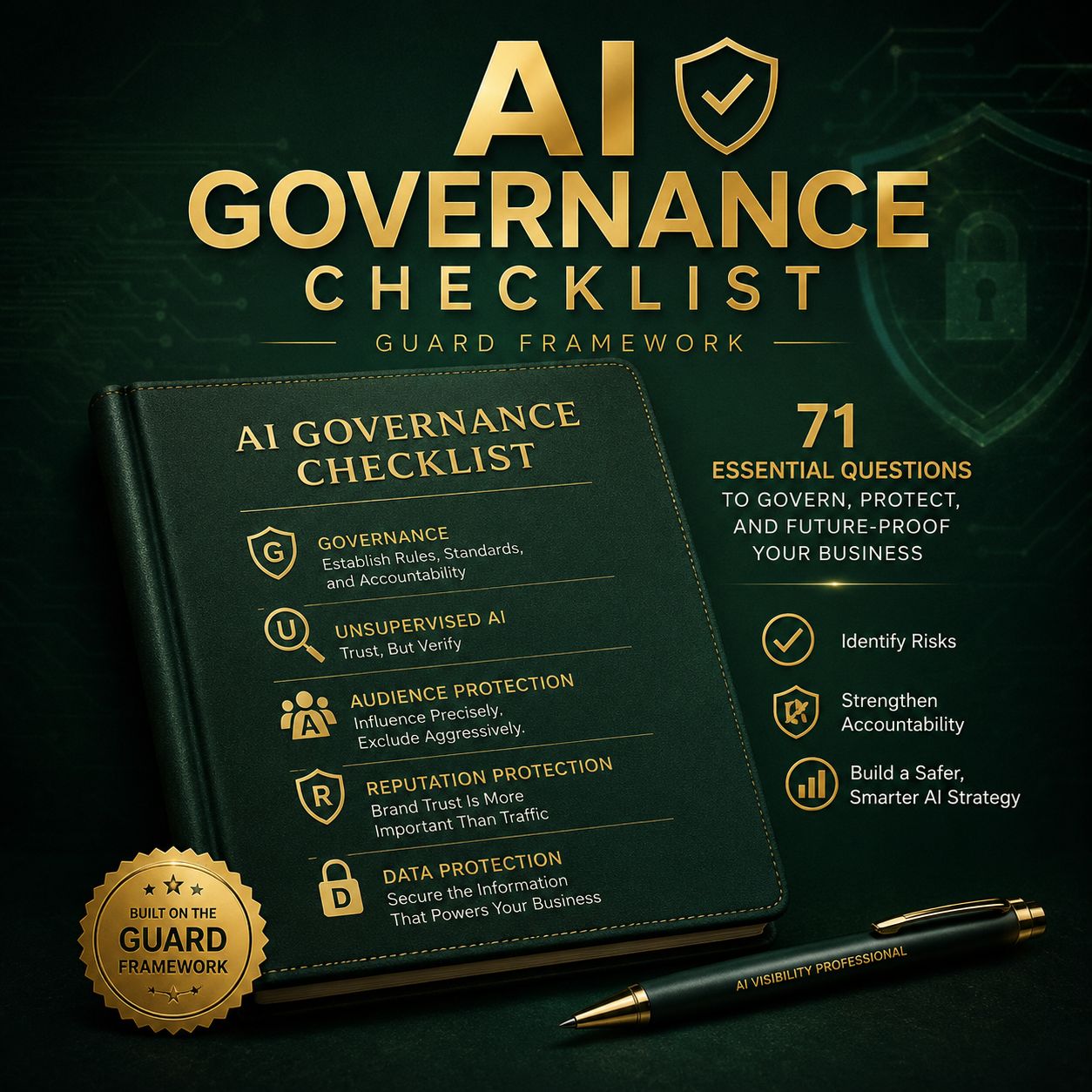
AI Governance Checklist
$50 - A self-guided diagnostic across seventy-one questions that shows you exactly where your AI governance gaps are.
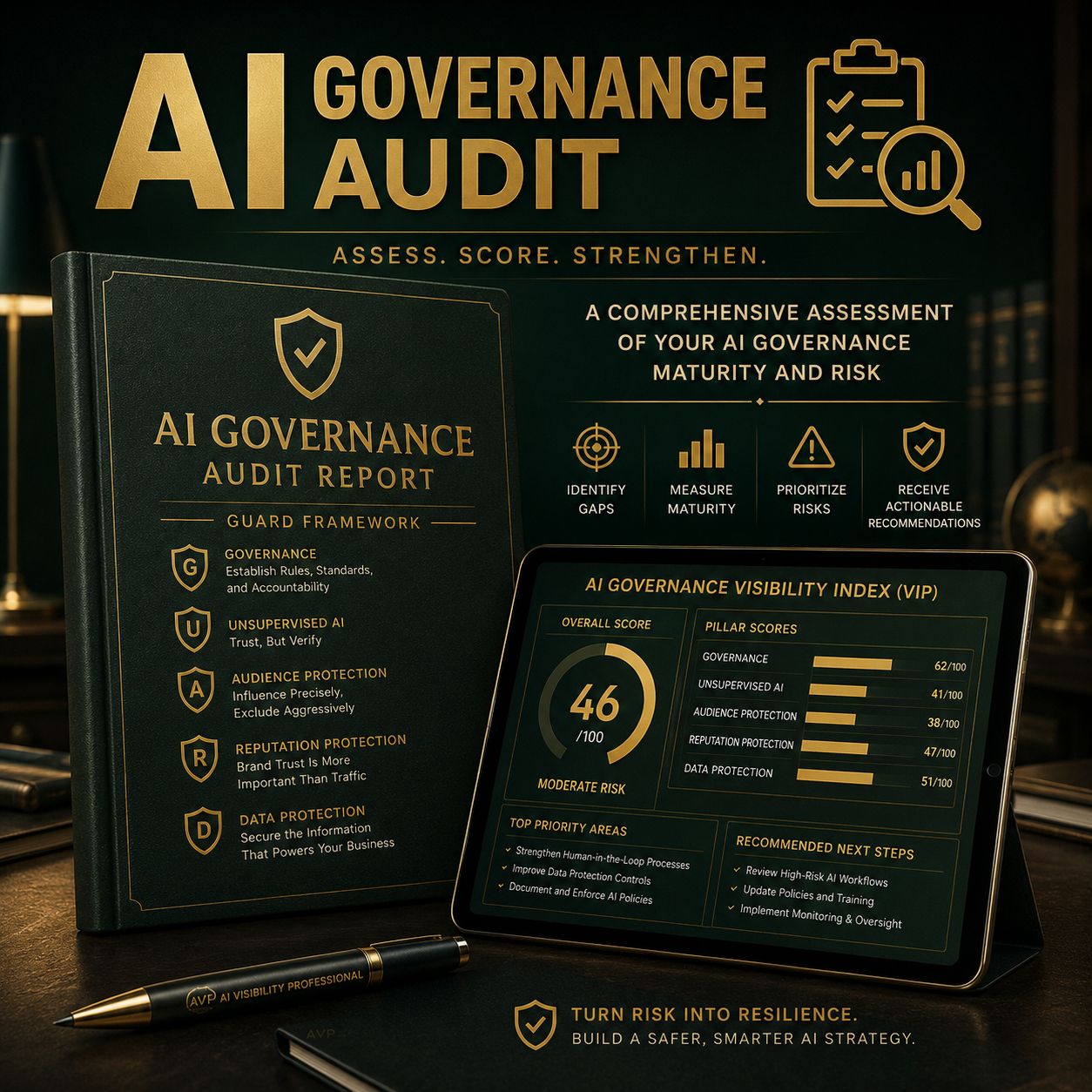
AI Governance Audit
$300 - A professional (human-led) assessment to identify your strengths, your shortfalls, and exactly where to go next.
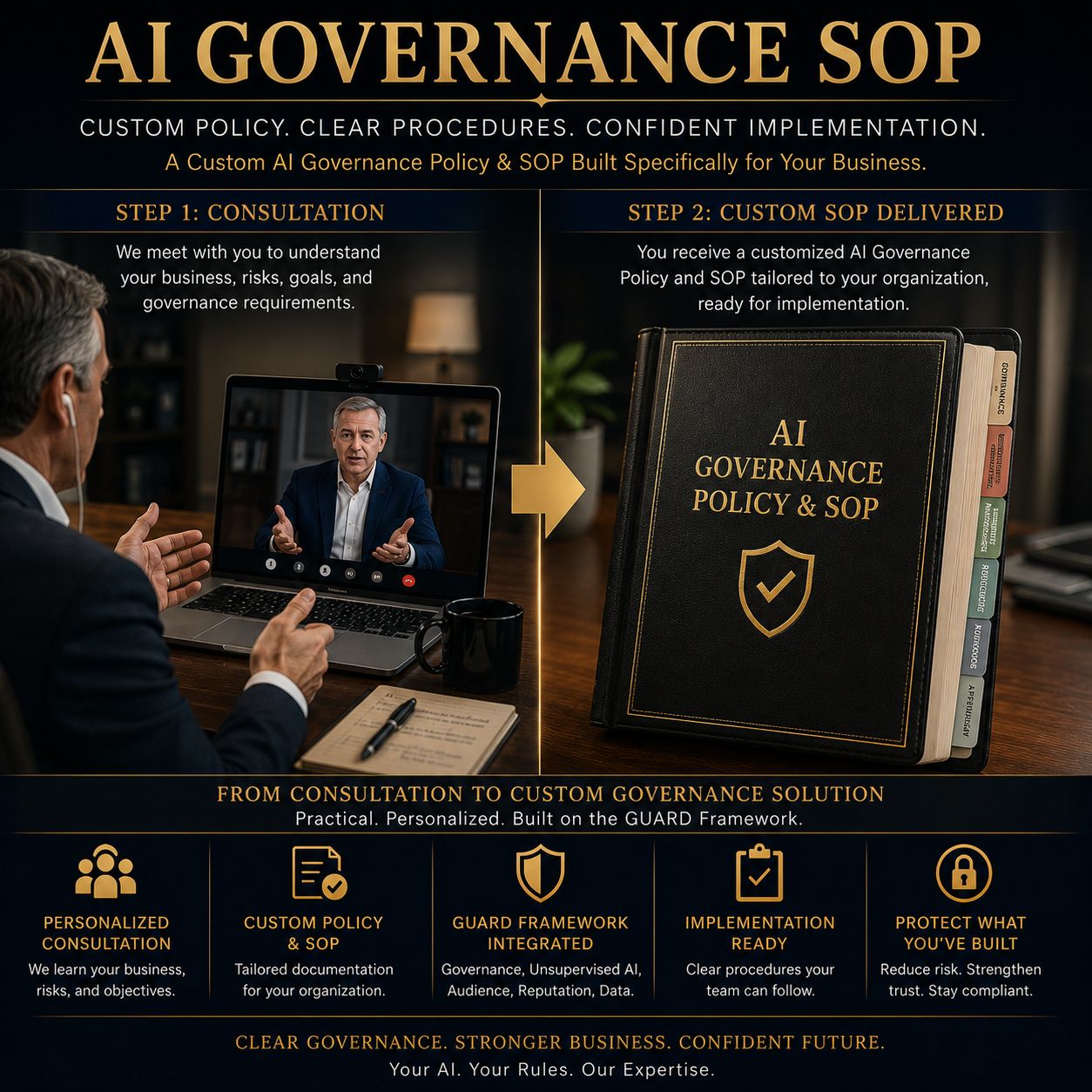
AI Governance Policy
$1000 - A custom AI Policy & SOP built specifically for your organization, ready to implement.
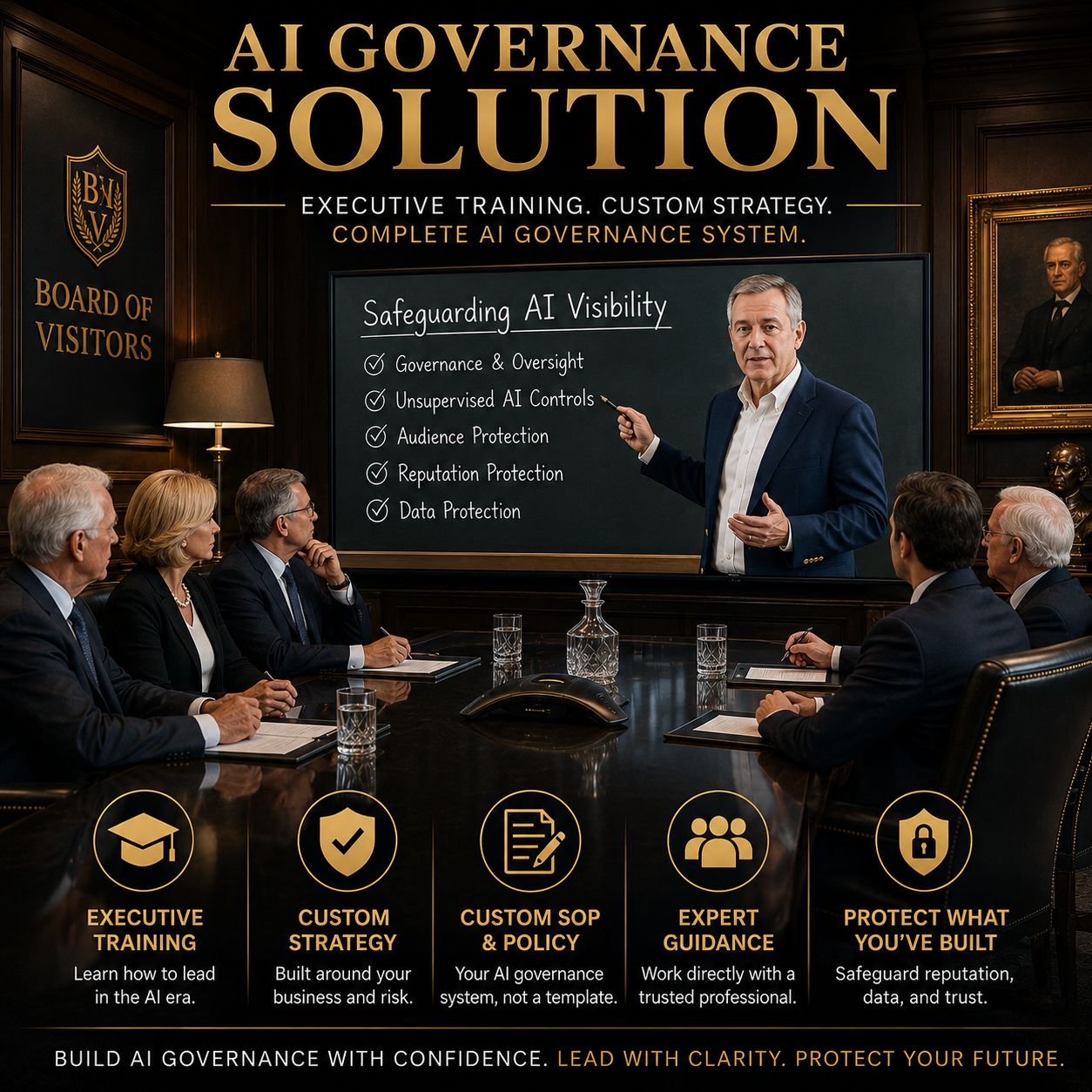
AI Governance Solution
$3000 - The complete engagement: audit, policy, implementation guidance, and direct consulting with Christopher Littlestone.